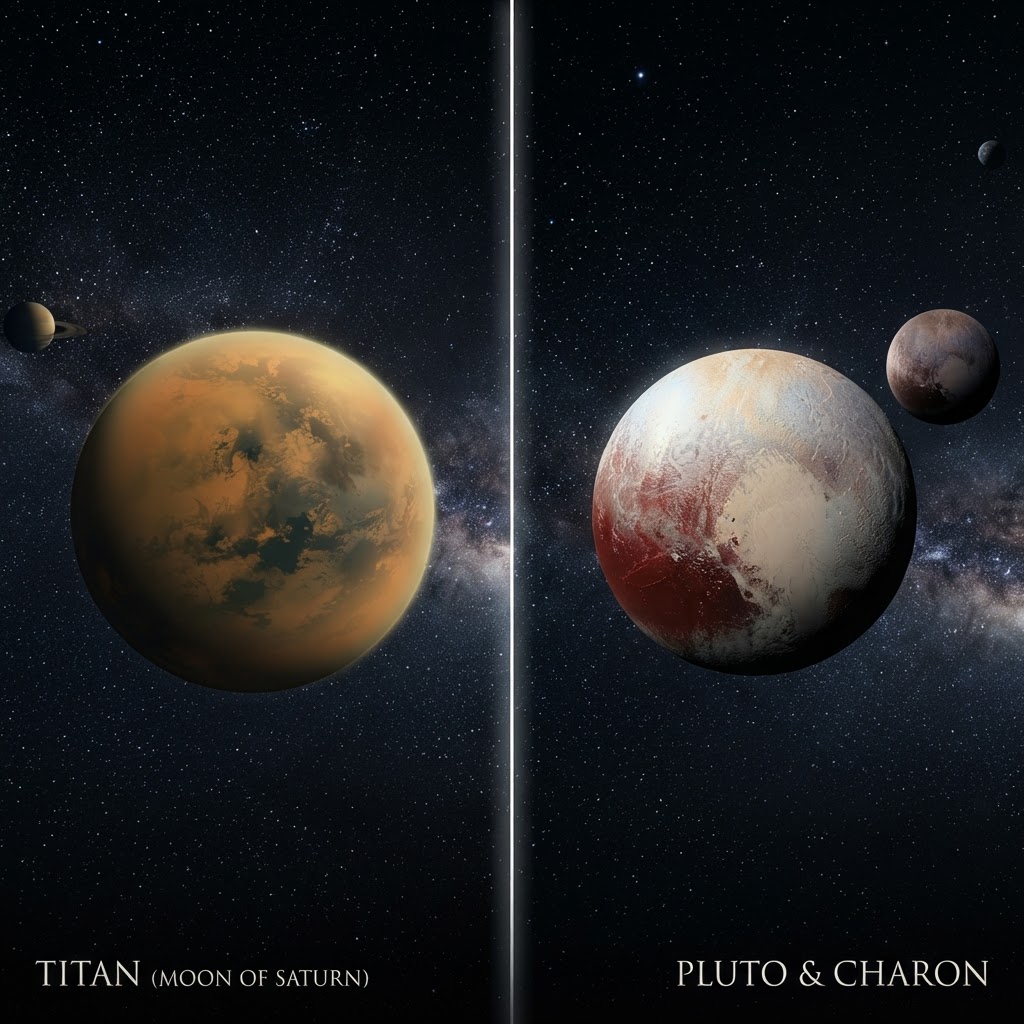
For decades, Saturn's moon Titan and the dwarf planet Pluto have fascinated scientists for one major reason: they shouldn't have much in common.
Titan is wrapped in a thick, hazy atmosphere with rivers and lakes of liquid methane. Pluto is a frozen world orbiting far beyond Neptune with an atmosphere so thin it nearly disappears as it travels around the Sun.
Yet, the James Webb Space Telescope (JWST) has revealed something astonishing.
Researchers have detected the exact same mysterious light-absorbing signature on the surfaces of both worlds—and no one knows what is causing it.
This isn't just another space curiosity. It could reshape what we know about chemistry throughout our solar system.
Two Very Different Worlds... One Identical Mystery
When scientists study distant planets and moons, they don't physically collect samples.
Instead, they study light.
Every chemical absorbs specific wavelengths of light, creating what scientists call a spectral fingerprint. By comparing these fingerprints with laboratory databases, astronomers can determine what materials exist on distant worlds.
This time, however, something unexpected happened.
Researchers discovered an absorption feature centered around 5.113 micrometers that doesn't match anything currently known.
That means one of two possibilities:
→ The material exists, but scientists have never measured it under the right conditions.
→ It represents an entirely new form of chemistry never before identified.
The finding appeared independently in observations of both Pluto and Titan using two separate JWST instruments, making an equipment error extremely unlikely.
Why This Discovery Is So Surprising
At first glance, Pluto and Titan seem like complete opposites.
Titan
→ Larger than the planet Mercury
→ Dense nitrogen atmosphere
→ Lakes and rivers made of liquid methane and ethane
→ Active weather system
→ Thick orange haze
Pluto
→ Tiny dwarf planet
→ Extremely thin atmosphere
→ Surface temperatures near -375°F (-225°C)
→ Vast plains of nitrogen ice
→ Ancient frozen landscape
Despite those dramatic differences, both worlds appear to produce—or preserve—the exact same unknown material.
That immediately caught scientists' attention.
Planetary scientist Dr. Bruno Bézard of the Paris Observatory, who led the study, summarized the mystery simply:
"We cannot say what it is."
For scientists, that's both frustrating and incredibly exciting.
Could It Be Related to Tholins?
One leading possibility involves substances called tholins.
If you've never heard of them, don't worry—they're some of the strangest materials in our solar system.
Tholins are complex organic compounds produced when ultraviolet sunlight or energetic particles interact with simple molecules like:
→ Nitrogen
→ Methane
→ Carbon monoxide
They aren't alive.
They aren't biological.
But they are incredibly important because they're thought to represent some of the earliest steps toward complex organic chemistry.
NASA's Cassini mission showed that Titan continuously produces tholins high in its atmosphere before they slowly drift down onto the surface. New Horizons later revealed similar reddish organic deposits across Pluto.
But There's One Big Problem
Scientists already know what tholins look like spectroscopically.
This new signal doesn't match.
Researchers tested numerous known compounds, including:
→ Benzene
→ Acetylene ice
→ Ketene
→ Various hydrocarbons
None reproduced the mysterious absorption feature.
That suggests the mystery material could be:
→ An unusual combination of multiple compounds
→ A chemical structure never recreated in laboratories
→ A completely unknown molecule
In other words...
Nature may have invented chemistry we've never seen before.
Why Light Absorption Matters
To understand why this discovery is important, imagine hearing an unfamiliar musical note.
You know an instrument produced it.
You know the sound is real.
But none of the instruments in your orchestra can make that note.
That's essentially what astronomers are experiencing.
The James Webb Space Telescope detected a clear chemical "note."
The problem is...
Nothing in Earth's chemical libraries plays it.
Every unexplained spectral line represents missing knowledge.
Finding its source helps scientists understand:
→ How molecules form in extreme environments
→ How planetary surfaces evolve
→ Whether similar chemistry exists throughout the solar system
→ How complex organic molecules develop before life ever begins
Why Titan Is Especially Important
Titan has long been considered one of the most fascinating worlds beyond Earth.
Planetary scientist Carl Sagan frequently highlighted Titan as a natural laboratory for studying prebiotic chemistry because its atmosphere resembles conditions that may have existed on the early Earth before life emerged.
Although Titan is far too cold for liquid water on its surface, it possesses an extraordinary organic chemistry unlike anything else in the solar system.
Understanding this newly discovered material could reveal another missing piece of that chemical puzzle.
Pluto Continues to Surprise Scientists
When NASA's New Horizons spacecraft flew past Pluto in 2015, many expected a frozen, inactive world.
Instead, they discovered:
→ Blue atmospheric hazes
→ Flowing nitrogen glaciers
→ Towering mountains made of water ice
→ Complex surface chemistry
→ Evidence of surprisingly active geology
Principal Investigator Dr. Alan Stern famously remarked that Pluto was far more complex than anyone expected.
This new discovery only strengthens that idea.
The Next Big Clue Could Come From Dragonfly
NASA's upcoming Dragonfly mission could finally solve this mystery.
Rather than orbit Titan, Dragonfly will fly across its surface like a giant autonomous drone.
Its scientific instruments will directly analyze:
→ Surface chemistry
→ Organic molecules
→ Atmospheric interactions
→ Possible prebiotic compounds
Unlike telescopes observing from millions of miles away, Dragonfly will investigate Titan's chemistry firsthand.
If the unknown substance truly exists on Titan's surface, Dragonfly could become the first mission to identify it.
What This Means for Planetary Science
Scientific breakthroughs don't always begin with discovering something new.
Sometimes they begin by discovering something that shouldn't exist.
This mysterious light-absorbing material has reminded researchers that even after decades of studying our solar system, there are still chemical fingerprints we cannot explain.
And that's one of the most exciting parts of science.
Every unanswered question pushes us to build better instruments, design bolder missions, and rethink what we thought we knew.
Somewhere on the frozen surface of Pluto and beneath the hazy skies of Titan lies a substance that has quietly absorbed sunlight for billions of years.
Only now are we finally noticing it.
The universe, it seems, still has plenty of secrets left to share.