For decades, Uranus has carried the label “ice giant.” But here’s the strange part: scientists haven’t actually been certain how much ice is hiding inside it.
Uranus is nearly 3 billion kilometers from the Sun, wrapped in a thick atmosphere and subjected to pressures and temperatures that make directly observing its interior impossible. Much of what we know about the planet still traces back to Voyager 2’s brief flyby in 1986, the only spacecraft ever to visit Uranus.
That has left planetary scientists with a surprisingly basic question:
Is Uranus really an ice giant—or is it mostly a rocky planet hiding beneath an enormous atmosphere?
New observations of carbon monoxide deep in Uranus’s atmosphere may finally be tipping the scales toward ice.
Scientists Found a Chemical Clue Deep in Uranus
A research team led by Thibault Cavalié of the University of Bordeaux detected carbon monoxide, or CO, in Uranus’s lower atmosphere.
The team used the Atacama Large Millimeter/submillimeter Array (ALMA) in Chile to observe Uranus on three occasions between 2022 and 2024. The observations revealed significant carbon monoxide deeper in the atmosphere than had previously been established.
That might sound like a small discovery. Carbon monoxide is just one molecule, after all.
But when you're trying to understand a planet whose interior is completely hidden from view, molecules become messengers.
→ Carbon monoxide detected deep in Uranus can provide information about oxygen and water much farther below.
→ More oxygen can imply a greater abundance of water in the planet's interior.
→ Under Uranus's extreme internal pressures and temperatures, that water isn't necessarily ordinary frozen ice like an ice cube.
→ Instead, "ice" in planetary science refers broadly to volatile materials such as water, methane and ammonia that formed as ices in the cold outer solar system.
And the new CO measurements appear to favor a Uranus containing substantially more ice than rock.
Why Carbon Monoxide Matters So Much
Scientists obviously can't drill into Uranus and take a core sample. Instead, they study atmospheric chemistry and use models to work backward.
Carbon monoxide is particularly valuable because its abundance can be connected to chemistry occurring at much greater depths.
Previous research led by planetary scientist Nicholas Teanby, alongside Patrick Irwin, Julianne Moses and Ravit Helled, showed how useful atmospheric CO can be for determining the ice-to-rock ratio of the giant planets. Their work found that tropospheric carbon monoxide can be highly diagnostic of the amount of oxygen—and therefore potentially water—inside these worlds.
Neptune already provided an important example.
Its atmospheric carbon monoxide has long been interpreted by some models as evidence of an extremely oxygen-rich interior. Uranus, however, lacked comparable evidence of deep atmospheric CO.
That missing carbon monoxide opened the door to another possibility:
Maybe Uranus wasn't as icy as Neptune after all.
Some researchers began seriously considering models in which Uranus contained considerably more rocky material.
The new observations complicate that picture.
Uranus Is Looking More Like a True Ice Giant Again
Cavalié summarized the implications of the team's findings by saying that Uranus now appears to fall more on the ice-giant side than the rock-giant side, although he also cautioned that the conclusion remains dependent on planetary models.
That's an important distinction.
Scientists haven't photographed a giant ball of ice sitting inside Uranus.
What they have done is detect atmospheric chemistry that can be compared with sophisticated models of what must be happening deep inside the planet.
Think of it like seeing smoke escaping from a building.
You can't see the fire directly, but the smoke can tell you something is happening inside.
In this case, carbon monoxide is part of the chemical trail.
But Another Study Recently Suggested Uranus Could Be Rockier
This is where the science gets especially interesting.
In 2026, researchers Vanesa Ramirez, Yamila Miguel and Saburo Howard published interior models investigating whether Uranus and Neptune might contain more rocky material than their "ice giant" nickname suggests.
Their models found significant refractory—or rocky—material in both planets. However, the researchers also found an intriguing difference between the two worlds: their models favored a comparatively more ice-rich deep mantle for Uranus than Neptune, while Neptune's modeled mantle was more rock-rich.
So rather than one simple picture replacing another, planetary scientists are dealing with several competing models.
And that's normal.
We have only scratched the surface—figuratively, because Uranus doesn't have a solid surface we could simply land on and examine.
What Does an "Icy Centre" Actually Look Like?
When most of us hear icy planet, we imagine something frozen solid.
Uranus is nothing like that.
Deep inside the planet, temperatures reach thousands of degrees and pressures become enormous. Water and other materials can behave in ways that would be completely unfamiliar on Earth's surface.
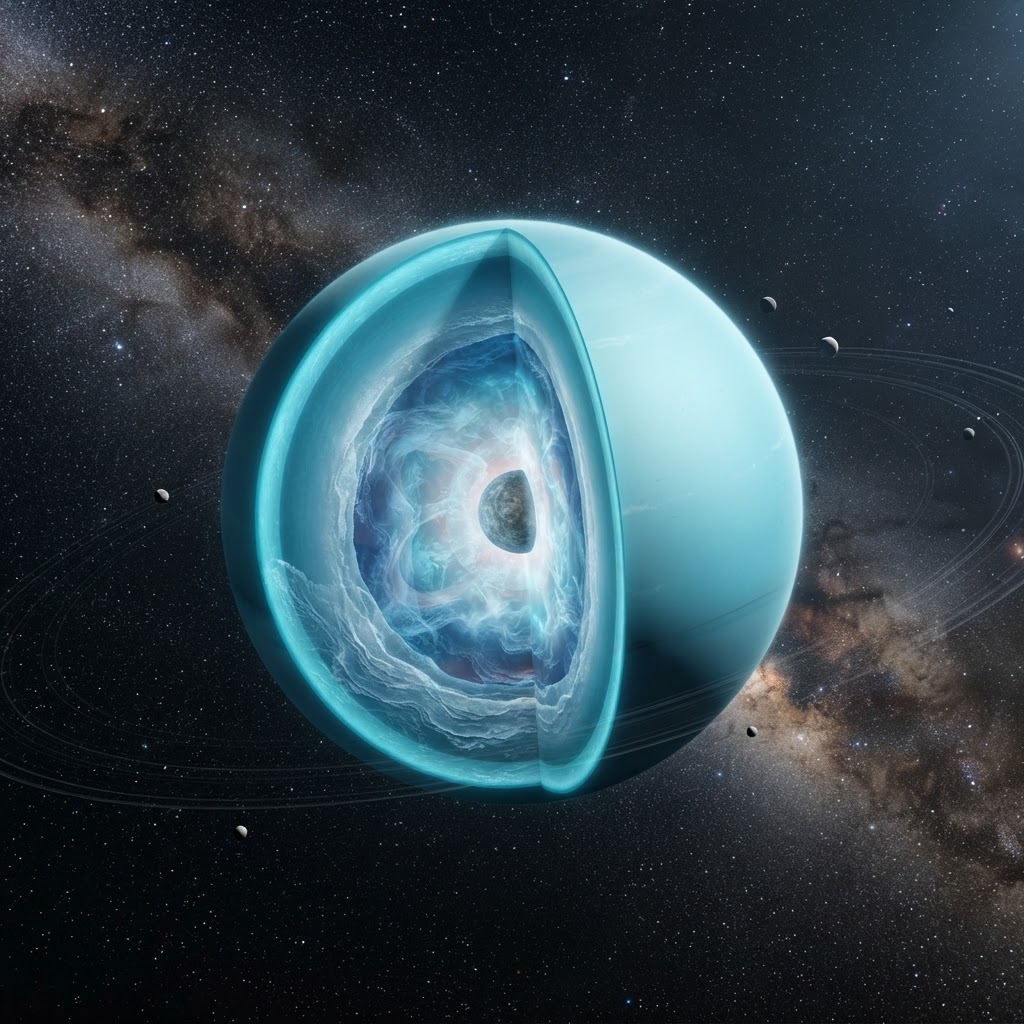
A simplified picture of Uranus looks something like this:
→ Upper atmosphere: Mostly hydrogen and helium, along with methane and other trace compounds.
→ Deeper atmosphere: Increasing temperature and pressure, with chemistry that may reveal material circulating upward from much greater depths.
→ Interior: Potentially enormous amounts of water, ammonia, methane and rocky material existing under extreme conditions.
→ Deep centre: A dense region whose exact composition and structure remain uncertain.
So calling Uranus an "ice giant" does not mean there's a giant frozen ocean sitting underneath its clouds.
It means that volatile compounds associated with planetary ices may account for a significant portion of its heavy material.
Uranus and Neptune May Be More Alike Than We Thought
The discovery also matters because Uranus and Neptune look like planetary siblings.
They're similar in size.
They're both blue.
They're both surrounded by hydrogen-rich atmospheres.
And they're both traditionally classified as ice giants.
Yet their internal behavior is surprisingly different.
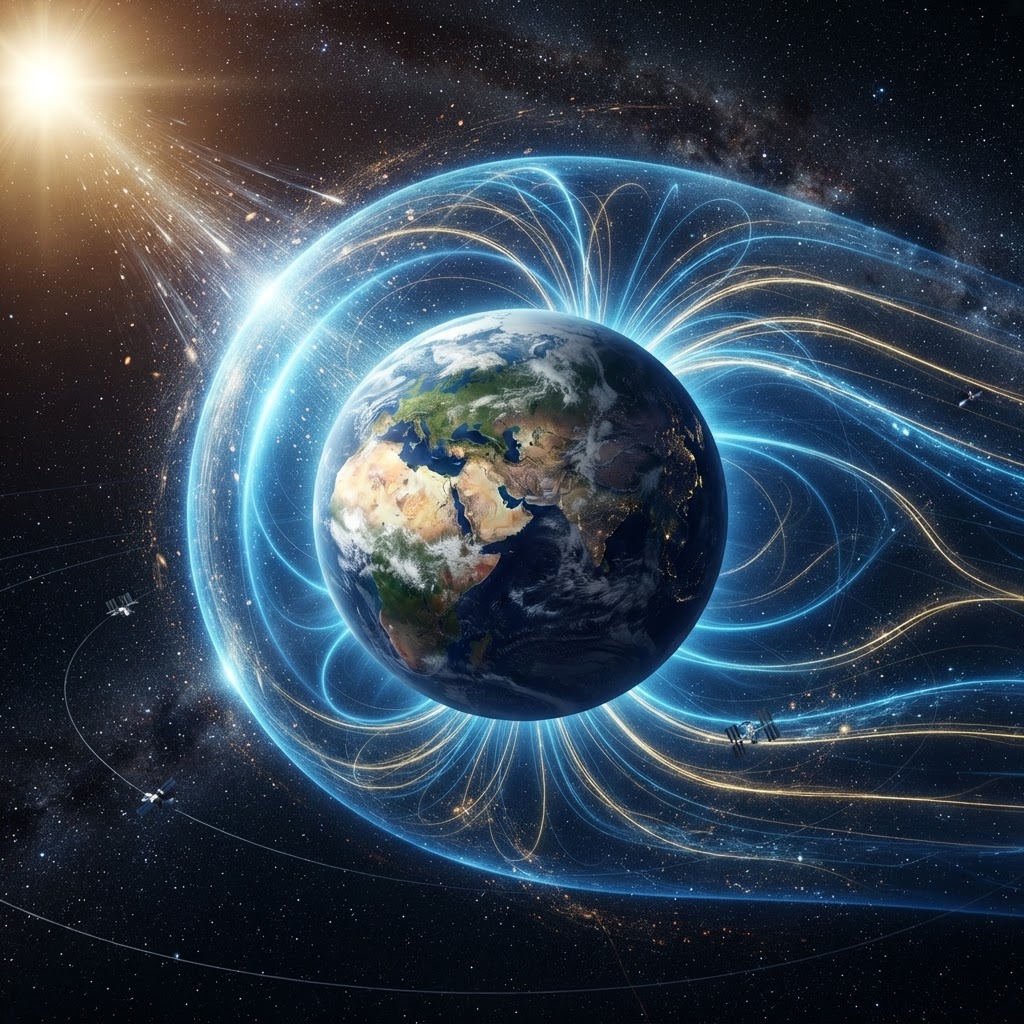
Neptune radiates considerably more internal heat, while Uranus releases remarkably little. Their magnetic fields are also unusual compared with those of Earth, Jupiter and Saturn.
Scientists have therefore wondered whether the two planets formed differently—or whether something dramatic happened to Uranus after formation.
Finding evidence supporting an ice-rich Uranus strengthens the possibility that the two worlds may share more similarities in their origins than some recent rock-dominated models suggested.
Earlier formation research has even proposed that Uranus and Neptune could have formed near a carbon-monoxide ice line in the young solar system, where carbon-rich solids accumulated. Such scenarios can potentially explain several unusual characteristics of their observed compositions.
Why Scientists Still Can't Declare the Mystery Solved
There is an important catch.
Atmospheric measurements depend heavily on models describing how gases move through a giant planet.
Scientists need to determine whether the carbon monoxide originated deep inside Uranus and was transported upward—or whether some of it could have arrived from outside the planet.
That distinction matters enormously.
If the CO is genuinely coming from deep within Uranus, it can serve as a window into the planet's hidden composition.
If much of it has an external origin, interpreting it as evidence for an ice-rich interior becomes more difficult.
This is why researchers remain careful about turning one atmospheric measurement into a definitive map of Uranus's interior.
We Need to Go Back to Uranus
Perhaps the biggest lesson from this discovery is how little direct information humanity has about one of the largest planets in our own solar system.
Voyager 2 flew past Uranus on January 24, 1986.
That encounter transformed our understanding of the planet, but it was still only a flyby.
Researchers including Sushil Atreya, Mark Hofstadter, Olivier Mousis and Michael Wong have argued that atmospheric probes and orbital observations of Uranus and Neptune could provide crucial measurements of their noble gases, gravitational fields, magnetic fields and atmospheric composition. Those measurements could dramatically improve models of how the planets formed.
Right now, we're essentially trying to understand an entire planet by studying the tiny amount of information escaping from its atmosphere.
A dedicated Uranus mission could change that.
Why Uranus Matters Beyond Our Solar System
Understanding Uranus isn't just about solving one planetary mystery.
Planets between the size of Earth and Neptune are common throughout the galaxy. Yet our solar system gives us only two nearby examples of ice giants: Uranus and Neptune.
That makes them extremely valuable laboratories.
If we can determine exactly how much rock, water and gas Uranus contains, scientists can improve models used to interpret distant exoplanets orbiting other stars.
In other words:
→ Understanding Uranus helps scientists understand how giant planets form.
→ Understanding giant planets helps reconstruct the history of our solar system.
→ Better planetary models help astronomers interpret worlds around other stars.
A molecule of carbon monoxide drifting through the atmosphere of Uranus might seem insignificant.
But sometimes the universe gives up its biggest secrets through its smallest clues.
For decades, Uranus's interior has remained hidden beneath thousands of kilometers of atmosphere. Now, chemistry rising from those depths is beginning to tell its story.
And that story increasingly suggests that the planet we've spent decades calling an ice giant may actually deserve the name.