 Billy's Colloidal Silver + Starfire Gold duo —
For centuries, humans looked up at the night sky and saw stillness. But the universe is anything but quiet. Deep inside massive clouds of gas and dust, stars are being born in violent, breathtaking waves — and now, thanks to the combined power of the NASA, the James Webb Space Telescope, and the Hubble Space Telescope, scientists are uncovering something remarkable:
The biggest star clusters don’t just create more stars.
They create them faster.
This discovery is reshaping how astronomers understand the life cycle of galaxies, the formation of planets, and even the origins of the cosmic materials that eventually made life possible.
What Exactly Is a Star Cluster?
A star cluster is a group of stars born from the same giant molecular cloud — massive regions filled with cold gas and cosmic dust.
Think of these clouds as stellar nurseries.
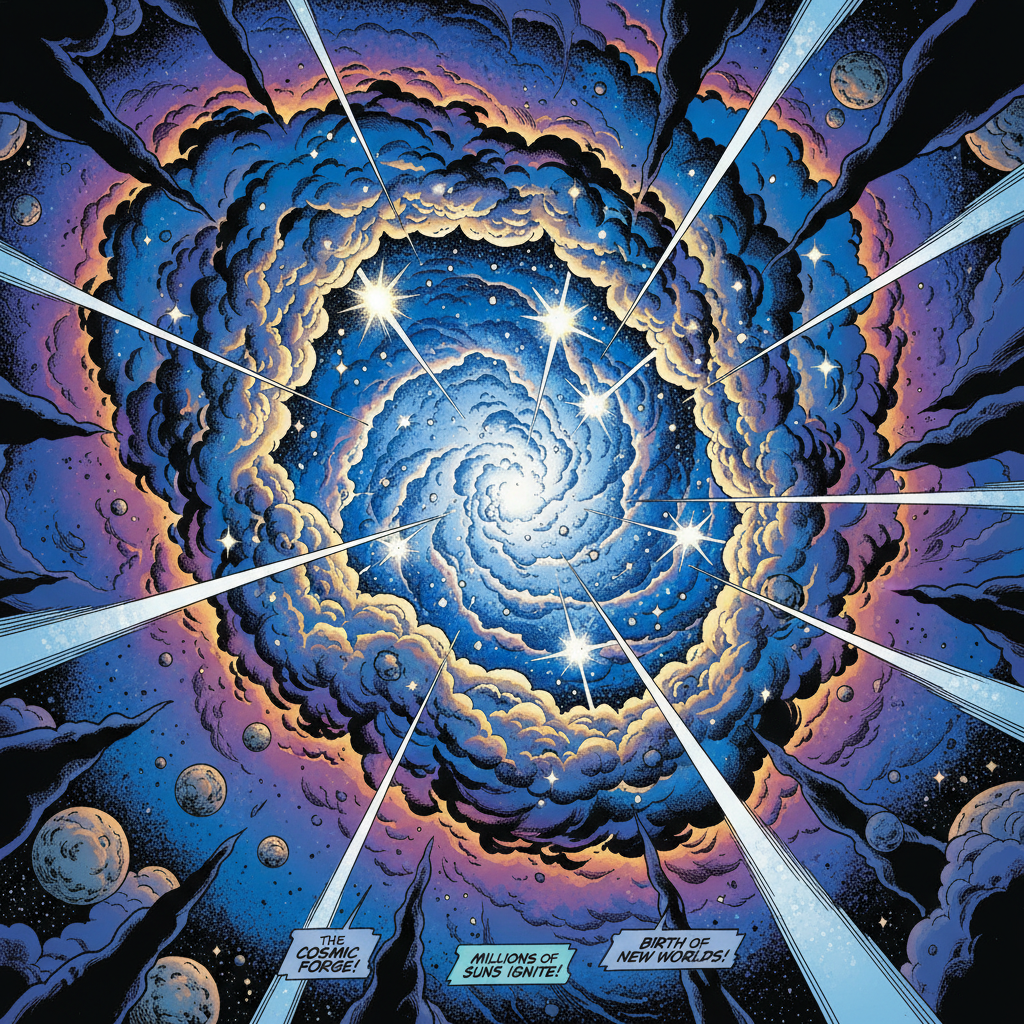
Inside them: → Gravity pulls gas and dust inward → Dense pockets begin collapsing → Temperatures rise dramatically → Nuclear fusion ignites → A new star is born
But scientists recently discovered that not all stellar nurseries operate at the same pace.
Massive star clusters appear to accelerate the process.
Smaller clusters take their time.
The cosmic equivalent of a crowded city versus a quiet rural town.
What Webb and Hubble Revealed
Using infrared observations from the James Webb Space Telescope and decades of archival imagery from Hubble, astronomers tracked how quickly star-forming clouds condensed in different environments.
Webb’s infrared technology allowed researchers to peer through thick dust clouds that previously blocked visibility.
Hubble contributed precise imaging that helped scientists compare the ages and structures of developing stars.
Together, the telescopes acted like a cosmic time machine.
Researchers observed: → Dense star-forming regions collapsing rapidly in massive clusters → Higher gas pressure accelerating gravitational collapse → Larger clusters producing stars in synchronized bursts → Smaller clusters showing slower, staggered star formation
According to researchers, the density of the environment plays a critical role.
The more crowded and massive the cluster becomes, the more efficiently gravity compresses material into stars.
Why Bigger Clusters Move Faster
Scientists believe massive clusters create a chain-reaction effect.
Here’s how it works:
In Smaller Star Clusters
→ Gas clouds are more spread out → Gravitational forces are weaker → Star formation occurs gradually → Energy from newborn stars can interrupt nearby formation
In Massive Star Clusters
→ Gas is tightly packed together → Gravity becomes overwhelmingly strong → Collapse speeds up dramatically → Multiple stars form almost simultaneously
Dr. Cathie Clarke, an astrophysicist known for her work on star formation, has long emphasized that stellar environments strongly influence how efficiently stars emerge from molecular clouds.
Meanwhile, Nobel Prize-winning astrophysicist Andrea Ghez has highlighted how gravitational dynamics in dense cosmic environments can drastically alter stellar evolution.
The universe, it turns out, rewards pressure.
The Role of the James Webb Space Telescope
The James Webb Space Telescope is changing astronomy in ways scientists once only imagined.
Unlike visible-light telescopes, Webb detects infrared wavelengths, allowing it to see through cosmic dust clouds that hide newborn stars.
That capability is crucial because: → Most star formation happens inside dense dusty regions → Visible light gets blocked by dust → Infrared light can pass through
This means Webb can observe stars in their earliest stages of formation — moments that older telescopes struggled to capture clearly.
Scientists studying these massive clusters are essentially watching stellar birth in real time.
And what they’re seeing is astonishing.
Why This Discovery Matters
This research is bigger than stars alone.
Understanding how quickly stars form helps scientists answer major cosmic questions:
Galaxy Evolution
Fast star formation changes how galaxies grow and evolve over billions of years.
Planet Formation
Young stars are surrounded by disks of material that may eventually become planets.
Black Hole Origins
Massive stars often collapse into black holes after exploding as supernovae.
The Building Blocks of Life
Heavy elements like carbon, oxygen, and iron are created inside stars and distributed across space after stellar explosions.
In other words: Every atom in your body was forged inside ancient stars.
Carl Sagan famously said:
“We are made of star stuff.”
Modern astronomy continues proving just how literal that statement truly is.
A Universe That Never Stops Creating
One of the most incredible parts of this discovery is the reminder that space is not empty.
It is constantly building.
Constantly collapsing.
Constantly igniting.
Somewhere in the universe right now: → A cloud is condensing → A star is being born → Planets may already be forming around it → The ingredients for future life may already exist
And thanks to Webb and Hubble, humanity is finally witnessing these hidden cosmic processes with unprecedented clarity.
The night sky suddenly feels less distant.
Less silent.
And far more alive than we ever imagined.