 Billy's Colloidal Silver + Starfire Gold duo —
For nearly a century, modern cosmology has rested on one massive assumption:
→ The universe is basically uniform everywhere when viewed on the largest scales.
That idea became one of the foundations of the standard model of cosmology — the framework scientists use to explain everything from the Big Bang to dark energy.
But now?
A growing number of physicists and astronomers are finding evidence that the universe may not be as smooth, balanced, or predictable as we once believed.
And if these findings hold up, they could force scientists to rewrite parts of our understanding of the cosmos.
The Assumption That Built Modern Cosmology
Back in the 1920s, physicists developed what’s known as the Friedmann-Lemaître-Robertson-Walker (FLRW) model.
At its core, the model assumes:
→ Matter is spread evenly throughout the universe on large scales → The universe behaves similarly in every direction → Space itself follows a consistent geometry
This idea helped scientists explain:
Cosmic expansion The Big Bang The cosmic microwave background Dark energy Galaxy formation
In simple terms:
Imagine zooming far enough away from Earth that galaxies begin looking like grains of sand scattered evenly across a beach.
That “evenness” is what cosmologists call homogeneity and isotropy.
For decades, the assumption worked remarkably well.
But the universe may be starting to reveal cracks in the theory.
What Scientists Are Finding
Recent studies combining observations from:
Supernova explosions Galaxy surveys Cosmic expansion measurements Large-scale cosmic mapping
have started detecting small but intriguing inconsistencies in the FLRW model.
Researchers using data from projects like:
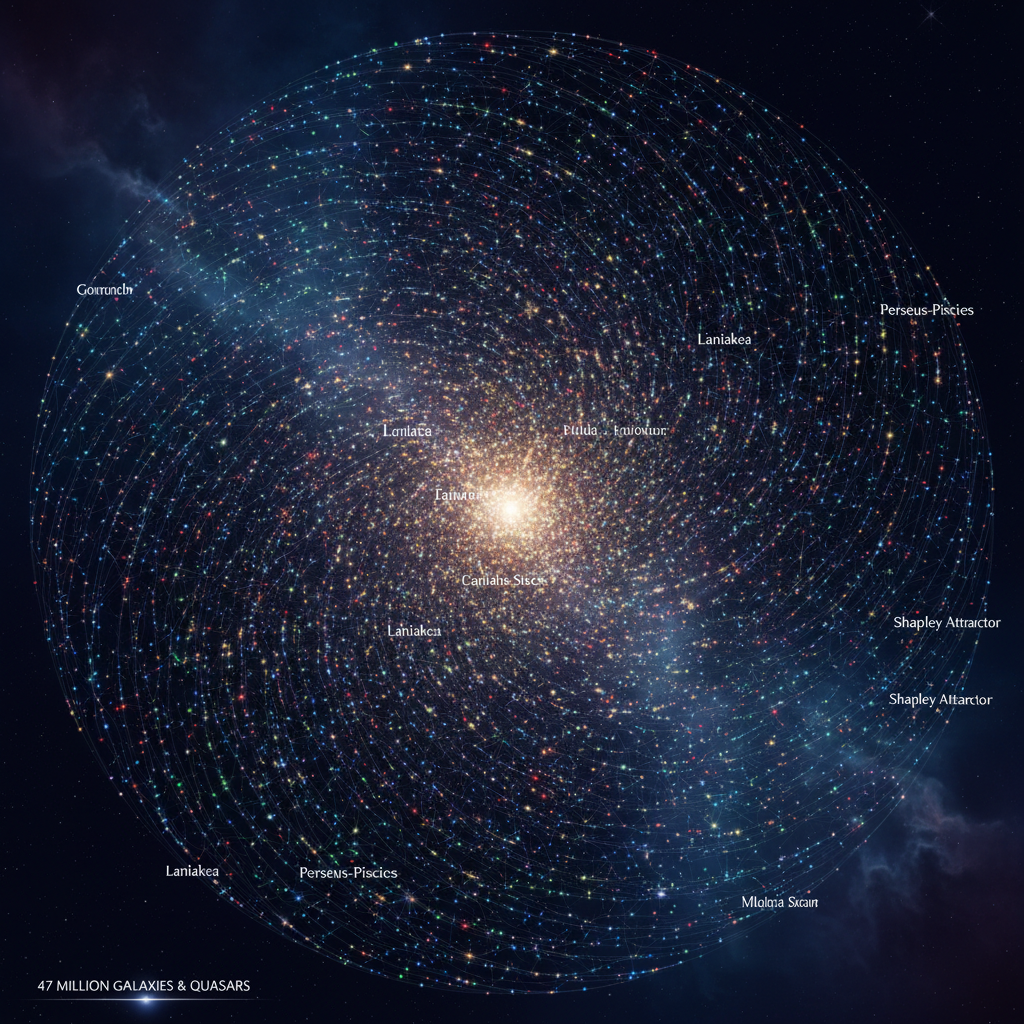
The Dark Energy Spectroscopic Instrument (DESI) The Pantheon+ supernova survey Large galaxy mapping programs
have reported hints that the universe’s curvature and expansion may not behave uniformly everywhere.
That may sound subtle.
It’s not.
Because if the universe is not uniform on the largest scales, then some of the equations scientists have relied on for nearly 100 years may only be approximations — not ultimate truths.
Asta Heinesen and the “Surprising Violation”
One of the researchers involved in this work, physicist Asta Heinesen from the Niels Bohr Institute and Queen Mary University of London, described the findings as:
“A surprising violation of an FLRW curvature consistency test.”
That’s scientific language for:
“We may be seeing evidence that the universe doesn’t follow the rules we thought it did.”
The research is still developing and has not yet reached the gold-standard statistical threshold physicists require for a confirmed discovery.
But the signals are strong enough that the scientific community is paying attention.
Why This Matters So Much
If confirmed, these discoveries could reshape how scientists think about:
→ Dark energy → Cosmic expansion → The age of the universe → The universe’s ultimate fate → Gravity itself
Some researchers now believe dark energy may not be constant after all.
Others suggest the universe may actually be “lopsided” rather than balanced evenly in every direction.
And some new models even reopen the possibility of a future “Big Crunch” — where cosmic expansion eventually reverses and collapses inward.
That’s a dramatic shift from the long-standing assumption that the universe would expand forever.
Einstein Would Probably Love This
Ironically, science overturning its own assumptions is exactly how science is supposed to work.
Even Albert Einstein famously revised his own theories multiple times as new evidence emerged.
Science is not a museum of permanent answers.
It’s a constantly evolving conversation with reality.
Today’s “settled science” can become tomorrow’s outdated framework if better evidence appears.
That’s not failure.
That’s progress.
The Universe Keeps Humbling Us
What makes this moment fascinating is that humanity has never had better tools to study the cosmos.
New observatories and instruments are generating absurd amounts of data:
DESI Euclid Space Telescope Vera Rubin Observatory James Webb Space Telescope
Each one is giving scientists a sharper look into deep space than ever before.
And the deeper we look?
The stranger the universe becomes.
What Happens Next?
Right now, scientists are cautious.
The evidence is intriguing — but not definitive.
Researchers still need:
→ More observations → Better statistical certainty → Independent verification → Additional cosmic mapping data
But if future data continues pointing in the same direction, modern cosmology could face one of its biggest paradigm shifts in generations.
Not because the old theories were “wrong.”
But because the universe may be far more complex than our models ever imagined.
And honestly?
That might be the most exciting possibility of all.