 Billy's Colloidal Silver + Starfire Gold duo —
Most of us grow up believing that time only moves in one direction.
Cause comes first. Effect comes second.
You drop a glass, and it shatters.
You make a choice, and then consequences follow.
Simple.
But what if the universe isn't quite that simple?
What if, deep within the strange world of quantum physics, there are hidden mechanisms where future events can influence what happened before them?
It sounds like science fiction.
Yet some of the world's most respected physicists have spent decades seriously exploring this possibility.
Not because they believe in magic.
Because the mathematics keeps leaving the door open.
The Question That Refuses to Go Away
For over a century, quantum mechanics has challenged our understanding of reality.
Particles behave like waves.
Objects appear connected across vast distances.
Measurements seem to change outcomes.
The deeper scientists look, the stranger things become.
One of the most fascinating ideas to emerge from these investigations is retrocausality—the possibility that future events may influence past events. While not accepted as proven fact, it remains an active area of research among physicists attempting to explain some of quantum theory's most puzzling behaviors.
What Is Retrocausality?
Retrocausality is exactly what it sounds like:
→ A future event influences an earlier event.
Not in the sense of traveling back in time and meeting your younger self.
Instead, the theory suggests that information or influences may move backward through time at the quantum level.
Imagine reading the final chapter of a mystery novel before writing the beginning.
The ending somehow helps shape the opening scenes.
That's the basic idea.
Physicists studying retrocausal models argue that some quantum phenomena may be easier to explain if information can flow both forward and backward through time.
John Wheeler's Famous Question
One scientist who helped spark these discussions was John Wheeler.
Wheeler proposed a thought experiment known as the Delayed Choice Experiment.
The experiment suggests that a particle's behavior may depend on measurements chosen after the particle has already begun its journey.
In other words:
→ The future measurement appears connected to how the particle behaved in the past.
While mainstream physics does not interpret this as proof that the future literally changes history, Wheeler's work raised profound questions about whether our traditional understanding of cause and effect is complete.
Yakir Aharonov and the Two-Way Flow of Time
Perhaps no modern physicist has explored this territory more deeply than Yakir Aharonov.
Aharonov developed what is known as the Two-State Vector Formalism (TSVF).
This framework suggests that quantum systems may be influenced by:
→ Conditions from the past
and
→ Conditions from the future
At the same time.
Instead of reality being determined solely by where something started, Aharonov's model proposes that both the beginning and the ending help define what occurs in between.
This doesn't mean your future self can send lottery numbers backward through time.
It does mean that, at the quantum level, the universe may not care about time's direction as much as we do.
Huw Price and the Symmetry of Time
Another influential thinker in this field is Huw Price.
Price argued that many laws of physics are fundamentally time-symmetric.
In simple terms:
→ The equations work just as well running backward as they do forward.
If the underlying laws don't prefer a direction of time, Price asked an uncomfortable question:
Why do we assume causation must move only forward?
His work has helped revive serious scientific discussions about retrocausality and whether future boundary conditions could influence present events.
The Transactional Universe
Physicist John G. Cramer proposed another fascinating model called the Transactional Interpretation.
According to this idea:
→ A particle sends a signal forward through time.
→ Another signal travels backward through time.
→ The interaction between both signals creates the observed event.
Think of it as a cosmic handshake.
One hand reaches forward.
One hand reaches backward.
Reality emerges when they meet.
This interpretation remains controversial, but it offers an elegant explanation for some of quantum mechanics' strangest behaviors.
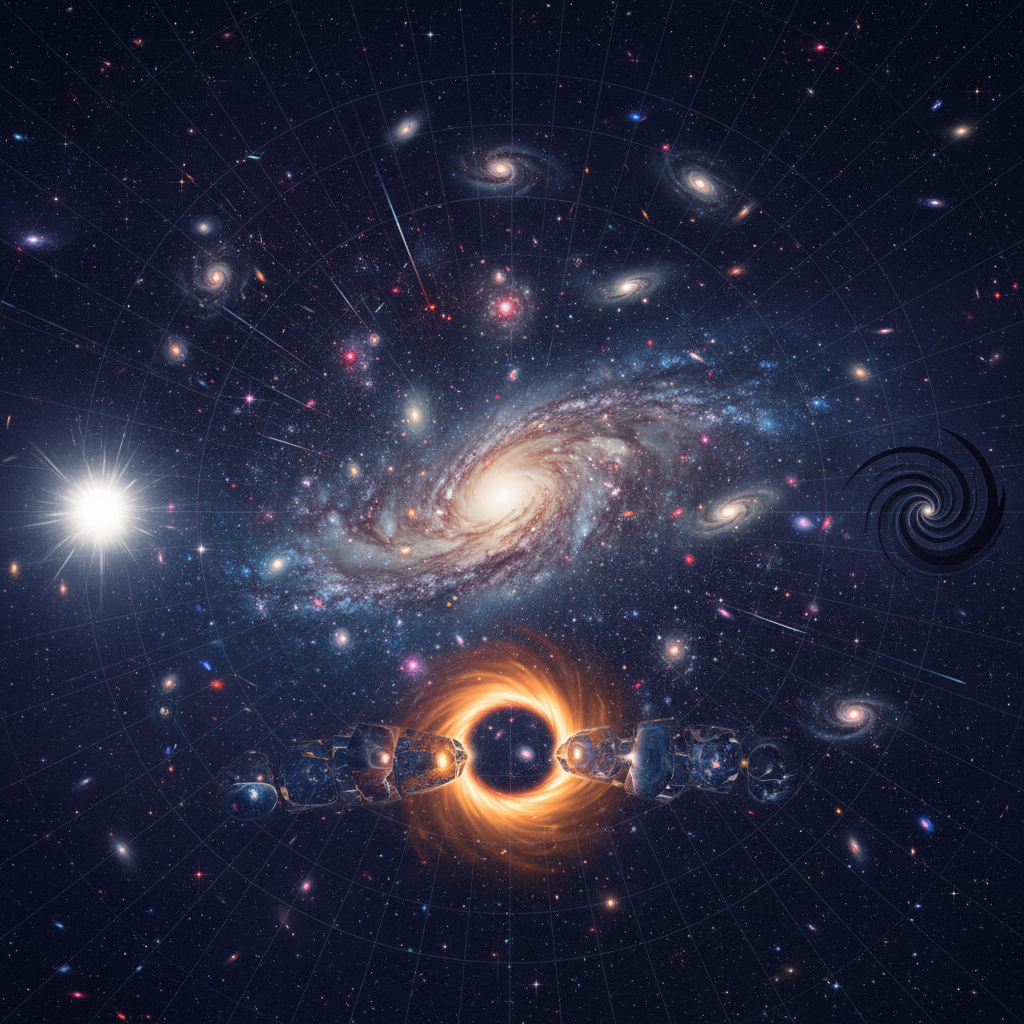
Are There Hidden Pockets of the Universe?
This is where things become truly fascinating.
Some researchers speculate that certain quantum systems may operate within regions of reality where our ordinary understanding of time breaks down.
Not alternate dimensions.
Not science-fiction wormholes.
But subtle domains where past and future become intertwined.
These "hidden pockets" aren't places we can point to on a map.
Instead, they may exist within the quantum structure of reality itself.
Within these regions:
→ Cause may not always precede effect.
→ Time may not be strictly one-directional.
→ Future possibilities may help shape present outcomes.
While experimental evidence remains incomplete, the mathematical frameworks continue to generate serious discussion among physicists.
Why This Matters Beyond Physics
You don't need a PhD to appreciate why these ideas are important.
For centuries, humanity has viewed time as a one-way road.
Past → Present → Future.
But modern physics increasingly suggests reality may be more interconnected than that simple timeline.
The universe may not resemble a line.
It may resemble a tapestry.
A woven structure where beginnings and endings influence one another in ways we are only beginning to understand.
That doesn't mean fate is predetermined.
It doesn't mean free will disappears.
It means our understanding of time itself may still be incomplete.
The Final Thought
The most remarkable discovery may not be that the future can influence the past.
It may be that the universe doesn't distinguish between them as sharply as we do.
Physicists like John Wheeler, Yakir Aharonov, Huw Price, and John Cramer have spent decades exploring a possibility that sounds impossible:
→ Perhaps time is not a river flowing in one direction.
→ Perhaps it is an ocean.
And somewhere beneath its surface are hidden currents moving both ways at once.
The deeper science explores reality, the more it seems that the universe is under no obligation to follow our common-sense rules.
Sometimes the future may not simply be waiting for us.
It may already be participating in the story.