 Billy's Colloidal Silver + Starfire Gold duo —
For centuries, humanity has looked into the night sky and wondered one thing:
How big is all of this?
Now, scientists may be closer than ever to answering that question.
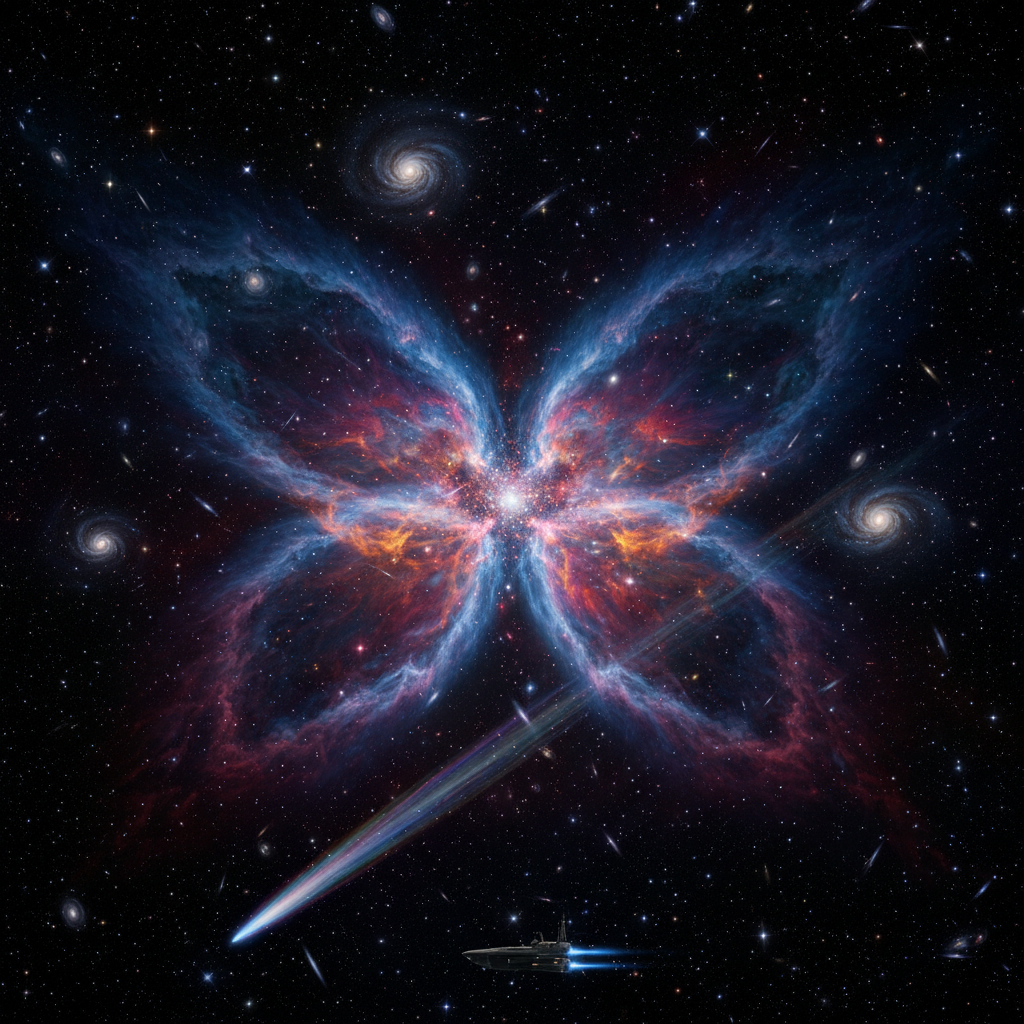
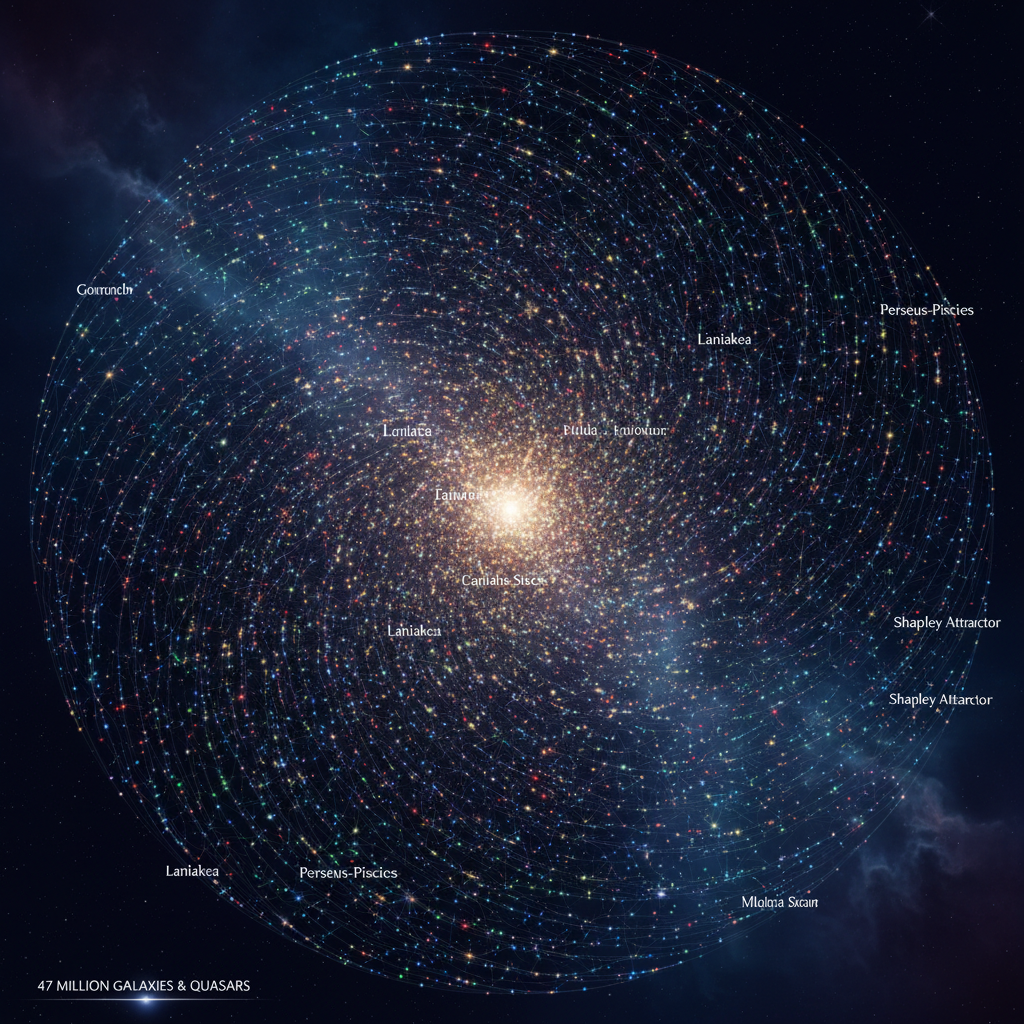
The Dark Energy Spectroscopic Instrument (DESI) has completed the largest and most detailed 3D map of the universe ever created — a staggering cosmic atlas containing more than 47 million galaxies and quasars stretching across billions of light-years.
This is not just another pretty space image.
It is a time machine. A cosmic fossil record. A giant clue about the mysterious force known as dark energy — the invisible phenomenon believed to be pushing the universe apart.
And according to researchers, something strange may be happening.
Dark energy might be weakening.
What Is DESI?
Dark Energy Spectroscopic Instrument is an international scientific collaboration designed to study the expansion of the universe with unprecedented precision.
Installed on the Nicholas U. Mayall 4-meter Telescope at Kitt Peak National Observatory, DESI uses thousands of robotic fibers that can simultaneously observe galaxies across enormous distances.
Its mission is ambitious:
→ Measure how the universe has expanded over billions of years → Investigate the nature of dark energy → Build the most precise 3D map of the cosmos ever attempted
Unlike ordinary telescopes that simply photograph the sky, DESI measures the light spectrum from galaxies and quasars to determine how far away they are.
That means scientists are not just seeing objects in space — they are seeing objects across time.
Some of the light captured by DESI began its journey toward Earth billions of years ago, long before humans even existed.
The Numbers Are Almost Difficult to Comprehend
The scale of this survey sounds almost fictional.
Here is what DESI accomplished:
→ Mapped over 47 million galaxies and quasars → Surveyed approximately one-third of the night sky → Measured cosmic structures spanning 11 billion years of history → Created the most detailed large-scale map of the universe ever produced
To put this into perspective:
If every galaxy in the DESI survey were a grain of sand, you could fill entire beaches with them.
And each galaxy may contain hundreds of billions of stars.
The universe is not just large. It is overwhelmingly vast.
The Biggest Mystery: Dark Energy May Be Changing
For decades, scientists believed dark energy behaved like a constant force.
The idea came from observations showing the universe’s expansion is accelerating — meaning galaxies are moving farther apart over time.
But DESI’s new findings suggest something unexpected:
→ Dark energy may not be constant after all → Its influence could be weakening over cosmic time → Current models of physics may need revision
This matters because dark energy makes up roughly 70% of the universe.
Yet scientists still do not fully understand what it actually is.
According to cosmologist Michael Levi:
“We are driven by the possibility of discovering something fundamentally new about the universe.”
That possibility is exactly why DESI has captured the attention of physicists worldwide.
What Exactly Is Dark Energy?
Imagine tossing a ball upward.
Gravity should eventually slow it down.
Scientists once assumed the same thing about the universe after the Big Bang — that gravity would gradually slow cosmic expansion.
Instead, astronomers discovered the opposite.
The universe is speeding up.
Something invisible appears to be pushing space itself outward.
That mysterious force became known as dark energy.
The problem?
Nobody truly knows what it is.
Researchers have proposed several theories:
→ A hidden property of space itself → A dynamic energy field changing over time → Evidence that Einstein’s theories may be incomplete → Signs of entirely new physics not yet discovered
DESI’s new map may help scientists narrow down these possibilities.
Why This Map Matters Beyond Astronomy
This is bigger than stars and galaxies.
Understanding dark energy could reshape humanity’s understanding of reality itself.
It influences:
→ The fate of the universe → The laws governing space and time → The origins of cosmic structure → Whether expansion continues forever or changes direction
Physicist Albert Einstein once introduced a concept called the cosmological constant — an idea many scientists now connect to dark energy.
Ironically, Einstein reportedly called it his “greatest blunder.”
More than a century later, researchers are still trying to understand whether he accidentally predicted one of the universe’s greatest mysteries.
Quasars: The Ancient Beacons of the Universe
The DESI survey also mapped millions of quasars.
Quasars are among the brightest objects in existence — supermassive black holes actively feeding at the centers of distant galaxies.
As matter spirals into these black holes, enormous amounts of energy are released.
Some quasars shine brighter than entire galaxies.
Because quasars are so luminous, scientists can detect them across immense distances, allowing DESI to peer deeper into cosmic history than many previous surveys.
In a sense:
→ Galaxies reveal structure → Quasars reveal deep time
Together, they create a giant cosmic roadmap.
A Universe That Refuses to Sit Still
One of the most fascinating aspects of modern astronomy is realizing the universe is not static.
Everything moves.
Everything evolves.
Galaxies collide. Stars explode. Black holes grow. Space itself expands.
DESI’s findings reinforce an uncomfortable but exciting truth:
The universe may still hold laws of physics humanity has not discovered yet.
That realization humbles even the most brilliant scientists.
Astrophysicist Saul Perlmutter, one of the researchers involved in discovering cosmic acceleration, once emphasized that understanding dark energy is one of the central challenges in physics.
And now, DESI may have delivered the clearest clues yet.
Final Thoughts
Human beings once thought Earth was the center of everything.
Now we are mapping tens of millions of galaxies across billions of light-years.
That evolution in understanding says something powerful about science: every answer opens the door to even bigger questions.
DESI’s massive cosmic map is not just a scientific achievement — it is a reminder that humanity is still exploring an ocean of mysteries.
And somewhere within those 47 million galaxies may lie the answers to questions we have not even learned how to ask yet.