 Billy's Colloidal Silver + Starfire Gold duo —
For over a century, scientists believed they had Uranus figured out.
Cold. Quiet. Mostly ice. A strange blue planet spinning sideways in the darkness like the forgotten oddball of our solar system.
But the deeper astronomers look, the weirder it becomes.
And now? The rings of Uranus are exposing something that could force scientists to rethink not only Uranus itself — but how giant planets form across the universe.
Uranus Was Supposed to Be Simple
For decades, Uranus and Neptune were labeled “ice giants.” The assumption sounded solid:
Thick layers of frozen materials Water, ammonia, methane Cold internal structure Relatively inactive compared to Saturn or Jupiter
Case closed.
Except modern telescopes — especially the James Webb Space Telescope — are tearing that assumption to pieces.
Recent studies now suggest Uranus may contain far more rocky material than previously believed, challenging the long-standing idea that the planet is dominated by ice.
That alone is enough to make planetary scientists sweat through their lab coats.
But the real chaos begins with the rings.
The Rings of Uranus Are Even Stranger Than Scientists Expected 5
Most people think Saturn owns the spotlight when it comes to rings.
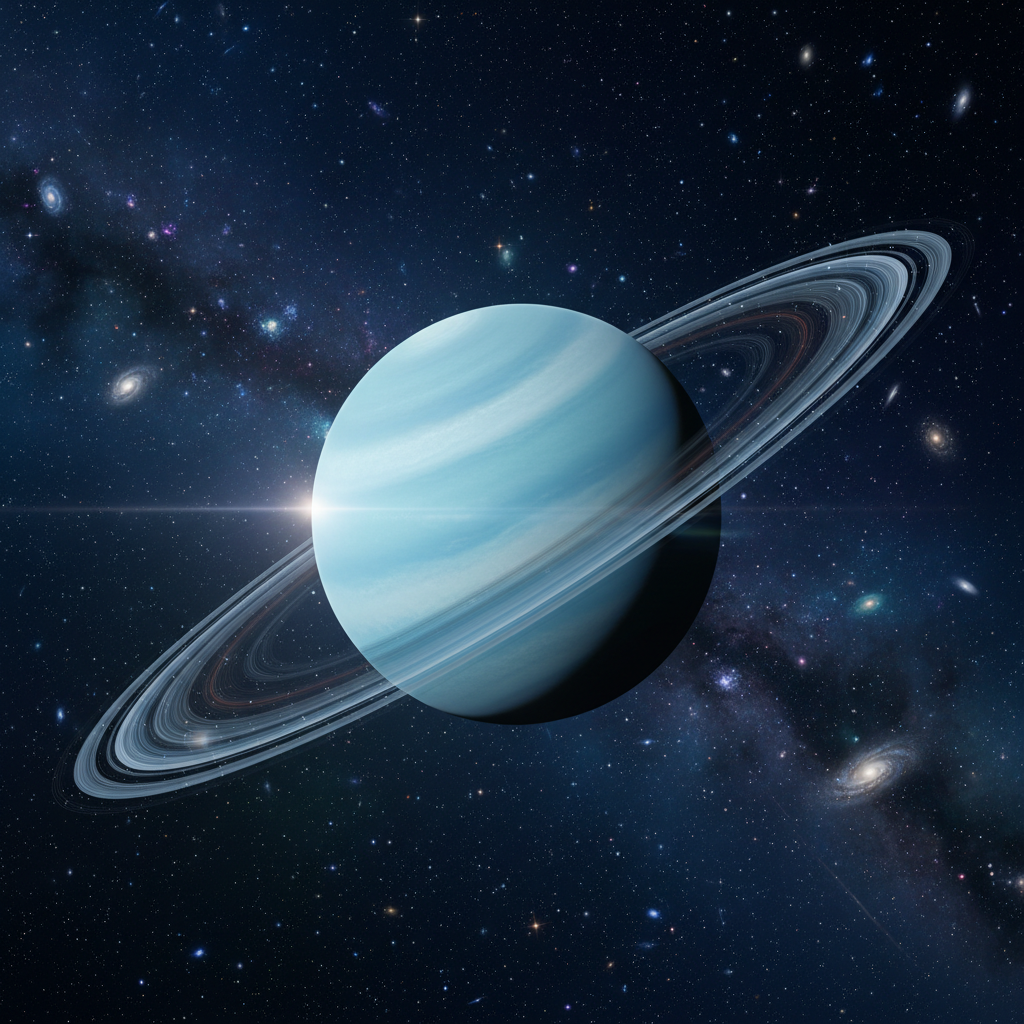
But Uranus quietly has one of the strangest ring systems in the solar system — and astronomers are now realizing those rings may be hiding secrets nobody expected.
Using data from Webb, Hubble, and the W. M. Keck Observatory, researchers recently analyzed Uranus’s faint outer rings in unprecedented detail.
What they discovered shocked them:
One outer ring appears rich in water ice Another contains carbon-rich organic material The two rings likely formed from completely different sources Hidden moonlets may be lurking inside the rings themselves
Scientists believe one ring is being fed by an icy moon called Mab, while another may be constantly replenished by unseen rocky objects being smashed by micrometeorites.
Translation?
Uranus isn’t just weird.
It’s messy.
Chaotic.
Alive with processes scientists did not expect to find in such a cold, distant world.
Hidden Moons May Be Lurking Inside the Rings
One of the most fascinating discoveries is the possibility that Uranus has moons we still haven’t found.
Tiny invisible moonlets may be shaping the rings through gravity while continuously shedding dust and debris into space.
That means the Uranian system could be far more active and crowded than Voyager 2 revealed back in 1986.
And honestly?
That’s becoming a theme in astronomy lately.
The more advanced our telescopes become, the more the universe seems to whisper:
“You barely understood me at all.”
Uranus’s Magnetic Field Is Basically a Cosmic Nightmare
As if the rings weren’t strange enough, Webb recently mapped Uranus’s upper atmosphere in 3D for the first time.
Scientists discovered:
Massive glowing auroras Dark atmospheric regions Strange energy patterns A wildly tilted magnetic field unlike almost anything else in the solar system
Its magnetic field is offset and tilted so dramatically that scientists describe the planet’s magnetosphere as one of the strangest ever observed.
Imagine Earth’s magnetic poles randomly sliding across the planet while the entire world rotated sideways.
That’s the kind of cosmic absurdity happening on Uranus.
The Bigger Question: Have We Been Wrong About Planet Formation?
This is where things get really interesting.
If Uranus is rockier than expected…
If its rings formed from wildly different materials…
If hidden moons are shaping its structure…
Then scientists may need to revisit long-held theories about how planets evolve.
And not just in our solar system.
Across the galaxy.
Because “ice giants” are common throughout the universe. If our understanding of Uranus is incomplete, it could affect how astronomers interpret countless exoplanets orbiting distant stars.
In other words:
This isn’t just about Uranus anymore.
It’s about the possibility that astronomy built an entire category of planets on an assumption that may have been oversimplified from the beginning.
Final Thoughts
Uranus spent decades being treated like the quiet middle child of the solar system.
Now it’s becoming one of the most scientifically disruptive planets we’ve ever studied.
Its rings are stranger than expected. Its atmosphere behaves unpredictably. Its magnetic field looks almost impossible. And its composition may overturn a century-old understanding of planetary science.
The universe has a habit of humbling humanity every time we think we finally understand it.
And right now?
Uranus is doing exactly that.