 Billy's Colloidal Silver + Starfire Gold duo —
For decades, the idea sounded like something straight out of science fiction:
What if empty space isn't actually empty?
In a groundbreaking discovery, physicists have gathered some of the strongest evidence yet that particles can emerge from what appears to be empty space. The finding offers a remarkable glimpse into one of the deepest mysteries in modern physics: Where does matter come from, and how does it acquire mass?
The Universe's Best-Kept Secret
Most of us think of a vacuum as complete emptiness.
No air.
No dust.
No matter.
Nothing.
But according to quantum physics, "nothing" is far more active than it seems.
Scientists describe empty space as a quantum vacuum—a state filled with fluctuating energy fields that constantly create and destroy tiny particle pairs known as virtual particles. These particles appear and disappear so quickly that they normally cannot be directly observed.
As the legendary physicist Richard Feynman once helped demonstrate through quantum field theory, the vacuum is not an empty void but a dynamic sea of activity occurring beneath the surface of reality.
What Scientists Actually Observed
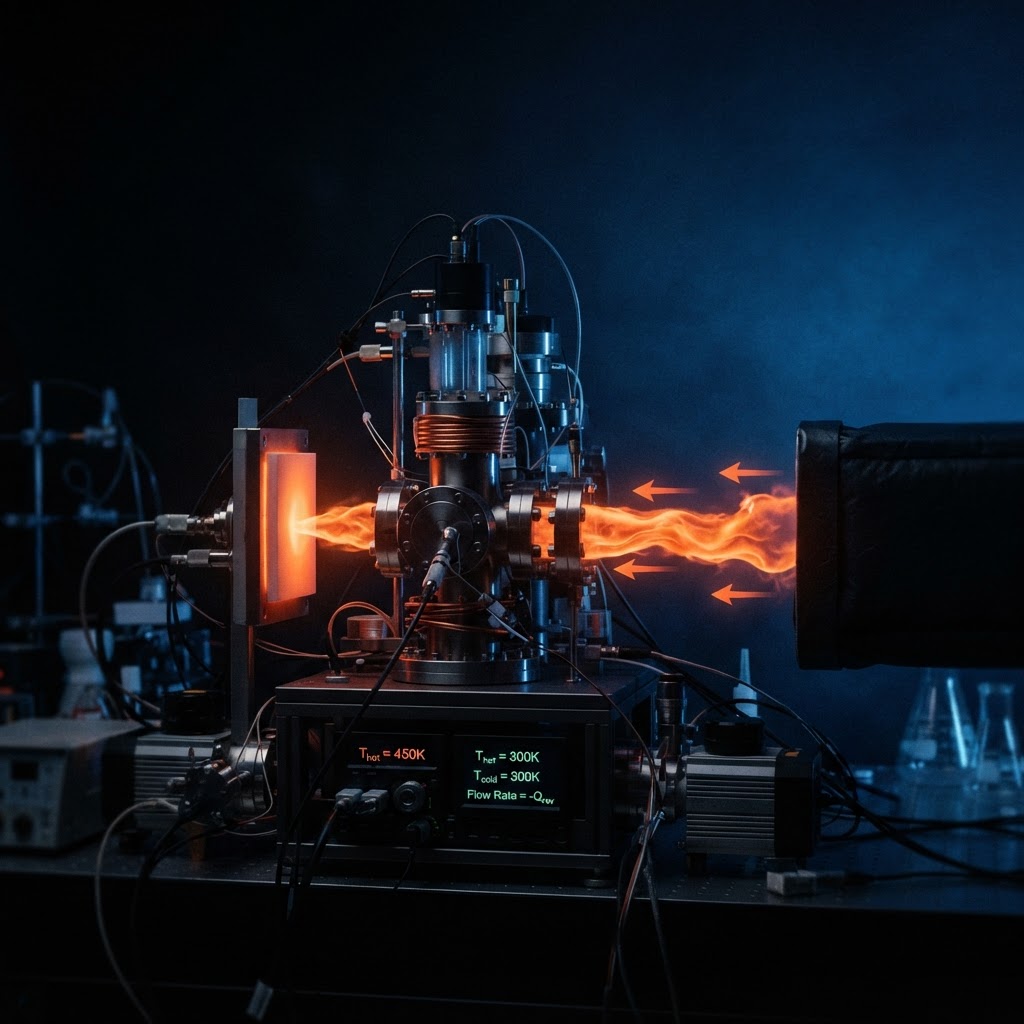
Researchers working at the Relativistic Heavy Ion Collider (RHIC) at Brookhaven National Laboratory smashed protons together at extremely high speeds.
When the collisions occurred, scientists analyzed the debris and discovered evidence suggesting that certain quark-antiquark pairs did not come directly from the protons themselves.
Instead, the particles appeared to have emerged from the quantum vacuum.
The research team examined unusual particles called lambda and anti-lambda hyperons.
Their spin alignments acted like fingerprints, allowing physicists to trace their origins.
What they found matched predictions that had existed only in theory for decades.
► The particles displayed correlated spin patterns.
► The alignment survived long enough to be measured.
► The signatures pointed toward particle pairs originating from vacuum fluctuations rather than the colliding protons themselves.
According to physicist Zhoudunming Tu and colleagues, this represents the first time researchers have been able to follow the entire process from vacuum fluctuation to observable particle evidence.
Why This Matters
This discovery isn't simply about finding strange particles.
It touches one of the biggest questions in physics:
Why does matter have mass?
Many people know that the Higgs field plays a role in giving elementary particles mass. The discovery of the Higgs boson at CERN in 2012 confirmed an important piece of that puzzle.
However, the Higgs field explains only part of the story.
Consider this:
► The individual quarks inside a proton are relatively light.
► Yet the proton itself is much heavier.
► Most of that mass comes from the energy generated by the strong force and the interactions occurring within the quantum vacuum.
In other words, much of the mass that makes up stars, planets, oceans, mountains, and even your body may ultimately be connected to the energy structure of empty space itself.
Einstein's Legacy Meets Quantum Reality
One of the most famous equations in history is:
When Albert Einstein introduced this relationship, he showed that mass and energy are interchangeable.
The new findings provide another powerful demonstration of that principle.
What appears to be "nothing" may contain enough underlying energy to contribute to the creation of measurable matter under the right conditions.
A New Window into Reality
Scientists are being careful not to claim that matter is literally appearing from absolute nothingness.
Energy from the particle collisions is still involved.
However, the research provides compelling evidence that the quantum vacuum actively participates in the creation of observable matter.
For physicists studying quantum chromodynamics (QCD)—the theory describing the strong nuclear force—this opens an entirely new avenue of investigation.
Researchers can now begin exploring questions such as:
► How does the vacuum generate mass?
► What role does vacuum energy play in the formation of matter?
► Could similar processes have shaped the early universe after the Big Bang?
► Are there deeper layers of reality hidden within the quantum vacuum itself?
Final Thoughts
For centuries, humanity viewed empty space as a passive backdrop upon which the universe unfolds.
Modern physics tells a very different story.
The vacuum is not silent.
It is not empty.
It is a restless ocean of quantum activity where particles flicker into existence, disappear, and under the right circumstances may leave behind traces that become part of the material universe itself.
This latest discovery doesn't answer every question about matter, mass, or reality—but it brings us one step closer to understanding how something can emerge from what appears to be nothing.
And perhaps the most astonishing lesson is this:
The emptiest places in the universe may be far more alive than we ever imagined.