For more than a century, one of the most reliable rules in science has been this:
A hot cup of coffee cools down. An ice cube melts in warm water. Heat naturally moves from hot to cold.
It's so predictable that we rarely stop to think about it.
But what if that wasn't always true?
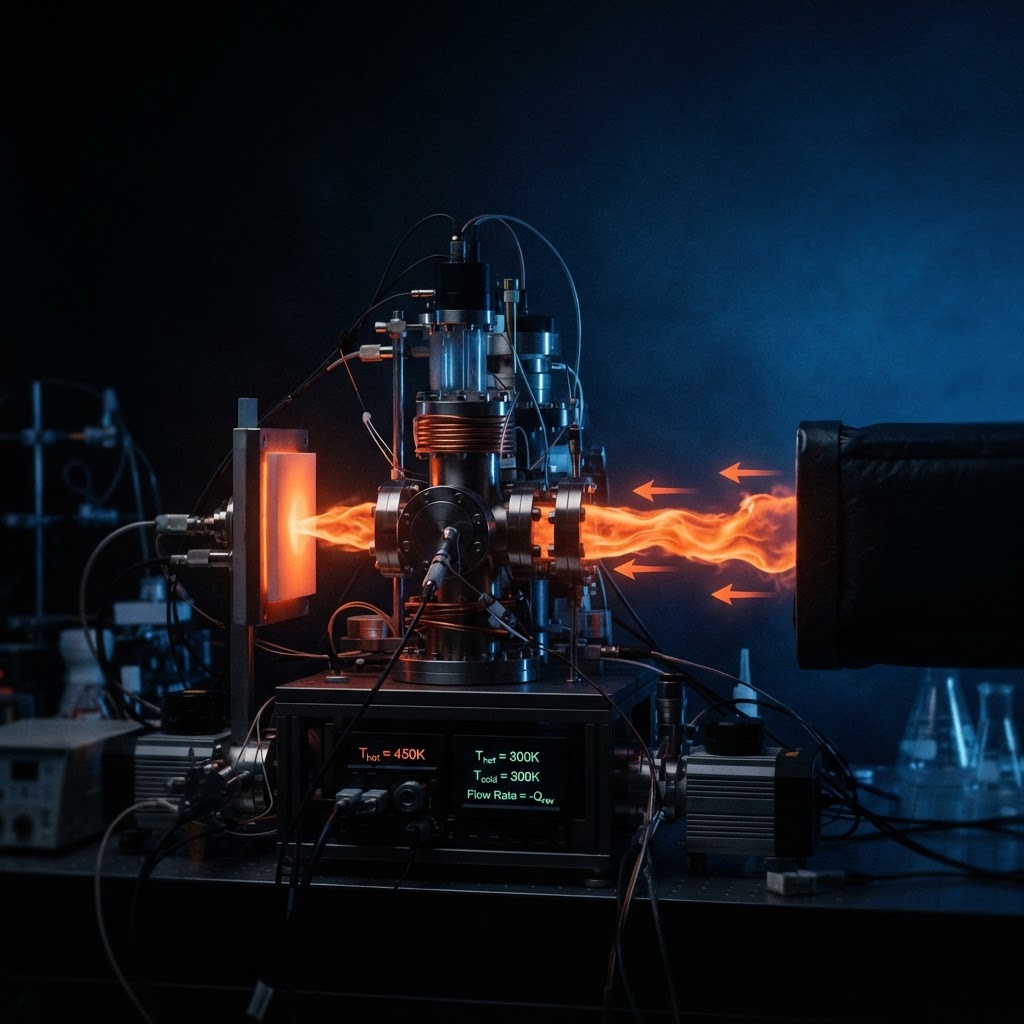
A new quantum physics experiment has demonstrated that under certain conditions, heat can briefly move in the opposite direction—from colder particles to hotter ones—without violating the deeper laws of physics. The discovery isn't rewriting thermodynamics, but it is forcing scientists to rethink how these famous laws behave inside the bizarre world of quantum mechanics.
The Rule We've Always Trusted
The Second Law of Thermodynamics explains why heat naturally flows from warmer objects toward cooler ones.
This law is responsible for everything from:
→ Why refrigerators require electricity to stay cold
→ Why engines lose energy as heat
→ Why ice melts in a warm drink instead of making the drink colder
→ Why time itself appears to move in only one direction
Physicist Lord Kelvin helped establish the foundations of thermodynamics during the 19th century, while Rudolf Clausius famously summarized the principle:
"Heat can never pass from a colder to a warmer body without some other change."
For everyday life, this remains absolutely true.
But quantum mechanics doesn't always behave like everyday life.
The Quantum World Plays by Different Rules
Atoms and subatomic particles don't experience reality the way larger objects do.
Instead they behave according to quantum mechanics, where particles can exist in multiple possible states, become entangled across distance, and interfere with one another like overlapping waves.
Researchers recently created an experiment involving tiny quantum systems where particles were prepared with carefully engineered quantum correlations.
Instead of allowing energy to randomly spread outward, those quantum relationships briefly redirected heat back toward the hotter system.
To anyone watching from our everyday perspective, it almost looks like heat is flowing backwards.
Did Scientists Break Thermodynamics?
No.
This is one of the biggest misconceptions surrounding the discovery.
Researchers did not prove the Second Law is wrong.
Instead, they showed that the law needs additional interpretation when quantum information enters the picture.
The hidden ingredient is quantum correlations.
These microscopic relationships store information that classical physics doesn't account for.
That stored information can temporarily influence where energy travels.
Think of it like this:
Imagine two dancers already perfectly synchronized before the music starts.
Their movements appear coordinated without communicating during the performance.
Quantum particles can behave in a surprisingly similar way because they already share information through quantum states.
That information changes how heat moves.
Information May Be Just as Important as Energy
One of the most fascinating ideas in modern physics is that information itself behaves like a physical resource.
Physicist Rolf Landauer famously proposed:
"Information is physical."
His work demonstrated that erasing information requires energy.
Since then, scientists have increasingly viewed information as something that directly affects physical processes—not merely something we observe afterward.
In quantum systems, information and energy become deeply connected.
Instead of thinking only about temperature differences, researchers must also consider how much quantum information exists between particles.
Why This Matters
At first glance, reversing heat flow sounds like little more than an interesting laboratory trick.
In reality, it could reshape several emerging technologies.
Possible applications include:
→ More efficient quantum computers
→ Improved quantum batteries
→ Reduced energy loss inside nanoscale electronics
→ Better quantum sensors
→ New approaches to cooling microscopic devices
As electronic components continue shrinking toward atomic scales, classical thermodynamics becomes less accurate.
Future technologies may require entirely new thermodynamic equations built specifically for quantum systems.
Scientists Have Been Expecting Something Like This
Physicists have suspected for years that thermodynamics would eventually need a quantum extension.
Among the leading contributors are researchers including:
→ John Preskill (California Institute of Technology), who has extensively studied quantum information science.
→ Seth Lloyd (Massachusetts Institute of Technology), whose work explores quantum computation and thermodynamics.
→ Vlatko Vedral (University of Oxford), known for connecting quantum information theory with entropy and thermodynamic behavior.
Their research suggests that information isn't simply describing nature—it actively participates in it.
This new experiment provides another piece of evidence supporting that idea.
Does This Mean Time Can Run Backwards?
Not exactly.
People often associate entropy with the "arrow of time."
Since entropy usually increases, we experience time moving forward.
The temporary reversal of heat flow doesn't reverse time itself.
Instead, it reveals that on extremely small quantum scales, microscopic fluctuations can briefly move opposite to what we normally expect.
Once systems become larger—containing trillions upon trillions of particles—those tiny quantum effects average out.
The familiar thermodynamic laws return.
Your coffee will still cool down tomorrow morning.
A New Chapter for Thermodynamics
Rather than replacing classical thermodynamics, researchers are expanding it.
Newton's laws still describe baseballs remarkably well even after Einstein introduced relativity.
Likewise, classical thermodynamics remains extraordinarily accurate for everyday objects.
But inside atoms, molecules, and quantum computers, scientists are discovering that heat doesn't always follow the simple path we learned in school.
Instead, energy, information, and quantum correlations appear to work together in ways that classical physics never predicted.
The result isn't the end of thermodynamics.
It may simply be the beginning of quantum thermodynamics.
Final Thoughts
Every major scientific breakthrough begins by questioning something we once believed was absolute.
The discovery of temporary backward heat flow doesn't overturn centuries of physics—it reveals that nature is even more sophisticated than we imagined.
As quantum technologies continue advancing, understanding how information influences energy may become just as important as understanding energy itself.
The future of physics may not be about replacing old laws.
It may be about discovering the hidden rules that only appear when we look deeply enough.