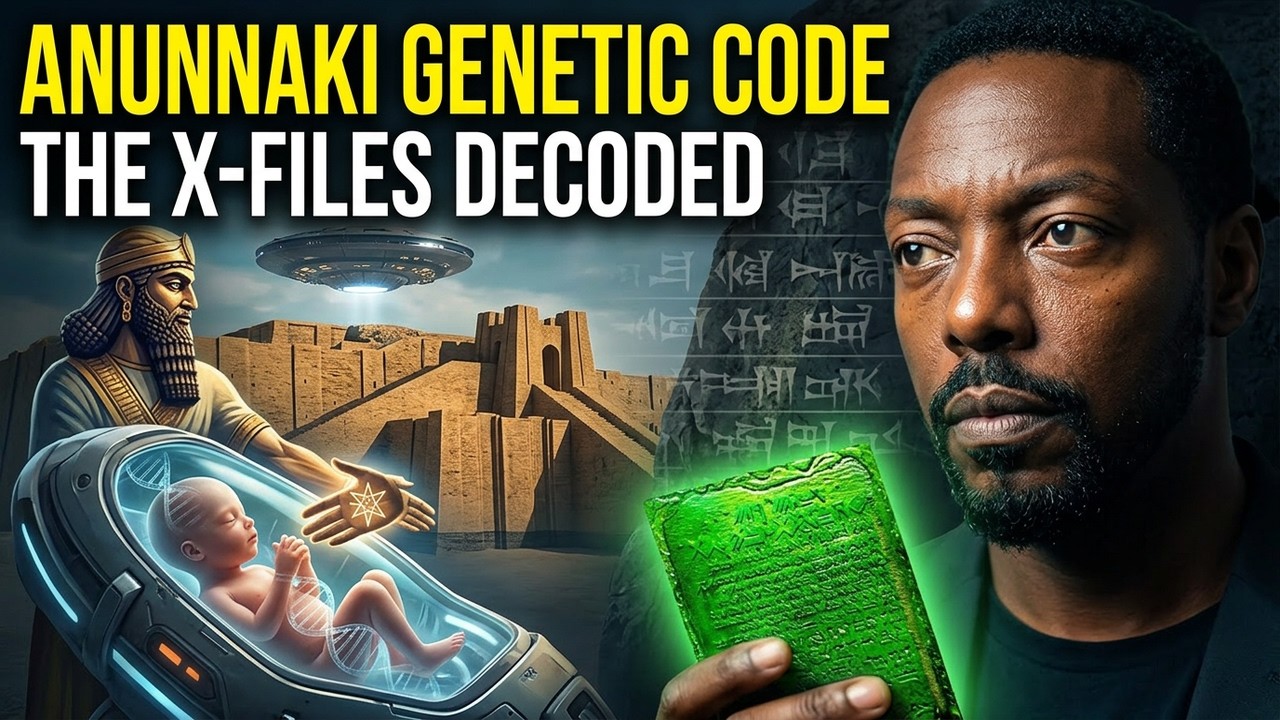
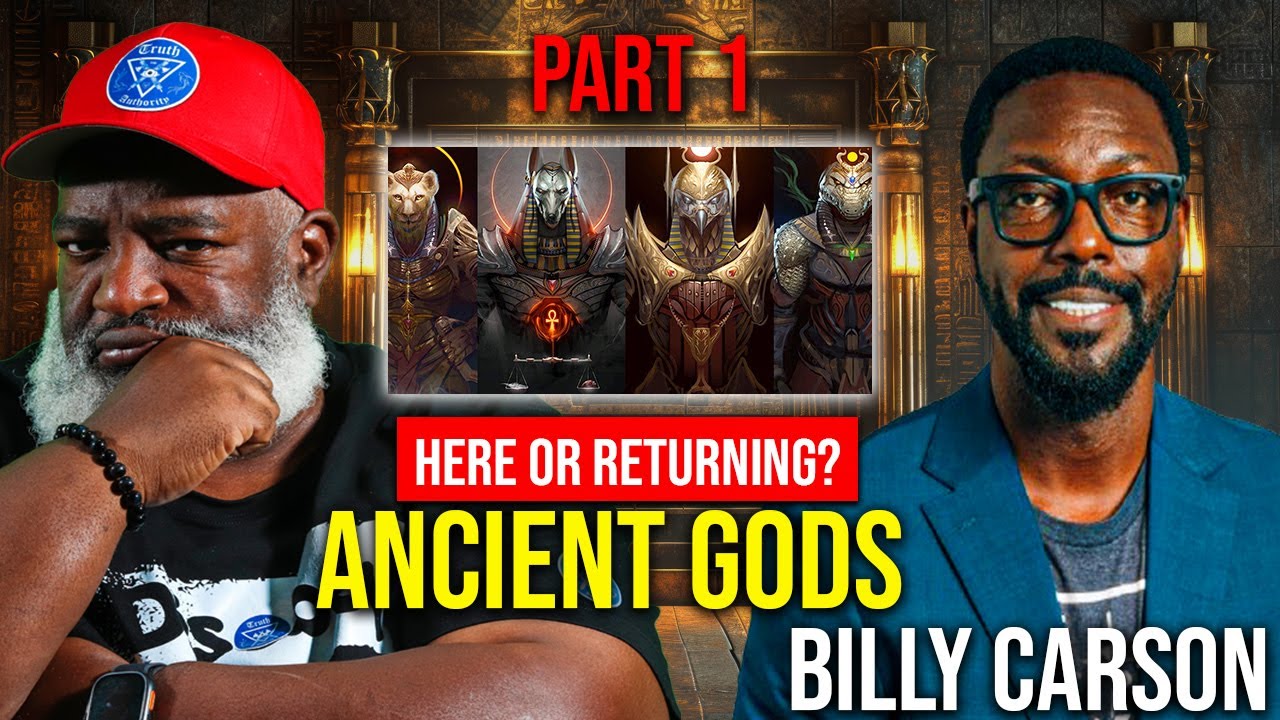
"The Anunnaki of Atlantis" is the idea, as Billy Carson and his guest Chris Jensen present it, that the Anunnaki of Sumerian myth and the Atlanteans of Plato and the Emerald Tablets were the same cast of beings, with the Egyptian god Thoth as the link between the two stories. In a long live conversation, Carson argues that Enki and his son Thoth ran a worldwide Atlantean civilization, kept "rejuvenation chambers" beneath Giza and Saqqara, and moved their base from Mesopotamia to Egypt after the flood. Jensen, a longtime supporter and business acquaintance of Carson's who says he has read Zecharia Sitchin for 30 years, asks the questions and adds his own readings. Scholars read the same texts differently, and that view sits beside each claim.
This article covers the Anunnaki in the Sumerian sources, Plato's Atlantis, Thoth in the Emerald Tablets and in Egypt, the Halls of Amenti and the Giza radar claim, the 100,000-year lifespan, the "genetic brand" hypothesis and what each man concludes. It leaves out the health material (including remarks about gold), the shareholder pitch, the tour promotion and the political asides.
Who were the Anunnaki in the Sumerian texts?
In Carson's telling, the Anunnaki were flesh-and-blood visitors who landed about 455,000 years ago, which he takes as proof that their culture is "at least a million years ahead of us." Anu, he says, "had the planet chopped into pieces," with a trinity of Anu, Enki and Enlil above twelve lesser gods who each ruled a region. Jensen sums up the picture with the Sitchin phrase "from heaven to earth they came," and adds that Enki came first to mine gold.
The documented picture is narrower. In Sumerian, Anunna (Akkadian Anunnaki) is a collective word for the great gods, usually glossed as the offspring of An, the sky god. The Enuma Elish, the Babylonian creation poem written down by about 1100 BC, has Marduk station 300 Anunnaki in heaven and 300 in the underworld. The Old Babylonian Atrahasis, from around 1700 BC, tells of lesser gods who dig canals, rebel, and are relieved when Enki and the mother goddess fashion humans from clay. Neither text gives an arrival date, a home planet or a gold mine. The 3,600-year orbit of Nibiru and the translation "those who from heaven to earth came" come from Sitchin's The 12th Planet (1976); no cuneiform dictionary supports that reading.
What does Plato actually say about Atlantis?
Carson says Atlantis "wasn't just a ring city." The ring city, he argues, was "one capital of dozens of capitals" in a global civilization run by the Anunnaki, with outposts from Egypt to China. Jensen agrees and treats the Emerald Tablets as the Atlantean record that picks up where the Sumerian tablets leave off.
Plato is the only ancient source for Atlantis. In the Timaeus and the unfinished Critias, written around 360 BC, the Athenian lawgiver Solon hears from Egyptian priests at Sais about an island beyond the Pillars of Heracles that ruled Libya as far as Egypt and Europe as far as Tyrrhenia, attacked Athens 9,000 years earlier, and sank "in a single day and night" of earthquakes and floods. The Critias describes the capital's concentric rings of land and water. Neither dialogue mentions Sumer or Thoth, and Egypt is the enemy of Atlantis, not its colony. Most classicists read the account as a philosophical fable about a proud sea power. Plato does mention Thoth, as Theuth, inventor of writing, but in the Phaedrus. The chain from Atlantis to Thoth comes from the Emerald Tablets.
Who is the Thoth of the Emerald Tablets, and who was the Egyptian Djehuty?
Carson calls Thoth the son of Enki and says the Emerald Tablets name Enki as "Thotme." He takes the text's claim that Thoth built the Great Pyramid 36,000 years ago as history and reads it as a message sealed for the present age. Jensen reads "many the worlds I have traveled" as confirmation that humanity is common in the universe. Both notice parallels with the teachings of Jesus, and Carson calls it "quite possible" that Thoth once chose to be born rather than enter an avatar body.
The book they quote is The Emerald Tablets of Thoth the Atlantean, published in 1939 by Maurice Doreal, the pen name of Claude Doggins. Doreal said he translated tablets carved in Atlantean; none have been produced, and the Halls of Amenti, the Dweller of Unal and Thotme first appear in his text. The older Emerald Tablet of Hermes, a single page of alchemical aphorisms, surfaces in Arabic around the eighth century. The Egyptian Djehuty, whom the Greeks called Thoth, was the ibis-headed god of writing, counting and the moon, worshipped at Hermopolis, who records the weighing of the heart in the Book of the Dead. Egyptian texts make him a god, not a visitor from a sunken island.
Where does Carson place the Halls of Amenti, and what did the Giza radar claim show?
Carson says he first thought the Halls of Amenti might lie in another dimension, then decided they were physical because Thoth describes leaving a chamber to "walk amongst men." He puts one set beneath Giza and another at Saqqara, where he says diorite and granite boxes of 600 to 1,500 tons sit in a hall he calls "a giant battery," with background radiation above normal and a lid marked with a radioactive symbol. Carson also says a 10-gigahertz radar revealed a complex that makes the pyramids "child's play"; Jensen puts the scan team's date at 38,000 years.
The Saqqara site is the Serapeum, discovered by Auguste Mariette in 1850, where 24 granite and diorite boxes held mummified Apis bulls from the 26th Dynasty onward. Egyptologists estimate them at 60 to 100 tons, and no published survey records elevated radiation. The radar claim was announced in March 2025 by Corrado Malanga, Filippo Biondi and Armando Mei, who said satellite SAR data showed shafts and chambers up to two kilometers below the Khafre pyramid. The work was not peer reviewed, and radar specialists objected that SAR cannot penetrate limestone to that depth. Radiocarbon dates published by Georges Bonani and colleagues in 2001 place the Giza pyramids in the third millennium BC.
How does Carson say Thoth lived for 100,000 years?
The mechanism, in Carson's account, is a chamber plus a spare body. Thoth would fashion a body, leave it in a "rejuvenation chamber" for a hundred years, then transfer his consciousness into a new "avatar" and walk unnoticed among people, repeating the cycle a thousand times. "That's his words, not ours," Carson says. Different avatars explain, in his view, why Thoth appears under different names, including Huangdi, the Yellow Emperor of China, who "arrived on a flying dragon." Modern laboratories are only now catching up, he argues, citing a DARPA program called Avatar in which a soldier controls a robot and a Russian "2045" project to move minds into machines. "We can only rediscover what already exists," he says.
The modern references are real but smaller than described. DARPA's Avatar line item, in its 2013 budget request, funded a remotely operated robot, not a mind transfer. The 2045 Initiative was founded in Russia in 2011 by Dmitry Itskov, not Ray Kurzweil. No laboratory has moved a consciousness anywhere. Huangdi is a legendary ruler placed by tradition in the 27th century BC, said to have ascended on a dragon at death; China's first historical emperor was Qin Shi Huang in 221 BC.
What is Billy Carson's "genetic brand" hypothesis?
Carson labels this part himself. "This is Billy Carson's hypothesis," he says, not something he read. The premise is a claim that human populations differ by about 2 percent genetically and that geneticists agree such a difference could not arise in 200,000 years, making it "an artificial mutation." His explanation borrows from a farm: a farmer brands cattle so a stray can be returned to its owner. The Anunnaki who ruled each region, he proposes, put a "genetic brand" on the people they governed, which is why ruler and ruled looked alike. Jensen adds that mitochondrial DNA tracing to an African ancestor about 200,000 years ago "matches up exactly" with the texts.
The genetics runs the other way. Richard Lewontin's 1972 paper, The Apportionment of Human Diversity, found that about 85 percent of human genetic variation occurs within any single population, with only 6 to 7 percent separating continental groups, a result confirmed since. No body of geneticists calls that variation artificial. The mitochondrial finding is genuine, from Rebecca Cann, Mark Stoneking and Allan Wilson in 1987, and it describes evolution in Africa. The Sumerian creation accounts, Atrahasis and Enki and Ninmah, have the gods make people from clay and a slain god's blood so the gods can rest; they say nothing about branding.
What do Carson and Jensen conclude?
Both men end in the same place: humanity was ruled by beings it mistook for gods, and the deception is wearing off. Carson's governing image is that "we've become a giant cargo cult." He describes temple storehouses where offerings became the gods' dinner. He reads a Sumerian passage about an "evil wind" that made hair fall out as a nuclear weapon used in a final pyramid war. Jensen offers his opinion that slavery was an Anunnaki invention and states his rule: "I go where the evidence leads me."
The cargo cult is a real term from Melanesian anthropology after the Second World War, where movements such as John Frum on Tanna formed around the arrival of military cargo. The evil wind passage is the Lamentation over the Destruction of Sumer and Ur, composed around 2000 BC, which Assyriologists read as a poetic account of the fall of Ur to Elamite and Amorite armies; the nuclear reading is Sitchin's, from The Wars of Gods and Men (1985). Carson closes gently: humanity is a baby learning to walk, and walking "is learning how to control your fall." Once that is mastered, in his telling, the cycle of rise and collapse ends and a golden age can be sustained.
Watch, read and listen next
The Sumerian side of the argument is laid out in who the Anunnaki were in the texts versus the ancient astronaut theory, the Sumerian King List explained and Carson's account of how the Anunnaki created humans, while the cargo cult idea gets a full treatment in Gods Among Us with Roderick Martin. For the Atlantis half, read Plato's Timaeus and Critias with Matthew LaCroix and Thoth the Atlantean, then compare the Egyptian record in who was Thoth, the god of wisdom.
The underground claims continue in where the Halls of Amenti are, Saqqara and the Serapeum and the Khafre radar claims. The whole subject lives in the Anunnaki and Sumer category, and long conversations like this one are collected on the 4biddenknowledge Podcast.
Frequently asked questions
What do Carson and Jensen mean by "the Anunnaki of Atlantis"? They mean that the gods of the Sumerian tablets and the Atlanteans of the Emerald Tablets were one group, with Enki's son Thoth appearing in both. In their telling, Thoth rebuilt Egypt after the flood.
Does Plato connect Atlantis to Thoth or Sumer? No. The Timaeus and Critias place Atlantis beyond the Pillars of Heracles and make Egypt the enemy that preserved the story. Plato mentions Thoth only in the Phaedrus, as the inventor of writing.
Are the Emerald Tablets an ancient text? The book Carson quotes was published in 1939 by Maurice Doreal, who said he translated tablets no one else has seen. The older Emerald Tablet of Hermes is a single page and says nothing about Atlantis.
Is there evidence of a "genetic brand" in human DNA? No. Lewontin's 1972 study found that most human genetic variation occurs within populations rather than between them, and the Sumerian creation texts describe nothing like branding.
Sources mentioned
- Enuma Elish, the Babylonian creation epic (written down by c. 1100 BC)
- Atrahasis, Old Babylonian flood and creation epic (c. 1700 BC)
- Lamentation over the Destruction of Sumer and Ur (c. 2000 BC)
- Zecharia Sitchin, The 12th Planet (1976) and The Wars of Gods and Men (1985)
- Plato, Timaeus and Critias (c. 360 BC)
- Maurice Doreal, The Emerald Tablets of Thoth the Atlantean (1939)
- Richard Lewontin, "The Apportionment of Human Diversity" (1972)
- Rebecca Cann, Mark Stoneking and Allan Wilson, "Mitochondrial DNA and human evolution," Nature (1987)
- Georges Bonani and colleagues, radiocarbon dating of Old Kingdom monuments (2001)
- Corrado Malanga, Filippo Biondi and Armando Mei, Khafre SAR claim (2025)