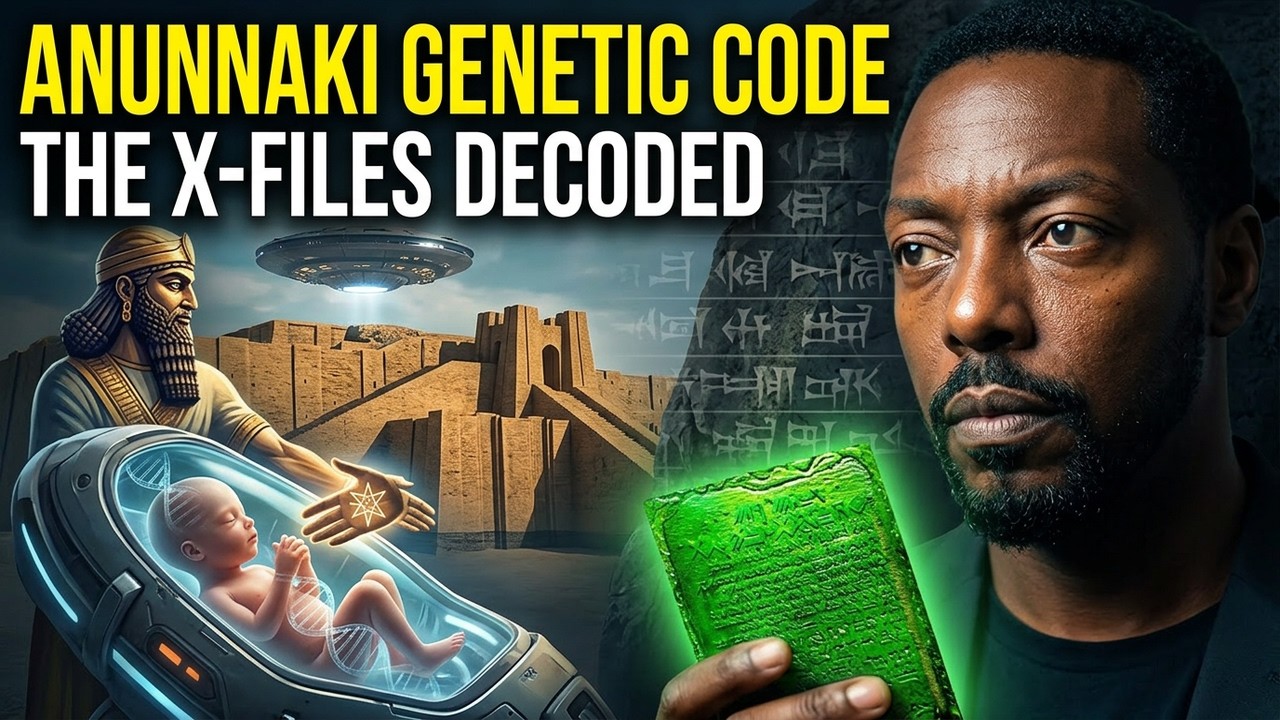
In this pop-up live Q&A, Billy Carson answers the audience's Anunnaki questions directly: the Anunnaki did not make humans from scratch but genetically modified a hominid cousin who was already here, Nibiru is a planet orbiting a brown dwarf on a roughly 4,200-year loop, Enlil rather than Enki is the figure the Bible calls Yahweh, and the Anunnaki never fully left because their offspring still walk among us. Those are his readings of the Sumerian and Akkadian tablets, and he flags which answers come from a text and which are his own hypothesis. Assyriologists read the same tablets as mythology, and astronomers have found no brown dwarf companion to the Sun, so each answer here sits beside the mainstream position.
The session happened by accident. Roderick Martin's Tuesday show on Forbidden Knowledge TV was cancelled by a Texas winter storm, so Carson went live himself and took questions from the chat for an hour and fifteen minutes, mixing in tour and awards announcements that are left out here.
Did the Anunnaki make humans or modify them?
Carson's answer is modify. Earth already had "upright, bipedal, bilateral hominids" with larger skulls and jaws, which he calls our cousins. The Anunnaki, mining the planet, faced a revolt from the faction doing the labor, and in the Epic of Atrahasis the solution was to take the existing hominid and "add their essence to it." He describes an egg taken from a hominid womb, combined with Anunnaki material into what biology would call a zygote, and carried to term by the goddess he identifies as Isis, who holds up the child and says "my hands have made it": the Adamu, first man, which he says is where the biblical Adam gets his name.
He is emphatic that there were dozens of such births, not one couple, because "two people can't populate a planet." Eden, which he spells out as E.DIN, was in his telling a guarded breeding farm where the engineered humans were paired at set times; he reads the guards at the gate in both versions as evidence, and adds that Genesis itself encodes the story: "Gen-Isis, generations of Isis."
The Atrahasis epic, an Akkadian text of the eighteenth century BCE, does describe the junior gods revolting over their labor and the birth goddess Nintu mixing clay with the flesh and blood of a slain god to make humans who will take over the work. The Sumerian word for a steppe is edin, and some scholars accept it as a possible source for Eden. Isis, however, is Egyptian rather than Mesopotamian, and Genesis is Greek for origin, so those two links are Carson's. Mainstream science places Homo sapiens emerging in Africa around 300,000 years ago, with no genetic signature of outside intervention.
Who is older, Enki or Enlil, and why is the planet named after Enki?
Enki is the elder, Carson says, with a higher rank number, yet Enlil ended up ruling Earth while Enki took over genetics. He offers an etymology for the planet's name: Enki's other name E.A plus KI, Sumerian for earth, gives "Ea-ki," which he hears as Earth. Enki's sons, in his account, were Ningishzida, whom he identifies with Thoth, and Marduk, whom he identifies with Amun-Ra and describes as the one who pushed a one-world religion.
In the Sumerian pantheon Enlil of Nippur was the chief executive god and Enki of Eridu the god of fresh water, wisdom and crafts. The English word earth descends from Old English eorþe and Proto-Germanic roots, not from Sumerian. The identification of Marduk with Amun comes from Zecharia Sitchin rather than from Egyptologists or Assyriologists.
Where are the Anunnaki now, and will they return?
Some never left, Carson says. He points to Mohenjo-daro, where he describes skeletons in the streets with elevated radiation and vitrified bricks, and to the sands of Giza, where he says balls of glass can be pulled up, as evidence of a final "pyramid war." After it some Anunnaki departed and some stayed, and he believes their offspring are indistinguishable from anyone else today. For the ones who left, the tablets promise a return, and to beings who live for eons "it's like they just went around the corner to the corner store." He adds a line from the Emerald Tablets in which Thoth says an enemy will come from deep space and whoever can raise his ship from beneath the Sphinx will defeat it.
The Mohenjo-daro radiation story traces to a 1979 book by David Davenport and has never been supported by a published survey; the skeletons found there lay in different strata and show no sign of a single catastrophe. The desert glass is real, but it is Libyan desert glass, dated to an impact or airburst around 29 million years ago. Carson flags the enemy-from-space passage as a possibility rather than a prediction.
What is Nibiru?
Nibiru, in Carson's account, is a planet orbiting a brown dwarf, a failed star with the mass of the Sun but far smaller and dimmer, visible only in infrared. He says this brown dwarf sits in the inner Oort cloud, orbits the Sun about every 4,200 years, and did so every 3,600 years in Sumerian times; that period, the shar, is how the Anunnaki counted their ages, which is why the Sumerian King List credits kings with reigns of 28,800 and 14,400 years. Its next approach, he says, will bring some extra earthquakes but no collision and no end of the world.
Nibiru does appear in the Enuma Elish as Marduk's star, usually identified with Jupiter, and the shar is the Sumerian unit of 3,600 used for counting, not an orbit. NASA's WISE infrared survey ruled out a Saturn-sized body out to 10,000 astronomical units and a Jupiter-sized one out to 26,000 AU; a solar-mass brown dwarf at the distance Carson describes would have shown up there and in the orbits of the outer planets.
Was the Great Pyramid a weapon?
Carson says no, it was "a multi-functional stone computer": a power generator, with Nile water flowing under the granite to produce electricity that rose through the Grand Gallery, was amplified in the King's Chamber and broadcast from the missing capstone to obelisks; a communications device, whose shafts aligned with Orion, Sirius and Aldebaran and beamed hydrogen, "the best way to communicate with ET," toward those stars; and a scale model of the planet, 43,200 times smaller than Earth. He supports the electricity claim with the absence of soot in painted tombs, which he says shows lamps rather than torches.
Egyptology treats the Great Pyramid as the tomb of Khufu, built around 2560 BCE, and has found no wiring, conductors or residue consistent with power generation. The soot problem has conventional answers: reflected daylight, and oil lamps burning with salt in the oil, which leave little soot. The 43,200 ratio is approximate and comes from Graham Hancock's reading of the pyramid's dimensions.
Who did the Anunnaki worship, and why did they want prayers?
The Anunnaki worshipped "the creator of all," Carson says, and admitted in the tablets that they would have to reckon with that creator for what they did on Earth, so they knew they were not the top of the hierarchy even while posing as gods. Prayers and offerings, in his reading, were about food and control: the offerings fed beings who were not going to farm, and the prayers trained people to feel blessed by any small leniency. He says the Lord's Prayer is an ancient prayer to Ptah, whom he identifies with Enki, and that the brother who became Yahweh was Enlil, who blamed his own harshness on Enki and labelled him the serpent.
The Lord's Prayer's closest known parallels are in Jewish prayer, particularly the Kaddish; no Egyptian text attributes it to Ptah. The origin of the name Yahweh is debated, with one leading proposal placing it among the Midianites south of Canaan, and none of the proposals involves Enlil. Carson's account of Enlil's temperament does follow the tablets, where Enlil sends plague, drought and finally the flood to silence noisy humanity.
Did Thoth and the Olmecs build Teotihuacan?
Yes, in Carson's telling. After clashing with Marduk, Thoth was sent by Enki to the other side of the world and took the Olmecs with him from Africa, founding the civilization that ran from Teotihuacan through the Yucatan into South America. The Maya and Aztecs, he says, inherited abandoned cities rather than building them, which is why the name Teotihuacan was given by later arrivals who did not know who had built it.
Archaeology dates Teotihuacan to roughly 100 BCE through 250 CE and a local population; the name is Nahuatl and was given by the Aztecs centuries later, one point where the accounts agree. The Olmec flourished on the Gulf coast between about 1500 and 400 BCE, and the African-origin claim, popularized by Ivan Van Sertima, is rejected by Mesoamericanists. Carson develops his "city of Tehuti" argument in a separate episode linked below.
What about the flood, the ark and the Tower of Babel?
Carson says the flood was Enlil's attempt to wipe out humanity after discovering that Enki had built the capacity for higher consciousness into the new species, and that Enki warned his half-human son Ziusudra, the Sumerian Noah. He insists the original ark was a round wooden vessel, "more like a DNA bank," stocked from the local area rather than with two of every animal. The Tower of Babel, with its shem on top, was Enlil's second alarm, so he confused the language and scattered the leaders.
The round-ark detail has a real source: the Ark Tablet, published by Irving Finkel in 2014, describes a circular coracle, though it also has animals boarding "two by two," so that detail is older than Genesis. Shem in Akkadian and Hebrew means name or monument; the rocket reading is Sitchin's.
Watch, read, listen
- Watch the full Q&A:
- The 4biddenknowledge Podcast archive: https://4biddenknowledge.ai/Podcast
- Topic hub: Anunnaki & Sumer
- Related reading: the earlier Anunnaki Q&A with Billy Carson, Nibiru and Planet X explained, Enki and Enlil, the two brothers, the Atrahasis epic explained, the Garden of Eden and the Sumerian edin, the Tower of Babel and Etemenanki, Noah's Ark and the Ark Tablet, the Sumerian King List, who were the Elohim? and Teotihuacan and Thoth.
Frequently asked questions
According to Billy Carson, did the Anunnaki create humans? Not from nothing. He says they genetically modified an existing hominid, following the Atrahasis epic, and produced many first humans rather than one pair. Atrahasis does describe humans made from clay and a god's blood to relieve the gods of labor; mainstream science attributes human origins to evolution.
What does Carson say Nibiru is? A planet orbiting a brown dwarf companion of the Sun on a roughly 4,200-year orbit. Infrared surveys have ruled out any such star within that range, and in the Enuma Elish Nibiru is Marduk's star, usually read as Jupiter.
Which Anunnaki does Carson identify as Yahweh? Enlil, whom he describes as the harsh brother who sent the flood. Scholars trace the name Yahweh to the southern Levant and do not connect it to Mesopotamian gods.
Does Carson believe the pyramids were weapons? No. He describes the Great Pyramid as a power plant, a communications device and a scale model of Earth. Egyptology regards it as Khufu's tomb.
Sources mentioned
- The Epic of Atrahasis (Old Babylonian, c. 18th century BCE)
- The Enuma Elish, the Seven Tablets of Creation
- The Sumerian King List, Weld-Blundell Prism, Ashmolean Museum, Oxford
- The Emerald Tablets of Thoth the Atlantean, as translated by Maurice Doreal (1939)
- Irving Finkel, The Ark Before Noah (2014), on the Ark Tablet
- Zecharia Sitchin, The 12th Planet (1976), for the shem and Nibiru readings
- NASA WISE survey results on the absence of large bodies in the outer solar system (2014)
- Graham Hancock, Fingerprints of the Gods (1995), for the 43,200 ratio