The secret space program is the idea that a hidden space effort operates beyond what NASA and the military publicly acknowledge. Part of that idea is documented history: the United States and the Soviet Union ran genuinely classified space projects, from spy satellites to military space stations, and some stayed secret for decades. The larger claims, such as off-world fleets, Mars colonies and twenty-year tours of duty in deep space, rest on personal testimony that no released record has corroborated.
This matters because the phrase is used for two very different things, and they are routinely blurred together. Sorting the documented record from the testimony is the only way to take the subject seriously, whether a reader is looking for evidence of a hidden program or trying to understand why so many people believe one exists. The government's own track record of secrecy is a large part of why the theory has endured, and it deserves to be examined on the facts.
What the term "secret space program" actually covers
The term covers a spectrum with three distinct layers. At one end are classified space projects that governments have since acknowledged, with budgets, hardware and declassified files. In the middle are programs whose existence is confirmed but whose payloads or purpose remain classified today. At the far end are claims, mostly made since the early 2000s, of a breakaway program operating interplanetary fleets with technology far ahead of the public world.
Most confusion comes from treating the first layer as proof of the third. That a government hid a spy satellite in 1960 is a fact; it does not follow that the same government runs a fleet in the outer solar system. For a longer chronology of how the idea grew, see [a brief history of the secret space program](/a-brief-history-of-the-secret-space-program). This article focuses on a narrower question: which parts can be verified.
Classified space projects that are documented
Several genuinely secret space programs are now part of the public record, and they are more remarkable than many people realize.
Corona and the National Reconnaissance Office
Corona was a photo-reconnaissance satellite program run by the CIA together with the US Air Force, flying from 1960 to 1972. Its satellites photographed the Soviet Union and returned exposed film to Earth in capsules that were recovered in mid-air by aircraft. The program was declassified in 1995 by executive order. The agency that came to manage America's spy satellites, the National Reconnaissance Office (NRO), was itself a secret: its existence was not officially acknowledged until 1992, three decades after it began operating.
The Manned Orbiting Laboratory
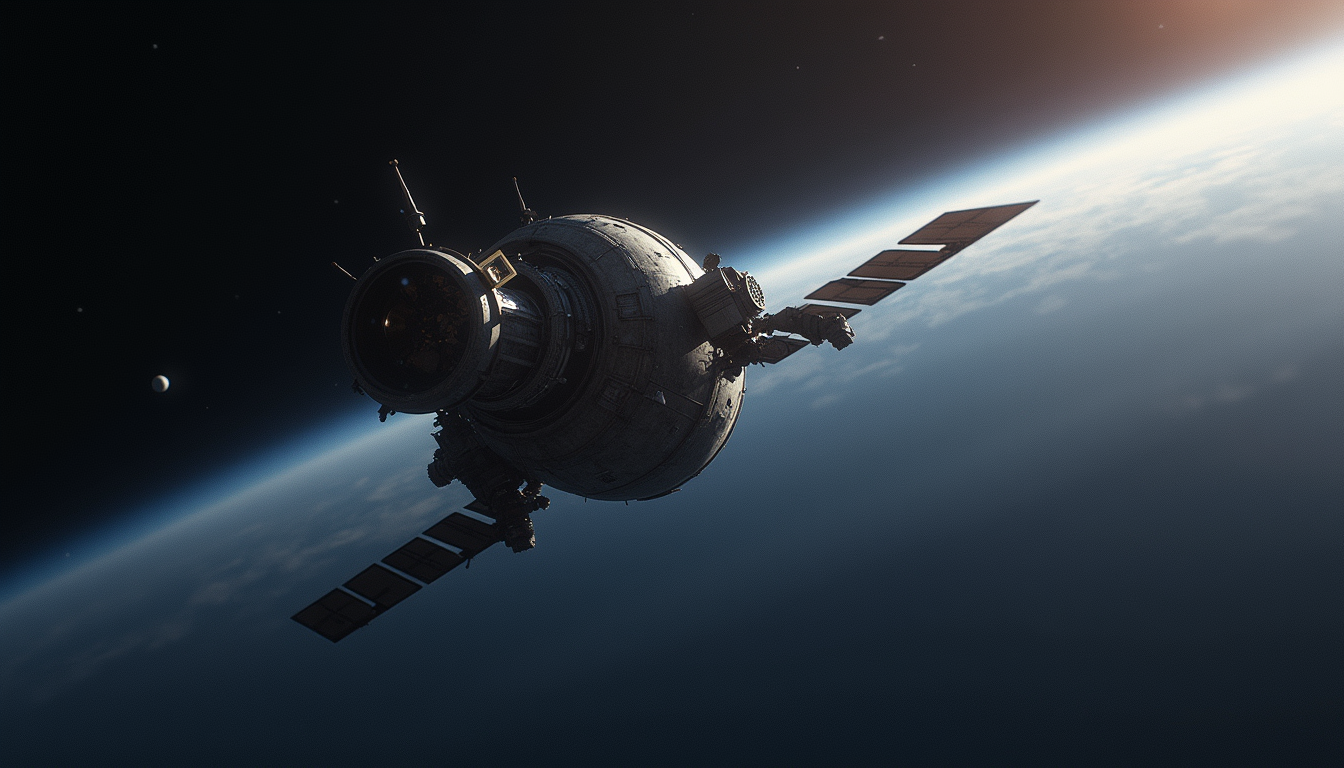
The Air Force's Manned Orbiting Laboratory was announced in 1963 as a crewed military space station intended largely for reconnaissance. It selected and trained its own corps of military astronauts, several of whom later flew with NASA, and it was cancelled in 1969 before any crew reached orbit. Much of its detailed history stayed classified until the NRO released its files in 2015.
Almaz, the Soviet military stations
The Soviet Union flew its own military space stations under the Almaz program, presented to the public under the civilian Salyut name. Salyut 3, launched in 1974, carried an onboard cannon that was test-fired in orbit. The military nature of these stations was not openly discussed at the time.
The X-37B and classified launches
The X-37B is an uncrewed, reusable robotic spaceplane operated by the US military; it has flown missions since 2010, and its longest mission lasted 908 days in orbit. Many of its payloads and experiments are classified. The NRO also launches satellites with undisclosed payloads under "NROL" mission designations. Since December 2019, the US Space Force has existed as a separate branch of the armed forces responsible for much of this military space activity.
None of this is fringe. It shows that governments have hidden space hardware, budgets and even an entire agency, which is exactly why the broader theory finds a receptive audience.
The UFO disclosure record since 2017
The second documented thread is the US government's changing stance on unidentified aerial phenomena, now officially called UAP. The Air Force's Project Blue Book investigated UFO reports from 1952 until it closed in 1969, concluding that none posed a threat to national security.
The subject returned in December 2017, when The New York Times reported that the Pentagon had funded a UFO study program, known as AATIP and linked to an earlier effort called AAWSAP, at roughly $22 million between 2007 and 2012. The Navy's UAP Task Force followed in 2020. In June 2021 the Office of the Director of National Intelligence (ODNI) released a preliminary assessment of 144 reports and could explain only one of them. The All-domain Anomaly Resolution Office (AARO) was created in 2022, and ODNI's 2023 report expanded the case count further.
In July 2023, former intelligence officer David Grusch testified under oath before a House Oversight subcommittee that the United States had recovered craft of non-human origin, saying his information came from interviews with others. AARO's Historical Record Report, released in 2024, found no evidence that any US government program had possessed or reverse-engineered extraterrestrial technology, and it attributed many such accounts to misunderstood but real classified programs. Further congressional hearings followed in 2024 and 2025.
One point is easy to miss: none of these official documents describes an off-world fleet or a program operating beyond Earth orbit. The disclosure record concerns unexplained objects in Earth's airspace.
Where the conspiracy claims come from
The off-world version of the secret space program comes almost entirely from individual testimony, and each claim should be read as testimony rather than documentation.
Gary McKinnon and Solar Warden
Gary McKinnon, a British systems administrator, broke into US military and NASA computers and was arrested in 2002. He later said he had seen files listing "non-terrestrial officers" and "fleet-to-fleet transfers." He produced no copies of these files, and nothing matching them has surfaced. The name "Solar Warden" became attached to this idea of a hidden space fleet in later retellings; no record of a program by that name has ever been produced.
Corey Goode and "20 and back"
Beginning in 2015, Corey Goode described a multi-faction secret space program on Gaia's Cosmic Disclosure series, including a "20 and back" tour in which personnel allegedly serve twenty years off-world and are then age-regressed and returned to the moment they left. No documentary or physical evidence has been offered, the claimed technology has no basis in known physics, and critics have pointed to inconsistencies within his own timeline.
Randy Cramer, Die Glocke and Antarctica
Randy Cramer has claimed he served for years at a Mars colony under a similar arrangement; no evidence of crewed Mars bases exists. The Nazi "Bell," or Die Glocke, is a supposed wartime anti-gravity device that first appeared in print around 2000, with no surviving wartime documentation. Claims of hidden Antarctic bases draw on real expeditions to the continent, which are covered in [the real history of Antarctica and the Piri Reis map](/secrets-of-antarctica-piri-reis-map-lost-continent-and-the-real-history).
How to tell documented history from testimony
The clearest test is whether a claim leaves a trail beyond one person's word. Every documented program above left several kinds of evidence: budgets, contractors, launch records, hardware seen by outsiders, and eventually declassified paperwork. Even the NRO, secret for three decades, was visible through launches that amateur observers tracked.
A few practical questions help:
- Is there a document, a photograph or hardware that someone other than the claimant has examined?
- Do independent sources confirm it, or do the accounts circle back to the same small group of speakers?
- Does it fit known physics and logistics, such as launch capacity, fuel and life support?
- Is the story consistent across the claimant's own retellings over time?
The same discipline applies to other space mysteries. The [Black Knight satellite](/black-knight-satellite-explained) story and the debate over [Oumuamua, the first known interstellar object](/oumuamua-explained-the-first-interstellar-object-and-the-alien-probe-debate) both show how real observations can be stretched into larger narratives, and how checking the original record changes the picture.
Billy Carson's reading
Billy Carson approaches the secret space program as an open investigation rather than a settled matter. His position is that the documented history of classified space projects gives good reason not to dismiss whistleblower claims out of hand, and that such testimony is worth hearing in full and examining on its own terms.
On his platforms he has explored the subject through long-form conversations with guests including Nick Pope, who handled UFO reports for the UK Ministry of Defence in the early 1990s, and researcher Matt LaCroix, and through 4BK TV series such as After Contact. Carson places modern disclosure within a much longer question of human contact with non-human intelligence, which connects to his broader work on [ancient astronaut theory](/ancient-astronaut-theory-explained-origins-evidence-and-criticism). Readers can weigh his reading alongside the official findings summarized above; the point of the discussion, in his framing, is to keep asking questions while the record continues to open.
Watch, read and go deeper
For the full conversations, watch [the Billy Carson 4biddenknowledge Podcast on 4BK TV](/watch/billy-carson-4biddenknowledge-podcast), where disclosure, whistleblowers and space programs come up regularly. The wider catalog, including After Contact, is available on 4BK TV. To trace how these ideas connect to ancient-contact theories, start at [the Anunnaki topic hub](/topics/anunnaki), then follow the articles linked throughout this piece.
Frequently asked questions
Is the secret space program real?
Classified space programs are real and documented, including the Corona spy satellites, the Manned Orbiting Laboratory, the Soviet Almaz stations and the X-37B spaceplane. The claims of off-world fleets, Mars colonies and "20 and back" service rest on personal testimony, and no document or physical evidence has been produced to support them.
What is Solar Warden?
Solar Warden is the name given to an alleged secret US space fleet, a story that grew in later retellings from Gary McKinnon's claims about files he said he saw after breaking into US military and NASA computers in the early 2000s. No record of any program by that name has been produced, and McKinnon did not retain copies of the files he described.
What did David Grusch claim?
In July 2023 testimony to a House Oversight subcommittee, former intelligence officer David Grusch said the US government had recovered craft of non-human origin, based on information from others he interviewed. AARO's 2024 Historical Record Report found no evidence supporting the claim that the government had possessed or reverse-engineered extraterrestrial technology.
What is the X-37B used for?
The X-37B is an uncrewed, reusable spaceplane that the US military uses for long-duration experiments in orbit; its missions began in 2010 and the longest lasted 908 days. Many of its payloads are classified, which makes it a frequent focus of speculation, but it is an acknowledged vehicle with a public launch and landing record.
Did the US government ever hide an entire space agency?
Yes. The National Reconnaissance Office, which builds and operates US spy satellites, operated for decades before its existence was officially acknowledged in 1992. It is one of the strongest documented examples of a secret space organization, though its work concerned reconnaissance from Earth orbit.
Sources and further reading
- Kevin C. Ruffner (ed.), CORONA: America's First Satellite Program, CIA Center for the Study of Intelligence, 1995.
- National Reconnaissance Office, declassified Manned Orbiting Laboratory document collection, 2015.
- Edward J. Ruppelt, The Report on Unidentified Flying Objects, 1956.
- Helene Cooper, Ralph Blumenthal and Leslie Kean, "Glowing Auras and 'Black Money': The Pentagon's Mysterious U.F.O. Program," The New York Times, December 16, 2017.
- Office of the Director of National Intelligence, Preliminary Assessment: Unidentified Aerial Phenomena, June 2021.
- All-domain Anomaly Resolution Office, Report on the Historical Record of U.S. Government Involvement with Unidentified Anomalous Phenomena, Volume 1, 2024.
- Nick Cook, The Hunt for Zero Point, 2001.