 Billy's Colloidal Silver + Starfire Gold duo —
A Cosmic Visitor We May Never See Again
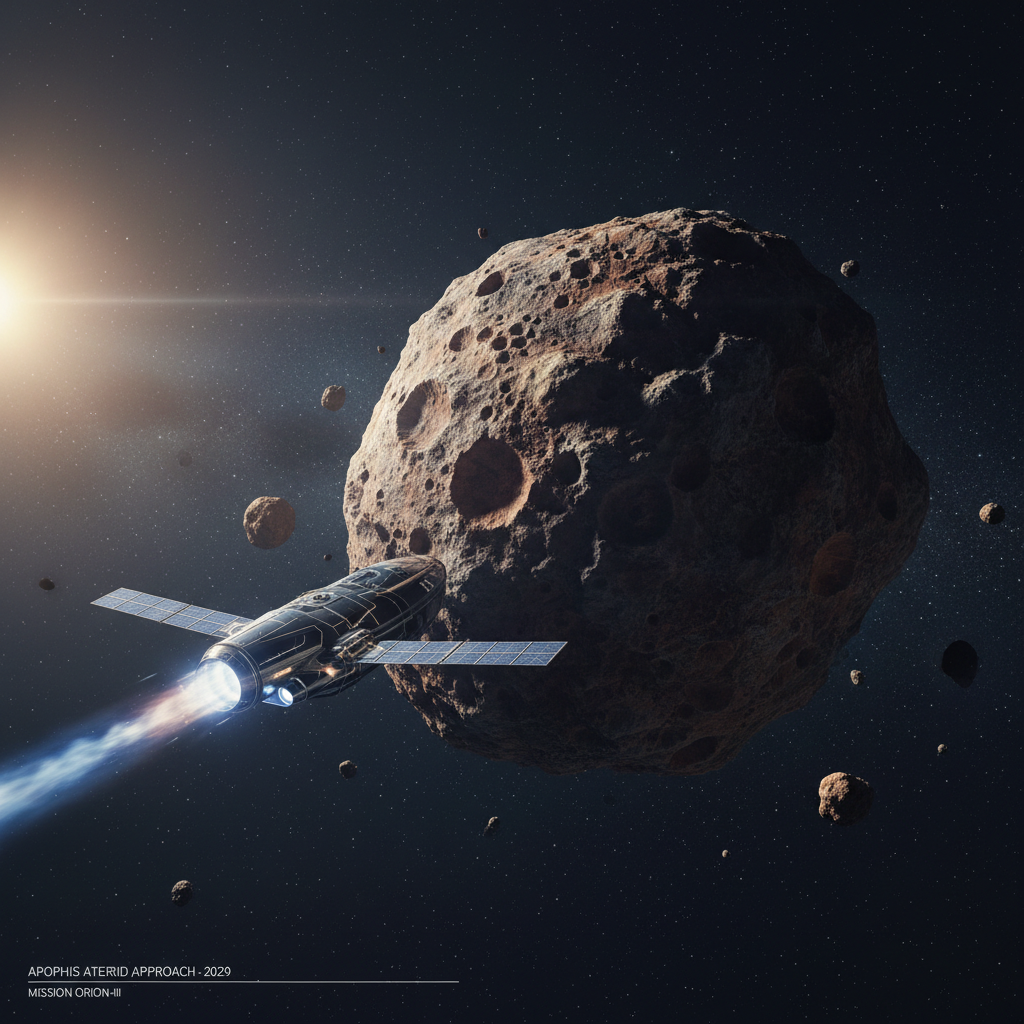
On April 13, 2029, asteroid Apophis will make an incredibly close but completely safe pass by Earth. At its nearest point, the asteroid will travel approximately 20,000 miles (32,000 kilometers) above Earth's surface—closer than many of the satellites we rely on every day.
To put that into perspective:
➜ Apophis is roughly 1,100 feet (340 meters) wide.
➜ It is larger than the Eiffel Tower.
➜ It will pass closer than many geostationary satellites.
➜ Scientists estimate an object this large comes this close to Earth only once every 5,000 to 10,000 years.
For skywatchers, this will be a once-in-a-lifetime event. For scientists, it may be a once-in-human-history opportunity.
From Planetary Threat to Scientific Treasure
When Apophis was discovered in 2004, initial calculations suggested a possible future collision with Earth. The asteroid was even named after Apophis, the Egyptian god of chaos.
Years of observations have since eliminated any impact threat for at least the next century. Today, researchers see Apophis not as a danger, but as a natural laboratory for understanding how asteroids behave when they encounter a planet's gravity.
As renowned planetary scientist Daniel Scheeres explained in his research on spacecraft operations around Apophis, the asteroid's close approach creates a unique environment for studying how Earth's gravitational forces influence an asteroid in real time.
NASA Is Already On Its Way
NASA has repurposed its successful OSIRIS-REx spacecraft—best known for collecting samples from asteroid Bennu—for a new mission called OSIRIS-APEX.
The spacecraft will rendezvous with Apophis shortly after the asteroid's Earth flyby and spend months studying changes to its surface, structure, and rotation. Scientists even plan to use the spacecraft's thrusters to stir up surface material, allowing researchers to examine what's hidden beneath the asteroid's outer layer.
According to NASA, Earth's gravity may:
➜ Alter Apophis' orbit
➜ Change its rotation speed
➜ Trigger landslides
➜ Cause surface shaking and seismic activity
➜ Expose material that has remained hidden for millions of years
Europe Wants to Get There First
The European Space Agency (ESA) is developing the Rapid Apophis Mission for Space Safety, better known as RAMSES.
Unlike NASA's mission, RAMSES aims to arrive before Apophis reaches Earth. This will allow scientists to compare the asteroid before and after the flyby, creating a scientific "before-and-after" snapshot of how Earth's gravity reshapes small celestial bodies.
The mission is expected to deploy smaller CubeSats that will conduct close-range observations and potentially provide detailed measurements of Apophis' surface and internal structure.
ESA describes the flyby as a rare opportunity for science, planetary defense, and public engagement unlike anything seen in modern astronomy.
Private Companies Are Joining the Race
Perhaps the most exciting development is that government agencies are no longer the only players involved.
California-based Exploration Labs (ExLabs) is developing the Apophis EX mission, a commercial deep-space expedition designed to rendezvous with the asteroid and deploy scientific payloads during the 2029 encounter. The company is also collaborating with universities and international partners on CubeLander technology that could attempt surface operations on Apophis.
ExLabs co-founder James Orsulak has described Apophis as an opportunity to create a new era of commercial deep-space exploration while helping improve Earth's planetary defense capabilities.
This represents a significant shift in space exploration:
➜ Government agencies are leading large-scale science missions.
➜ Universities are developing experimental spacecraft.
➜ Private companies are entering deep-space exploration.
➜ International partnerships are expanding planetary defense research.
The result is an unprecedented global effort focused on a single asteroid.
What Scientists Hope to Learn
The biggest question isn't whether Apophis will hit Earth—it won't.
The real question is:
What happens to an asteroid when it experiences Earth's gravitational pull this closely?
Researchers hope to discover:
➜ How asteroid surfaces evolve
➜ Whether close flybys trigger asteroid quakes
➜ How asteroid rotation changes over time
➜ How internal structures respond to gravitational stress
➜ Better methods for future asteroid deflection missions
These answers could prove invaluable if humanity ever needs to protect itself from a genuinely dangerous asteroid.
Former NASA astronaut Ed Lu, a leading advocate for planetary defense, has repeatedly emphasized that understanding asteroid behavior before a threat emerges is one of the most important investments humanity can make. Similar perspectives are driving many of the missions planned around Apophis.
More Than an Asteroid
Apophis isn't just another space rock.
It's a rare chance to watch planetary science unfold in real time.
For one brief moment in 2029, humanity will have front-row seats as an ancient asteroid passes closer than many satellites, while an international fleet of spacecraft studies every movement, tremor, and transformation.
What was once called the "God of Chaos" may ultimately become one of the greatest teachers in the history of planetary science.
And when Apophis flashes across our skies in April 2029, it won't be a warning.
It will be a lesson.