The myth of Adapa is an Akkadian story, usually called "Adapa and the South Wind", about a sage of the god Ea's temple at Eridu who is summoned to heaven by the sky god Anu, is offered the bread and water of life, and refuses them on Ea's advice, so that he returns to earth mortal. It is one of the oldest surviving stories that explains why human beings, however wise, do not live forever.
It sits at a crossroads. Assyriologists read it as a Mesopotamian reflection on mortality and on the relationship between a city's priest and its gods. Bible scholars have argued for a century about whether it echoes, or is echoed by, the story of Adam in Genesis. And for readers of Billy Carson, it is one of the clearest texts in which a human being stands at the threshold of immortality and is turned away. This article sets out what the tablets actually say before turning to those readings. For the wider context, start at the Anunnaki topic hub.
What are the sources for the Adapa myth?
The Adapa myth survives on a small number of clay tablets from three different places and periods, none of them complete. Scholars usually call the composition "Adapa and the South Wind"; an ancient catalogue of texts may preserve an older title, "Adapa into heaven".
The longest fragment was not found in Mesopotamia at all, but at Tell el-Amarna in Egypt, in the archive of cuneiform tablets left by the court of Akhenaten in the 14th century BCE. It is catalogued as EA 356. The Amarna archive is overwhelmingly diplomatic correspondence written in Akkadian, the international language of the period; only a few dozen of its roughly 380 tablets are literary or school texts, and Adapa is one of them. Like the other myths in the archive, it is generally thought to have been used to teach Egyptian scribes to read and write cuneiform.
Further fragments come from the library of the Assyrian king Ashurbanipal at Nineveh, from the 7th century BCE. Three had been identified as Adapa material by 1912, and by 2001 five fragments from the library were known. The versions differ in detail.
The oldest tradition is in Sumerian rather than Akkadian. Tablets from Tell Haddad, ancient Me-Turan, in the Diyala region of Iraq, dated to the Old Babylonian period, preserve a Sumerian-language version in which Adapa appears as a ruler of Eridu. The standard modern edition of the whole dossier is Shlomo Izre'el's Adapa and the South Wind: Language Has the Power of Life and Death (Eisenbrauns, 2001).
Who is Adapa?
Adapa is a mortal sage and priest of Ea's temple in Eridu, the city the Sumerians remembered as the first. Ea, the Akkadian name of the Sumerian god Enki, created him and gave him great wisdom, but not eternal life. In the Akkadian story he serves the temple directly: he bakes with the bakers of Eridu, sets the god's table and fishes for the temple's offerings. The site and its temple are covered in depth in Eridu explained: the first city, Enki's temple and kingship descended from heaven.
Outside the myth, Adapa became a byword for wisdom. Some scholars link him with Uanna, the first of the seven apkallu sages, whom the Babylonian priest Berossus, writing in Greek in the 3rd century BCE, called Oannes, a fish-man who taught humanity writing and the arts. The identification is debated: Uanna is pictured as half fish, while Adapa is a fisherman, and the word adapa itself may be an epithet meaning "wise". If Adapa is the first sage, he is the adviser of Alulim, the first king of Eridu in the king lists. In his annals, the Assyrian king Sennacherib says Ea endowed him with knowledge equal to that of "the Sage Adapa". Exorcists invoked his name in their rituals, and incantations from as early as about 1800 BCE use it.
What happens in the story?
The plot of the Akkadian myth runs, in outline, as follows. While Adapa is out on the water fishing for Ea's temple, the south wind blows up and capsizes his boat. In anger he breaks its wing, for the wind is pictured as a bird, and for seven days the south wind does not blow.
Anu, the god of heaven, notices the stillness and asks his vizier Ilabrat why. Ilabrat reports that Adapa, a mortal man, has broken the south wind's wing, and Anu summons him to heaven to answer for it.
Ea prepares his servant for the audience. He tells Adapa to dress in mourning. At the gate of heaven he will meet two gods, Dumuzi and Ningishzida (Gizzida in some translations). When they ask why he mourns, he is to say that two gods have vanished from the land; when they ask which gods, he is to name Dumuzi and Ningishzida themselves. Flattered, they will speak for him before Anu. Ea then gives the warning on which the story turns: Adapa will be offered bread of death and water of death, and must refuse them; he will be offered a garment and oil, and should accept.
Everything happens as Ea predicted, except one thing. The gatekeepers intercede, and Anu's anger cools. But instead of bread and water of death, Anu has the bread of life and the water of life brought out. Adapa, obeying Ea, refuses them. He accepts the garment and anoints himself with the oil.
In the Amarna version, Anu laughs at what Ea has done and asks Adapa why he did not eat or drink. Adapa answers that Ea told him not to. Anu sends him back to earth, still mortal. The broken ending, preserved differently in the fragments, ties his fate to humanity's: it speaks of the illness people will suffer, which the healing goddess Ninkarrak may ease.
Did Ea deceive Adapa?
Whether Ea deliberately deceived Adapa is the central puzzle of the myth, and scholars still argue about it. The text never says what Ea intended.
On one reading, Ea knew exactly what Anu would offer and lied to his servant so that humanity would stay mortal. Supporters point to Anu's reaction: he laughs at Ea's doing, and in some renderings asks why Ea revealed the things of heaven to impure mankind, which sounds like a rebuke to a god who has overstepped.
On the other reading, Ea's advice was sincere. He expected an angry Anu to punish Adapa and did not foresee that the gatekeepers' intercession would turn the punishment into an offer of immortality. Critics of this view note that nothing in the surviving text says Anu ever planned to kill Adapa, but the gaps in the tablets leave room for both. Either way, the story explains why even the wisest servant of the gods remains mortal. The relationship between Ea and the other great gods, often at cross purposes in Mesopotamian myth, is explored in Enki and Enlil: the two brothers of Sumerian myth.
How does the Adapa myth fit with other Mesopotamian stories?
Adapa belongs to a group of Mesopotamian texts concerned with the limits of human life. In the Epic of Gilgamesh, the hero searches for immortality and loses the plant of rejuvenation to a snake. In the Atrahasis epic, the gods create humans to do their labour and later set limits on human numbers and life after the flood. Ea, as Enki, is the god who stands closest to humanity in all three, warning, advising and sometimes protecting. The creation story behind that relationship is covered in the Atrahasis epic explained: the Igigi revolt, the creation of humans and the flood.
What sets Adapa apart is that immortality is not sought but offered, and the refusal comes from obedience rather than failure.
Is Adapa the same as Adam?
The question of whether Adapa and Adam are connected has been argued since the early 20th century and has not been settled. In 1923 the Assyriologist Albert T. Clay saw a resemblance between Adapa and the biblical Adam. Alexander Heidel, in his studies of Babylonian parallels to Genesis, rejected the link, writing that the Adapa legend and the biblical story "are fundamentally as far apart as antipodes".
In 1981 Niels-Erik Andreasen set out the possible parallels: names that sound alike and may share a root; a test that turns on eating food that is said to bring death; and a human summoned before a deity to answer for a transgression. In both stories, the loss of immortality follows.
The differences are just as sharp. Adam eats what he was told not to eat; Adapa refuses what he is offered. Genesis frames the loss as disobedience to God, while the Adapa myth frames it as obedience to a patron god. In Genesis humans gain knowledge by eating; Adapa already has wisdom from Ea and is offered only life. Whether the similar names point to a shared tradition or are coincidence remains an open question, and no direct link has been demonstrated. The wider comparison between Eden and Sumerian tradition is laid out in the Garden of Eden and the Anunnaki explained, which treats Adapa in one section; this article goes further into the tablets themselves.
Billy Carson's reading
Billy Carson reads the Adapa myth as a record of humanity being denied immortality and its divine potential by the Anunnaki. He presents this as his interpretation of the texts, not as the conclusion of Assyriology.
In his reading, Anu's heaven is a real place above the earth rather than a purely mythic realm, and the bread and water of life describe something physical, a means of extending life that the ruling group possessed and withheld. Ea's warning then becomes the key to the story: either Enki kept the human he had made limited, or he was protecting him, the same question scholars ask in different terms. Carson connects this to his wider view, set out in the Eden article, that Genesis 2 and 3 preserve a compressed memory of events recorded more fully in the Sumerian and Akkadian tablets, with Adapa as an earlier telling of the same restriction.
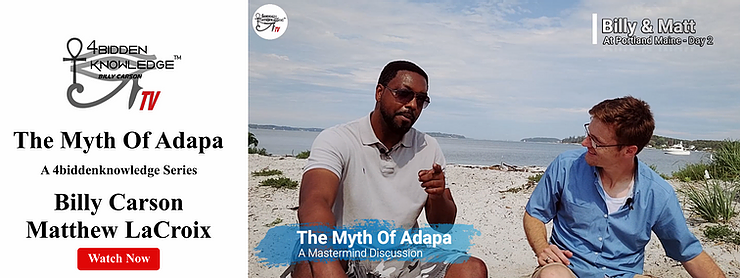
Carson discussed the myth at length with the researcher Matthew LaCroix in a 2021 Mastermind session filmed on an island near Portland, Maine, presented on the site as The Myth of Adapa: Billy Carson and Matt LaCroix. He returned to it with Paul Wallis in the 4biddenknowledge Podcast episode "Bible Gods or Alien Overseers?" (Season 8, Episode 22, 15 September 2025), which lists "the Myth of Adapa and humanity's forgotten divine potential" among its topics.
The tablets themselves do not describe spacecraft, genetics or planets, and the Assyriological reading treats Anu's heaven as the divine realm of Mesopotamian religion. Readers can weigh the scholarly reading, in which the myth explains mortality, against Carson's, in which it records a decision made about humanity.
Watch, read and go deeper
Watch Billy Carson's conversations with Matthew LaCroix on the Matthew LaCroix show on 4BK TV. Listen to Bible Gods or Alien Overseers? with Paul Wallis for Carson's discussion of Adapa alongside the Elohim and Yahweh. For the city where the story is set and the wider Sumerian background, the Anunnaki topic hub collects every related article.
Frequently asked questions
What is the myth of Adapa about?
The myth of Adapa tells how Adapa, a sage of Ea's temple at Eridu, breaks the wing of the south wind and is summoned to heaven by Anu. Warned by Ea to refuse the bread and water of death, he refuses the bread and water of life when Anu offers them. He returns to earth mortal, and the story explains why humans do not live forever.
Where was the Adapa tablet found?
The longest fragment, EA 356, was found at Tell el-Amarna in Egypt among the 14th-century BCE cuneiform archive of Akhenaten's court. Other fragments come from Ashurbanipal's library at Nineveh (7th century BCE), and a Sumerian-language version survives on Old Babylonian tablets from Tell Haddad, ancient Me-Turan.
Is the Adapa myth Sumerian or Akkadian?
Both traditions exist. The best-known version, including the Amarna tablet, is written in Akkadian. An older version in the Sumerian language survives from Tell Haddad. The story is set in the Sumerian city of Eridu.
Did Ea trick Adapa?
Scholars disagree. Some argue that Ea deliberately misled Adapa to keep humans mortal, pointing to Anu laughing at Ea's doing. Others argue Ea genuinely expected Anu to offer deadly food and misjudged the outcome. The surviving text does not settle it.
Is Adapa the biblical Adam?
There is no demonstrated link. Albert T. Clay (1923) compared the two, Alexander Heidel rejected the comparison, and Niels-Erik Andreasen (1981) listed real parallels: similar names, a test involving food, a summons before a god and the loss of immortality. The key difference is that Adam disobeys while Adapa obeys.
Sources and further reading
- Shlomo Izre'el, Adapa and the South Wind: Language Has the Power of Life and Death (Eisenbrauns, 2001), the standard edition and translation.
- Stephanie Dalley, Myths from Mesopotamia: Creation, the Flood, Gilgamesh, and Others (Oxford World's Classics), which includes a translation of Adapa.
- William L. Moran, The Amarna Letters (Johns Hopkins University Press, 1992), on the Amarna archive.
- Alexander Heidel, The Babylonian Genesis (University of Chicago Press), on Mesopotamian parallels to Genesis.
- Niels-Erik Andreasen, "Adam and Adapa: Two Anthropological Characters", Andrews University Seminary Studies 19 (1981).
- Robert W. Rogers, Cuneiform Parallels to the Old Testament (1912), an early English translation.