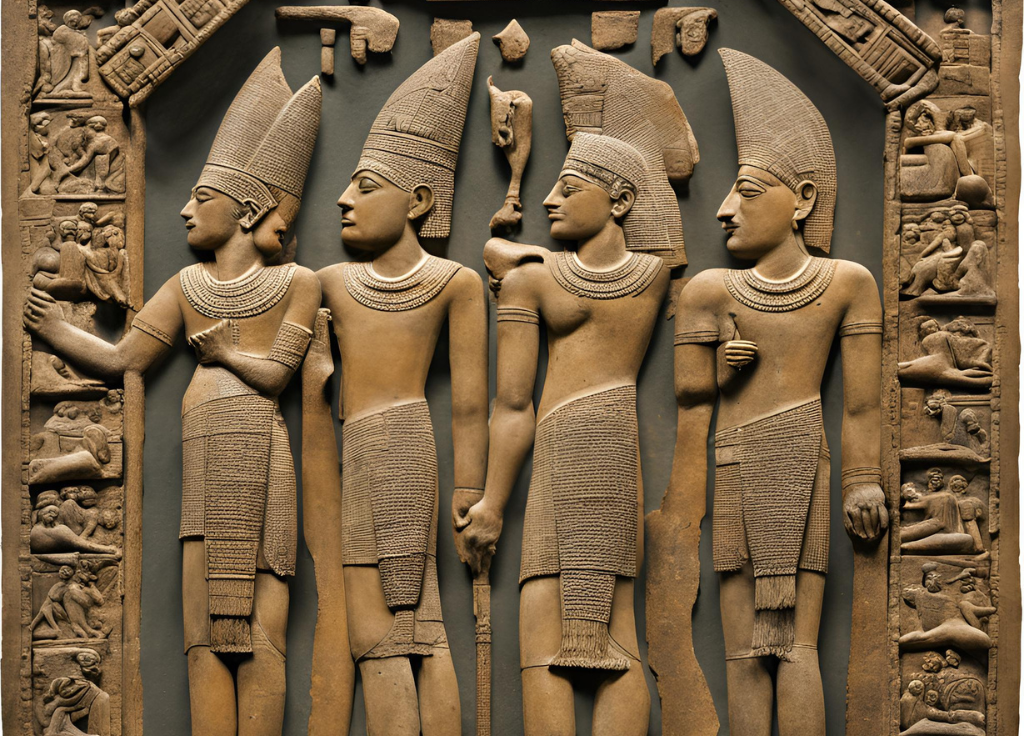
Enki and Enlil are the two most powerful sons of the sky god An in Sumerian myth, and the tension between them runs through almost every major story that survives from Mesopotamia. Enlil, "Lord Wind," is the king of the gods, the ruler of Nippur and the deity who decrees the flood; Enki, "Lord Earth" (Akkadian Ea), is the god of fresh water, wisdom and craft who proposes the creation of humanity and then saves it from that same flood. One brother commands, the other creates.
The pair matters because their rivalry is the frame through which later readers, from Babylonian scribes to modern ancient-astronaut writers, have understood what the Anunnaki wanted from humans. Billy Carson's [Anunnaki: Ancient Secrets Revealed](/watch/anunnaki-ancient-secrets-revealed) series devotes a full episode to Enlil and takes a clear side. Before weighing that reading, it helps to know what the tablets say about each brother, where they disagree, and where the modern retelling departs from them.
Who was Enlil in Sumerian religion?
Enlil was the effective head of the Sumerian pantheon, the god whose word carried the force of law for gods and kings alike. His name is conventionally read as "Lord Wind" or "Lord Air," and his seat was the Ekur, the "Mountain House," at Nippur, the religious capital of Sumer. Nippur was never a political power in its own right, but rulers from Lagash to Ur to Babylon sought Enlil's endorsement there, because kingship was something the gods granted and Enlil was the god who granted it.
Several texts give Enlil the Tablet of Destinies, the object that fixed the fates of the world; in the Akkadian Anzu epic the bird-monster Anzu steals it from him and Enlil's son Ninurta wins it back. In "The Song of the Hoe," Enlil separates heaven from earth and drives his hoe into the ground at Nippur so that the first humans can sprout from the soil like plants. He is a cosmic organizer as much as a ruler.
The myth "Enlil and Ninlil" shows a less flattering side. Enlil takes the young goddess Ninlil against her mother's warning, is judged by the assembly of the gods and banished to the underworld; their children include Nanna, the moon god. The story still ends in praise, which shows how the Sumerians held judgment and reverence for the same god at once.
Who was Enki, and why is he also called Ea?
Enki was the god of the Abzu, the subterranean fresh water that fed springs, marshes and wells, and by extension the god of wisdom, incantation, crafts and clever solutions. His temple was the E-abzu at Eridu, the city that the [Sumerian King List](/the-sumerian-king-list-explained) names as the first place where kingship descended from heaven. In Akkadian he is Ea, and the two names refer to the same figure throughout Babylonian and Assyrian literature.
His myths are the most inventive in the corpus. In "Enki and Ninmah," his mother Nammu rouses him to create workers who will relieve the gods of their labour, and he and the birth goddess shape humans from clay over the Abzu. In "Enki and the World Order" he travels the land assigning functions to rivers, fields, cities and gods. In "Inanna and Enki," Inanna gets him drunk at Eridu and sails off to Uruk with the me, the divine powers of civilisation, while a hungover Enki sends monsters after her boat and fails to get them back.
That last story points to something the texts insist on and modern retellings tend to drop: Enki is a trickster. He is generous, but he is also outwitted, cursed by Ninhursag after eating the plants she grew, and forever finding loopholes in the decisions of the divine assembly rather than confronting them head-on.
Were Enki and Enlil really brothers?
In most traditions both gods are sons of An, which makes them brothers, but the texts are not consistent about it. "Enki and Ninmah" makes Nammu, the primeval sea, Enki's mother. The Babylonian Enuma Elish gives a different genealogy again, with Ea born to Anu in a line descending from Apsu and Tiamat, and Enlil's own ancestry is traced differently in different god lists.
Sumerian religion was not a single system with one authorised family tree. Each city compiled its own theology, and scribes at Nippur naturally placed Enlil at the centre while scribes at Eridu did the same for Enki. The "two brothers" framing is fair as a summary, but it is a summary of several overlapping traditions rather than a fact stated on any single tablet. Readers who want the wider cast of the pantheon can start with [who the Anunnaki were according to the Sumerian texts](/who-were-the-anunnaki-sumerian-texts-vs-ancient-astronaut-theory).
What the Atrahasis flood story actually says
The Old Babylonian epic Atrahasis is the clearest account of the two brothers working against each other, and so much of the modern argument rests on it that it is worth reading closely. The main copy dates to the reign of the Babylonian king Ammi-saduqa in the seventeenth century BC; it is edited in W. G. Lambert and A. R. Millard's Atra-hasis: The Babylonian Story of the Flood and translated in Stephanie Dalley's Myths from Mesopotamia.
In Tablet I, the lesser gods, the Igigi, are worn out digging the rivers and canals and revolt against Enlil, surrounding the Ekur at night. Enki proposes a solution: let the birth goddess, called Nintu, Mami and Belet-ili in the text, create a human being to take on the work. A god is slaughtered, his flesh and blood are mixed with clay, and Mami pinches off fourteen pieces to make seven men and seven women. Humanity exists because Enki suggested it, but he does not make it alone.
Humans multiply, and their noise keeps Enlil awake. He sends plague, then drought, then famine, and each time Enki quietly advises Atrahasis on how to survive. Finally Enlil demands a flood and makes the gods swear an oath not to warn mankind. Enki keeps the letter of his oath by speaking not to Atrahasis but to the wall of his reed house: "Wall, listen to me. Reed wall, observe all my words." Atrahasis builds a boat, survives, and offers a sacrifice that the starving gods crowd around "like flies." Enlil is furious that a human has lived, but the gods settle on a compromise: humanity will continue, with death and infertility as permanent checks on its numbers.
The Sumerian version, often called the Eridu Genesis, tells the same story with Ziusudra of Shuruppak as the survivor, and the flood also appears in Tablet XI of the Epic of Gilgamesh, where Ea says he did not break the oath but merely let Atrahasis see a dream. The sequence, Enlil decides and Enki circumvents, is consistent across all three, and it is the strongest textual basis for the idea that the brothers stood on opposite sides of humanity's fate.
Was Enlil a tyrant or a provider?
Enlil was both, depending on which tablet you pick up, and any honest account has to hold the two together. The flood tradition presents him as impatient and vindictive, and in [Inanna's descent into the underworld](/inanna-s-descent-into-the-underworld-a-sumerian-tale-of-injustice) it is Enlil at Nippur who refuses to help the trapped goddess, and Enki at Eridu who fashions the two creatures that revive her. Those stories are the source of Enlil's modern reputation.
But the hymns tell a different story. "Enlil in the Ekur," available in the Oxford Electronic Text Corpus of Sumerian Literature as Enlil A, calls him the shepherd of the black-headed people and says that without him no city would be built, no settlement founded, no cattle pen or sheepfold made, no king or high priest born. Kings of the Ur III dynasty and later Babylonian rulers built their legitimacy on his favour, and Jacobsen's translations in The Harps That Once show how affectionate the Nippur tradition was toward its patron.
The fairest summary is that the myths dramatise a fear of Enlil's power while the hymns celebrate its benefits. A reader who keeps only the flood story gets a tyrant; a reader who keeps only the hymns gets a benevolent father. The Sumerians kept both.
Where the ancient-astronaut reading comes from
The idea that Enki and Enlil were rival half-brothers in a dynastic power struggle, rather than gods in a religious tradition, comes chiefly from Zecharia Sitchin's The 12th Planet, published in 1976. Sitchin recast the Anunnaki as flesh-and-blood visitors from a planet he called Nibiru, with Enlil as the commander of the Earth mission and Enki as its chief scientist. In his account Enki, the firstborn, was passed over for succession in favour of Enlil, and the resentment between the two lines shaped everything from the creation of humans to the flood.
Sitchin turned the clay-and-blood scene in Atrahasis into a genetic engineering project, with Enki and Ninmah producing a hybrid worker from Anunnaki material and an existing hominid. Mainstream Assyriologists do not accept this. They point out that Sitchin's readings of Sumerian words are not supported by the dictionaries, that "Nibiru" in the cuneiform record is an astronomical term linked to Jupiter and Marduk rather than a planet beyond Pluto, and that the texts describe gods, not astronauts.
What makes his framing durable is the pattern in the texts themselves. Enlil really does decree destruction and Enki really does subvert it. The ancient-astronaut reading is an interpretation laid over a genuine structure in the mythology, which is why it has outlasted its critics' expectations.
Billy Carson's reading
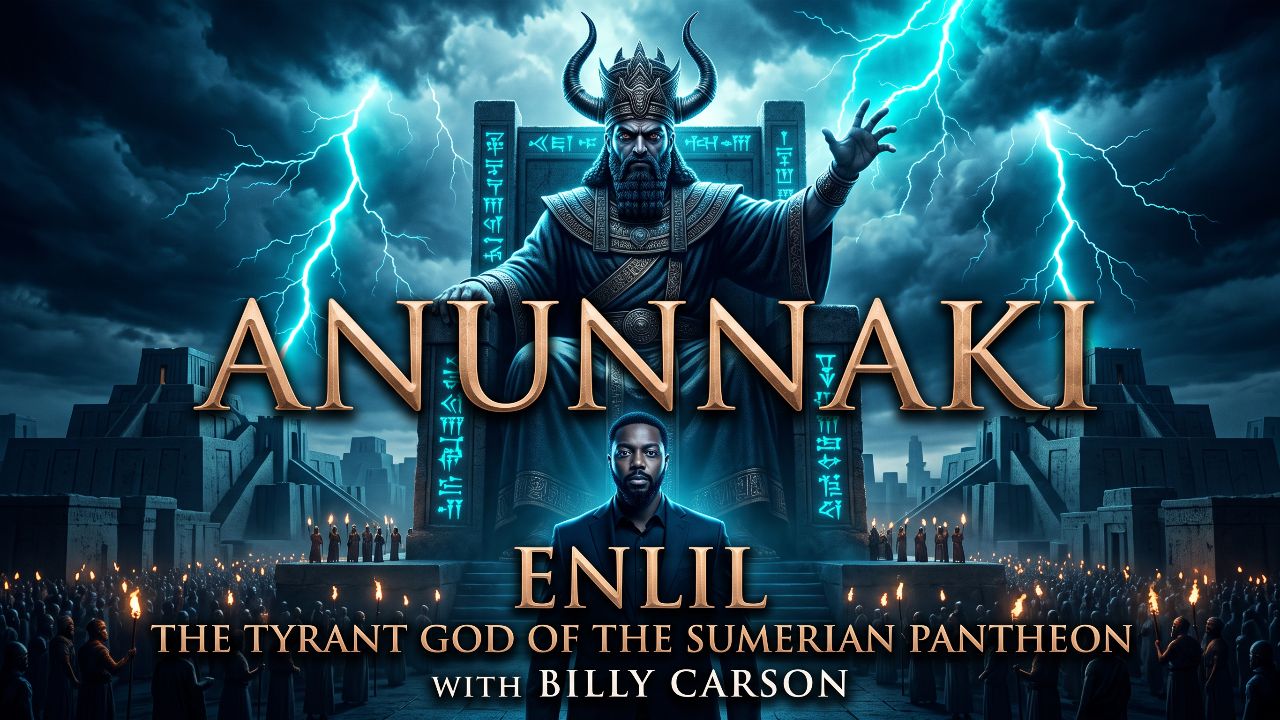
Billy Carson sides with Enki. In his Anunnaki series, episode five is titled "Enlil: the tyrant god of the Sumerian pantheon," and the title is the argument. Carson reads Enlil as an authoritarian ruler who saw humanity as a labour force that had become a nuisance, and Enki as humanity's creator and consistent defender, from the first clay figures in Atrahasis to the warning through the reed wall. In his reading the moral centre of Sumerian myth is not the king of the gods but the god who disobeyed him on humanity's behalf.
Carson builds that case from the same texts discussed above, and he follows Sitchin in treating the brothers as historical actors in a real succession dispute rather than as symbols. He also draws a line from Enki's role as keeper of the me, the arts of civilisation, to the broader theme in his work that ancient knowledge was given to humans and later suppressed. A skeptic will note, fairly, that this depends on privileging the flood narrative over the Enlil hymns, and that the texts never call Enlil a tyrant. A fan will note, equally fairly, that the story the Sumerians told most often about the two brothers is the one in which Enki saves us.
The disagreement is not really about the tablets, which both sides can read. It is about whether the drama in them records theology, politics or memory. Carson argues for memory, and makes the case in full on [4BK TV](/watch/anunnaki-ancient-secrets-revealed).
Watch, read and go deeper
The episode on Enlil sits in the middle of [Anunnaki: Ancient Secrets Revealed](/watch/anunnaki-ancient-secrets-revealed), and it is best watched after the episodes on the Anunnaki arrival and the creation of humanity. For the textual side, Dalley's Myths from Mesopotamia and the free ETCSL corpus at Oxford will let you read Atrahasis, "Enki and Ninmah" and "Enlil and Ninlil" for yourself in an afternoon. The [Anunnaki topic hub](/topics/anunnaki) collects every article on the site about the Sumerian gods, the king list and the flood. To see how a neighbouring civilisation handled the same themes, the [Ancient Egypt hub](/topics/ancient-egypt) covers Khnum, who shaped humans from clay on a potter's wheel, and the rival Egyptian creation accounts.
Frequently asked questions
Were Enki and Enlil brothers or half-brothers?
In most Sumerian traditions both are sons of the sky god An, which makes them brothers. Some texts give Enki a different mother, Nammu, and the god lists are not consistent. The specific claim that they were half-brothers competing for succession comes from Zecharia Sitchin's modern reconstruction rather than from any ancient tablet.
Which brother created humans?
In Atrahasis, Enki proposes creating humans and the birth goddess Mami or Nintu shapes them from clay mixed with the blood of a slaughtered god. In "Enki and Ninmah," Enki and Ninmah make humans together at Eridu. "The Song of the Hoe" gives the credit to Enlil, who breaks open the ground at Nippur so people can grow from it. Different cities told the story differently.
Why did Enlil send the flood?
According to Atrahasis, humanity had grown so numerous and noisy that Enlil could not sleep, and after plague, drought and famine failed to reduce their numbers he ordered a flood. Enki warned one man, Atrahasis, Ziusudra or Utnapishtim depending on the version, so that life could continue.
Is Enlil the same as the God of the Bible?
No scholarly consensus makes that identification. The Mesopotamian flood clearly influenced the Genesis account, and writers in the ancient-astronaut tradition, including Sitchin and Billy Carson, have argued that the biblical God preserves features of Enlil. Mainstream scholars treat the parallel as literary borrowing within a shared Near Eastern culture rather than as the same figure.
What is the Abzu?
The Abzu, or Apsu in Akkadian, is the underground body of fresh water that the Sumerians believed fed springs, rivers and marshes. It was Enki's domain and gave its name to his temple at Eridu. In the Babylonian Enuma Elish, Apsu is also a primeval god whom Ea kills and whose body becomes his dwelling.
Sources and further reading
- W. G. Lambert and A. R. Millard, Atra-hasis: The Babylonian Story of the Flood (Oxford, 1969)
- Stephanie Dalley, Myths from Mesopotamia: Creation, the Flood, Gilgamesh, and Others (Oxford World's Classics)
- Thorkild Jacobsen, The Harps That Once: Sumerian Poetry in Translation (Yale, 1987)
- Samuel Noah Kramer, Sumerian Mythology (1944, revised 1961)
- Samuel Noah Kramer and John Maier, Myths of Enki, the Crafty God (Oxford, 1989)
- Jeremy Black and Anthony Green, Gods, Demons and Symbols of Ancient Mesopotamia (British Museum Press, 1992)
- The Electronic Text Corpus of Sumerian Literature (ETCSL), University of Oxford: "Enki and Ninmah," "Enlil and Ninlil," "Enlil in the Ekur," "The Song of the Hoe," "Inanna and Enki"
- Zecharia Sitchin, The 12th Planet (1976)