For decades, scientists have built increasingly sophisticated detectors in an attempt to answer one enormous question:
What is dark matter?
We can’t see it. We can’t touch it. And so far, we haven’t directly detected the particle—or particles—that make it up.
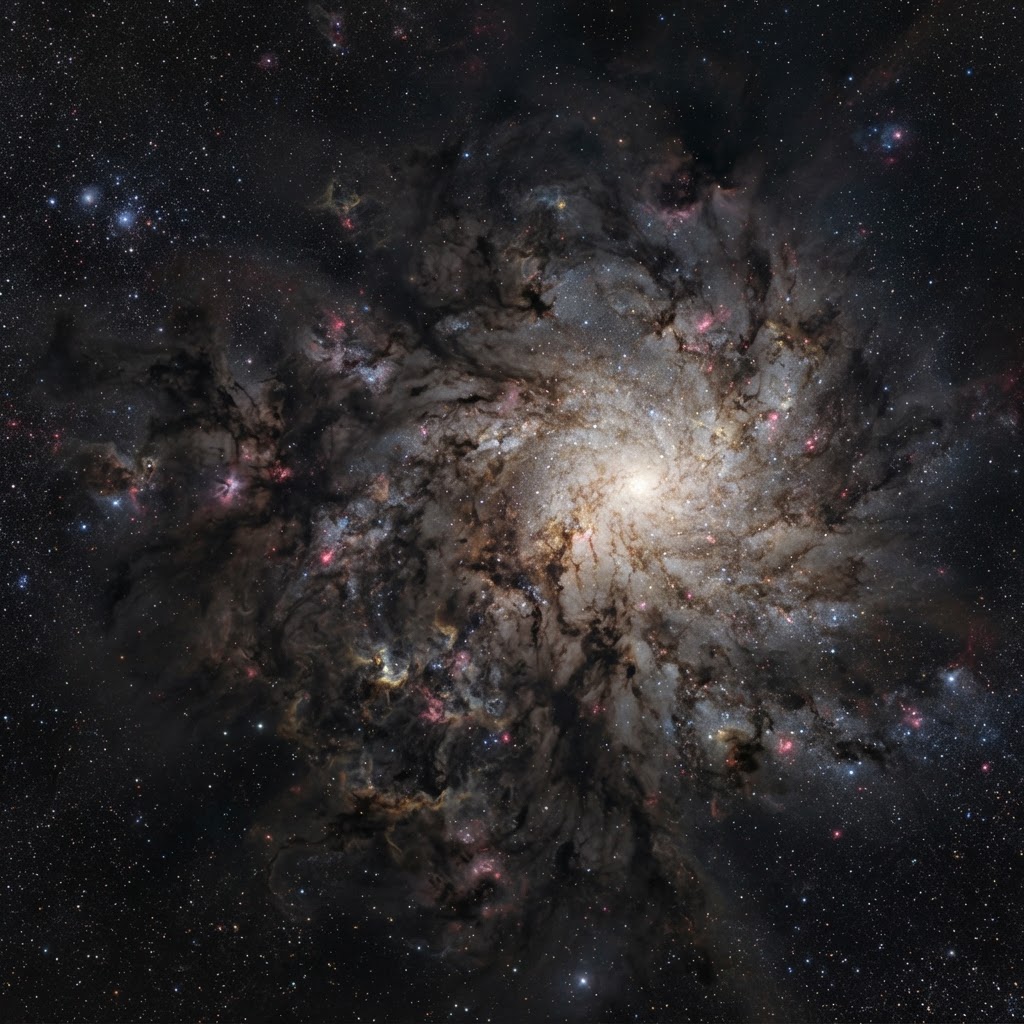
Yet astronomers have strong evidence that something invisible is exerting gravitational influence throughout the universe. Dark matter is thought to account for roughly 85% of all matter, helping explain how galaxies rotate, how galaxy clusters behave and how large-scale cosmic structures formed.
Now, researchers are exploring an unexpectedly old idea that could help in the hunt.
Instead of relying solely on enormous underground detectors or increasingly complex machines, physicists are revisiting experimental techniques connected to Henry Cavendish, whose electrical experiments date back to 1773.
And a modern version could potentially become up to 10,000 times more sensitive in the search for certain forms of dark matter.
In other words, sometimes the next great discovery doesn't require throwing away the past.
Sometimes it requires looking at an old experiment differently.
First, What Exactly Is Dark Matter?
Look at a galaxy and you'll see stars, gas, dust and planets.
But what we can see doesn't appear to provide enough gravitational pull to explain how galaxies behave.
Stars orbiting far from the centers of galaxies can move much faster than expected based only on visible matter. Observations of galaxy clusters, gravitational lensing and the structure of the universe also point toward large quantities of unseen mass.
Scientists gave that mysterious component a simple name:
Dark matter.
The problem is that "dark matter" describes what it seems to do—not necessarily what it actually is.
Researchers have proposed numerous candidates over the years, including:
→ Weakly interacting massive particles, or WIMPs
→ Axions and axion-like particles
→ Ultralight dark matter
→ Sterile neutrinos
→ Other hypothetical particles beyond the Standard Model of particle physics
One especially interesting possibility involves particles carrying an incredibly tiny electric charge. These hypothetical particles are often called millicharged particles.
And that's where an experiment from the 1700s suddenly becomes relevant again.
The Cavendish Connection
Henry Cavendish was one of the most influential experimental scientists of the 18th century.
He studied electricity, gases and gravity, and his surviving scientific work includes a substantial collection of electrical experiments conducted in 1773. Those experiments were later edited and published with the involvement of legendary physicist James Clerk Maxwell.
Cavendish became particularly famous for extraordinarily sensitive measurements.
His later 1798 gravitational experiment used a torsion balance to measure the tiny gravitational attraction between masses. Variations of torsion-balance technology are still used in precision physics today.
Think about that for a second.
We are searching for an unknown component of the modern universe using principles developed when the United States was barely becoming a country.
But the new dark-matter proposal isn't simply repeating Cavendish's old work.
Researchers are asking what happens when the basic concept is redesigned using modern physics and modern instrumentation.
A Tiny Charge Could Leave a Detectable Footprint
In July 2026, researchers published work in Physical Review Letters examining how Cavendish-style tests of Coulomb's law could search for millicharged particles.
Their idea centers on a fascinating possibility.
If certain millicharged particles exist around Earth—either because they represent a component of dark matter or because they're produced when cosmic rays interact with Earth's atmosphere—electrically charged experimental equipment could potentially accumulate them.
That accumulation could make an otherwise incredibly weak signal much easier to detect.
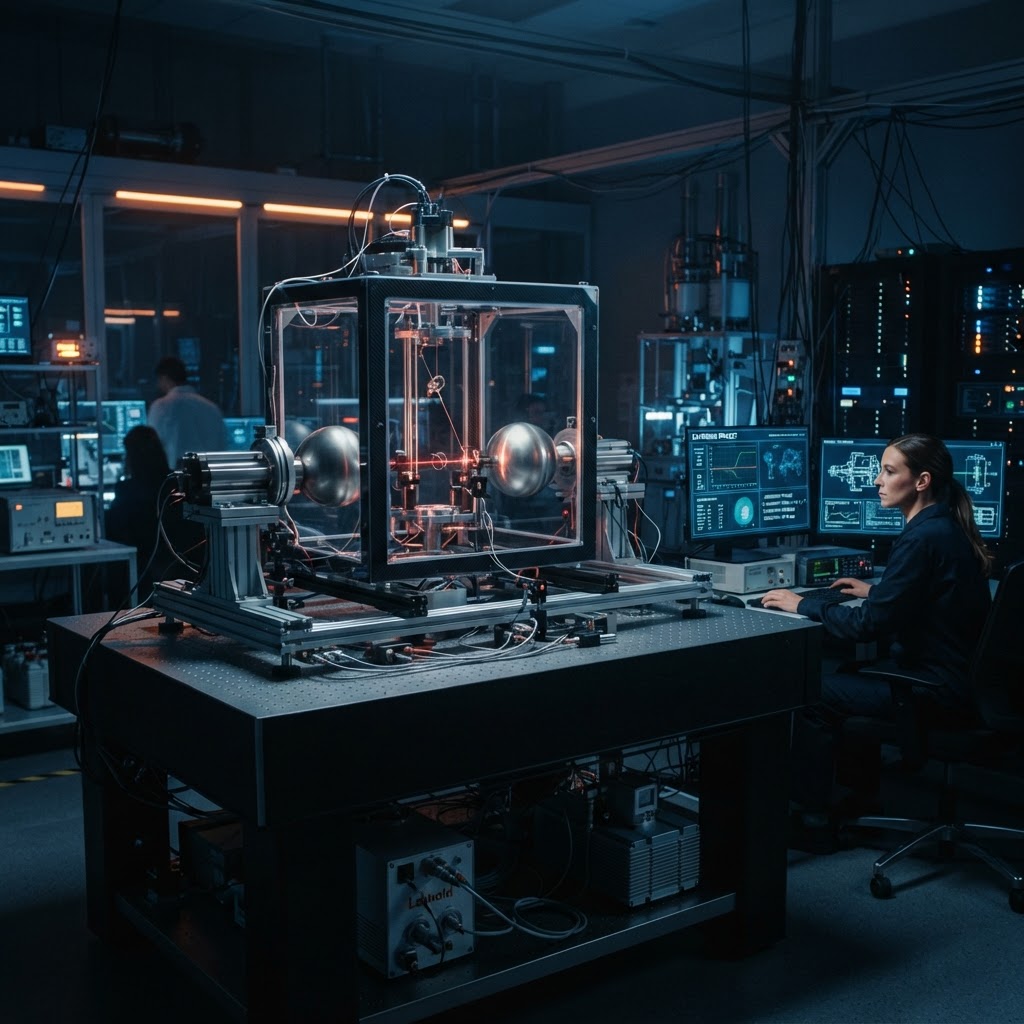
The researchers propose surrounding a Cavendish-style experiment with an additional charged shell.
That sounds deceptively simple.
But theoretically, it could dramatically increase the concentration of these elusive particles near the detector.
More particles nearby means a stronger potential signal.
And a stronger signal means scientists don't necessarily need to build an impossibly sensitive detector to find them.
The basic idea looks something like this:
Possible millicharged particles exist around Earth
↓
A charged shell attracts and accumulates them
↓
Their local concentration increases
↓
A Cavendish-style experiment searches for their electrical effects
↓
Scientists look for deviations that ordinary physics cannot explain
The researchers argue that even technology developed decades ago could, under certain conditions, outperform future accelerator searches for millicharged particles with masses below a billion electron volts.
That's a remarkable possibility.
Why 10,000 Times More Sensitive Matters
Dark matter experiments face a frustrating problem.
The signal scientists are looking for may be unbelievably small.
That means experiments often have to isolate themselves from vibrations, electromagnetic interference, radiation, temperature fluctuations and countless other sources of noise.
But increasing sensitivity by several orders of magnitude changes the game.
Reports on the proposed Cavendish-inspired approach suggest it could potentially achieve sensitivity improvements of around 10,000 times for the relevant dark-matter search.
That's not simply making the same experiment slightly better.
It's potentially opening an entirely different region of particle physics to investigation.
And there is another advantage:
The underlying technology isn't exotic.
Instead of waiting decades for an enormous new collider or detector to be constructed, researchers may be able to adapt experimental methods whose foundations have already been understood for generations.
Cavendish-Style Experiments Are Already Entering the Dark Matter Conversation
This isn't the only recent research connecting old precision experiments with modern dark-matter physics.
In March 2026, Shigeki Matsumoto, Jie Sheng, Chuan-Yang Xing and Lin Zhu published research in Physical Review Letters showing that torsion balances could directly probe extremely light—or sub-electronvolt—dark matter.
Their analysis points to something important.
If very light dark-matter particles are abundant throughout our galaxy, enormous numbers of them could continuously interact with ordinary objects.
One interaction would be essentially impossible to notice.
But huge numbers of coherent or repeated interactions could potentially produce a measurable acceleration.
And torsion balances are exceptionally good at measuring tiny forces.
In fact, the researchers found that existing torsion-balance experiments originally designed to test fundamental principles of gravity already place powerful limits on certain dark-matter interactions.
So equipment designed to answer one question may have quietly been collecting information about another.
Why Scientists Keep Returning to the Torsion Balance
The beauty of a torsion balance is its sensitivity.
A basic version uses a horizontal beam suspended by an extremely thin fiber. When an incredibly small force acts on masses attached to the beam, the fiber twists.
Scientists measure that tiny rotation.
And when I say tiny, I mean tiny.
Modern demonstrations of Cavendish-style gravitational balances can detect forces smaller than one-billionth of a newton.
The fundamental gravitational constant, G, is notoriously difficult to measure precisely because gravity is extraordinarily weak at laboratory scales. NIST notes that this weakness is one reason measurements of G remain so challenging.
But that's exactly why torsion balances are interesting for dark matter.
If you're searching for something that barely interacts with ordinary matter, you want an instrument designed to notice when nature whispers.
We May Have Been Looking for Dark Matter in Too Narrow a Way
For years, a major part of the dark-matter search focused on relatively heavy particles such as WIMPs.
Scientists built huge underground experiments hoping a dark-matter particle would collide with an atomic nucleus and produce a detectable signal.
Those searches have become extraordinarily sensitive.
But there still hasn't been a universally accepted direct detection of dark matter.
That doesn't necessarily mean dark matter particles don't exist.
It could mean we're searching in the wrong mass range.
Or looking for the wrong interaction.
Or using the wrong type of detector.
The newer research reflects a broader shift toward exploring lighter and more weakly interacting dark-matter candidates.
Axions are another example. Experiments around the world are developing new ways of converting or amplifying hypothetical axion signals using electromagnetic fields, resonators and specially designed materials. Yale's ALPHA experiment, for example, is developing an "axion radio" approach using tunable plasma structures and powerful magnetic fields.
Dark matter may not announce itself with one spectacular collision.
Its presence could appear as a tiny force.
A strange electrical effect.
A nearly invisible acceleration.
A persistent deviation from what established physics predicts.
The Experiment Doesn't Prove Dark Matter Exists
There is an important distinction here.
Scientists have not discovered dark matter with Cavendish's experiment.
The recent work shows that updated Cavendish-style experiments could provide an unusually sensitive way to search for specific hypothetical particles.
That's exciting, but it's not the same thing as detection.
Researchers would still have to:
→ Build and calibrate the improved experiment
→ Control environmental and electromagnetic interference
→ Identify possible background signals
→ Reproduce any unexpected result
→ Determine whether conventional physics could explain it
→ Have independent teams confirm the finding
Extraordinary sensitivity can reveal new physics.
It can also reveal incredibly tiny experimental problems.
That's why independent verification would be crucial.
An Experiment Nearly Three Centuries Old Could Help Answer a Cosmic Mystery
There is something almost poetic about this research.
Henry Cavendish performed electrical experiments in 1773, long before scientists understood atoms in their modern sense.
He didn't know about electrons.
He didn't know about galaxies beyond the Milky Way.
Quantum mechanics didn't exist.
Einstein wouldn't be born for another century.
Dark matter wasn't even a concept.
Yet the experimental philosophy behind his work—isolating incredibly small effects and measuring them with extreme precision—remains relevant to some of the biggest questions in physics.
Today, researchers are combining that philosophy with modern theories of dark matter.
And they may be able to transform a centuries-old experimental concept into an extraordinarily powerful particle detector.
That's one of the fascinating things about science.
Progress doesn't always move in a straight line.
Sometimes we build bigger machines.
Sometimes we invent entirely new technology.
And sometimes we open an old notebook and realize that an experiment designed centuries ago was asking a question we weren't ready to understand yet.
The Bigger Question
If Cavendish-inspired experiments eventually detect evidence of millicharged particles—or another form of dark matter—the implications would reach far beyond one laboratory result.
It could provide evidence of physics beyond the Standard Model.
It could reveal an entirely new family of particles.
And it could bring us closer to understanding the invisible matter that appears to surround galaxies, stars, planets—and us.
For nearly 250 years, Cavendish's experiments have been part of the history of physics.
They may not be finished making history.