 Billy's Colloidal Silver + Starfire Gold duo —
Most of us experience time like a straight road.
You wake up. You make choices. Tomorrow arrives after today.
Simple.
But deep inside the equations of modern physics, scientists have uncovered something unsettling: certain regions of the universe may allow the future to influence the past.
Not metaphorically. Not spiritually. Mathematically.
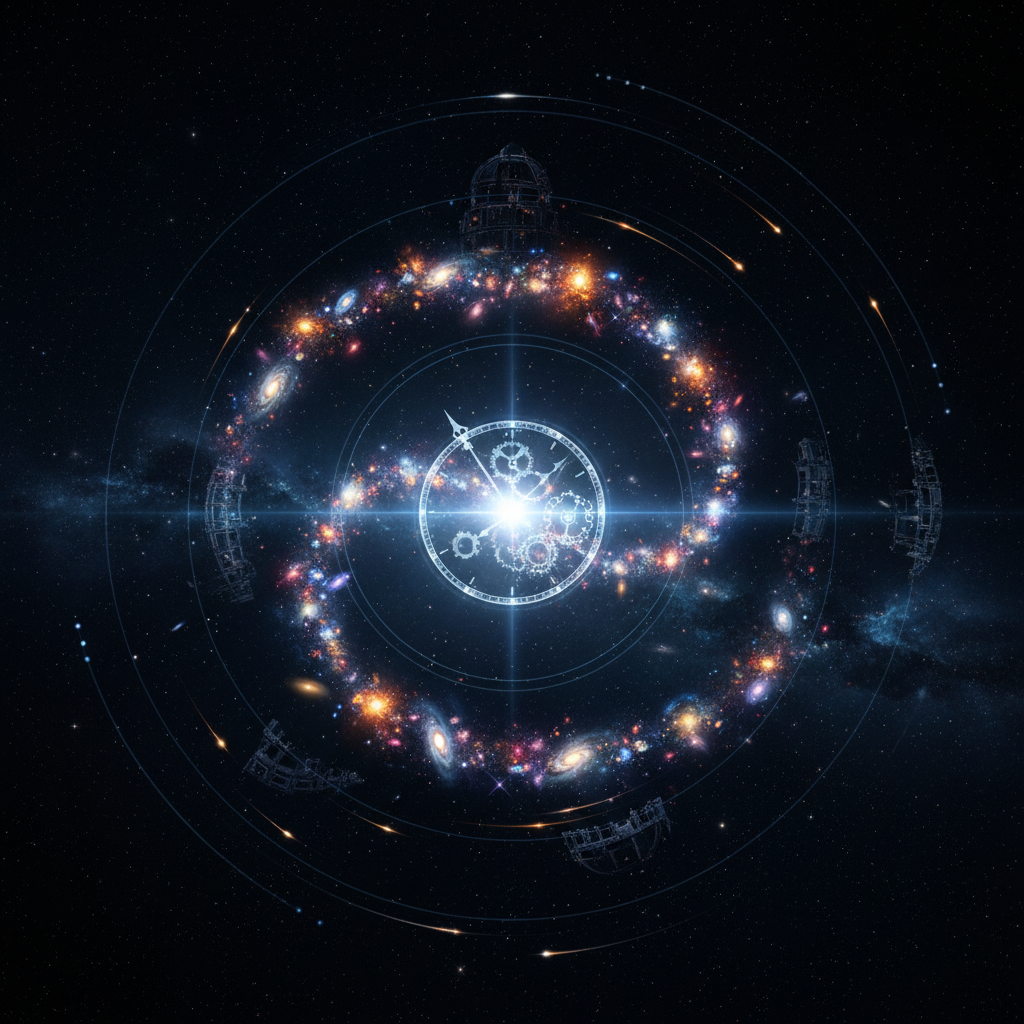
Some physicists believe there could be hidden “pockets” in spacetime where cause and effect stop behaving normally — where time folds back on itself like a cosmic snake eating its own tail.
And the strangest part?
The math says it might actually work.
The Universe Doesn’t Treat Time the Way Humans Do
Humans think of time as fixed and flowing in one direction.
Physics doesn’t.
According to Albert Einstein and his Theory of Relativity, time is flexible. Gravity can stretch it. Motion can slow it down. Massive objects can bend it.
In Einstein’s universe, spacetime behaves more like fabric than a clock.
→ The stronger the gravity, the slower time moves → The faster you travel, the more time distorts → Space and time are connected as one system
This idea alone shattered humanity’s traditional understanding of reality.
But later physicists pushed the concept even further.
Some discovered equations suggesting that under extreme conditions, spacetime might curve so dramatically that time itself loops backward.
These theoretical structures are called:
→ Closed Timelike Curves (CTCs)
A closed timelike curve is essentially a path through spacetime that returns to its own past.
In plain English?
You could theoretically travel forward and end up earlier than where you started.
The Physicist Who Proposed Rotating Universes
In 1949, mathematician and physicist Kurt Gödel shocked the scientific world when he presented a strange solution to Einstein’s equations.
Gödel proposed a rotating universe.
Inside this universe, spacetime twists in such a way that time travel becomes mathematically possible.
Not science fiction. Actual mathematics.
Gödel wrote:
“By making a round trip on a sufficiently wide curve… it is possible to travel into any region of the past, present, and future.”
Einstein himself was deeply disturbed by the implication.
Because if Gödel’s equations were correct, then the laws of physics did not forbid movement into the past.
That realization cracked open one of the biggest philosophical questions in science:
→ Is the future already influencing reality?
Quantum Physics Makes the Situation Even Stranger
Things become even more bizarre once quantum mechanics enters the conversation.
At the quantum level, particles behave in ways that appear to ignore ordinary cause-and-effect logic.
One of the most famous examples comes from physicist John Wheeler and his “Delayed Choice Experiment.”
The experiment suggested something astonishing:
→ A particle’s behavior in the present can appear to determine what it “did” in the past.
Read that again.
Depending on how scientists measure a photon after it travels through an apparatus, the photon behaves as if it had already “known” what future measurement was coming.
This does not necessarily mean humans are rewriting history.
But it does suggest that at quantum scales, the boundary between past and future may not be as rigid as we assume.
Physicist Richard Feynman once described antimatter mathematically as particles moving backward through time.
Even today, some interpretations of quantum mechanics continue exploring whether retrocausality — effects occurring before causes — may genuinely exist.
Could Wormholes Connect Different Moments in Time?
Another major theory involves wormholes.
A wormhole is a hypothetical tunnel connecting two separate points in spacetime.
Think of spacetime like a sheet of paper.
Normally, traveling from one point to another means crossing the entire page.
But if you fold the paper, two distant points suddenly touch.
That shortcut is essentially what a wormhole represents.
Physicists like Kip Thorne studied whether wormholes could theoretically become time machines.
The idea works like this:
→ One side of the wormhole experiences time differently due to gravity or speed → The two ends become desynchronized → Entering one side could allow exit into another point in time
The math, surprisingly, does not immediately reject this possibility.
The real problem is stability.
Scientists believe wormholes would require “exotic matter” with negative energy to remain open — something humanity has never successfully harnessed at usable scales.
Still, the equations remain on the table.
And physics has a dangerous habit of turning impossible ideas into future technology.
The Grandfather Paradox Problem
Of course, time travel creates terrifying logical problems.
The most famous:
→ What happens if someone travels into the past and prevents their own existence?
This is known as the Grandfather Paradox.
Physicist Igor Novikov proposed a possible solution called the Novikov Self-Consistency Principle.
According to this idea:
→ Events in time loops are self-correcting → You cannot create contradictions → Anything you do in the past was already part of history
In other words:
If time travel exists, reality may prevent paradoxes automatically.
The universe would “protect” consistency.
That concept sounds like science fiction, but it emerges directly from attempts to mathematically stabilize time-travel scenarios.
Black Holes May Hold the Biggest Clues
Many scientists suspect black holes could be connected to these strange time effects.
Near a black hole:
→ Gravity becomes extreme → Time slows dramatically → Spacetime bends toward infinity
Some theoretical models suggest rotating black holes, called Kerr black holes, may contain regions where spacetime curves back into itself.
Inside these regions, ordinary rules about past and future could break down entirely.
Physicist Roger Penrose and physicist Stephen Hawking spent decades debating whether nature ultimately permits these bizarre structures.
Hawking even proposed the “Chronology Protection Conjecture,” essentially arguing that the universe itself may prevent time travel before paradoxes can form.
In classic Hawking fashion, he joked that if time travel were possible:
“Where are the tourists from the future?”
Fair point.
So… Can the Future Actually Affect the Past?
Right now, science does not have a definitive answer.
But modern physics has revealed something important:
→ The universe is far stranger than human intuition.
The deeper scientists explore spacetime, quantum mechanics, and gravity, the more reality begins to resemble something fluid instead of fixed.
Some equations allow backward causation. Some experiments hint at retroactive behavior. Some theories suggest time may not fundamentally “flow” at all.
Instead, past, present, and future could all coexist inside a larger structure humans barely understand.
Physicist Carlo Rovelli argues that time itself may emerge from relationships between events rather than existing as a universal ticking clock.
If true, humanity’s entire perception of reality may be incomplete.
Not wrong.
Just unfinished.
Final Thoughts
The idea that the future could influence the past sounds impossible because human brains evolved for survival — not for understanding relativistic spacetime or quantum causality.
But science has repeatedly shown us that reality does not care what feels intuitive.
The Earth moves. Time stretches. Space bends. Particles exist in multiple states at once.
And somewhere in the mathematics of the cosmos, hidden deep inside warped spacetime and quantum uncertainty, the future may already be touching the past.
Quietly. Constantly. Waiting for us to understand it.