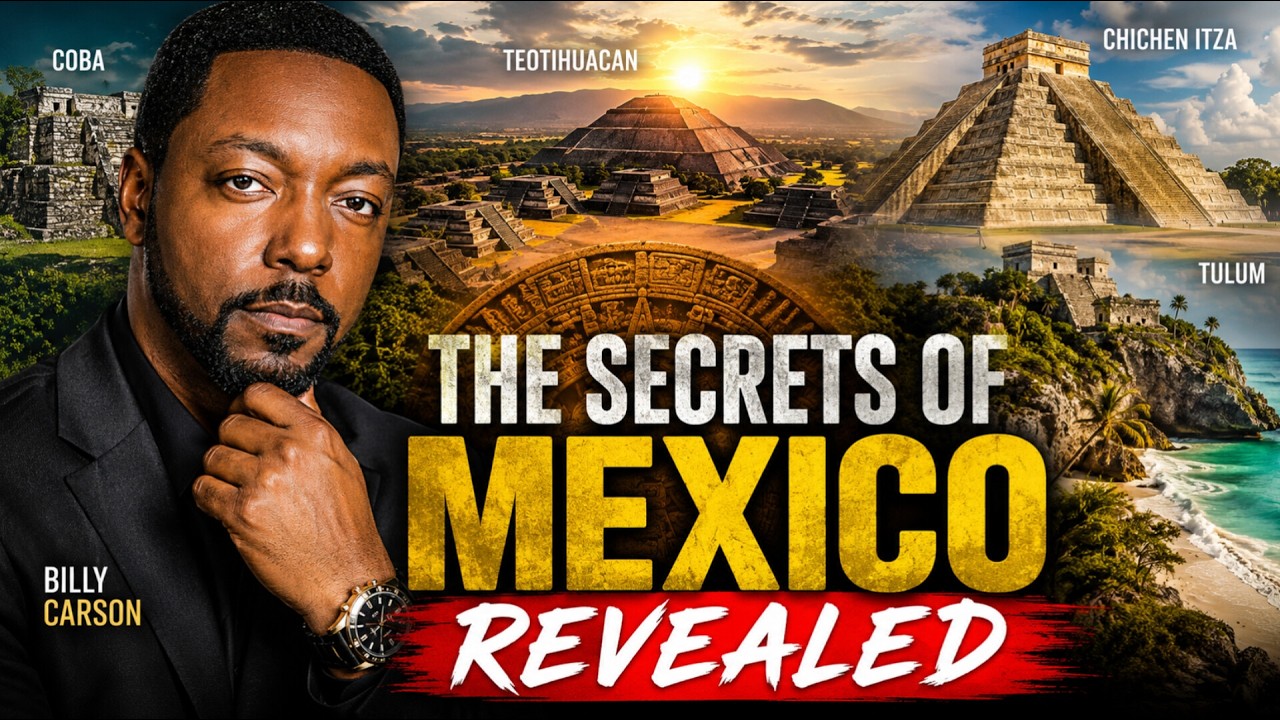
In this live pop-up podcast, Billy Carson argues that Teotihuacan, the great pyramid city north of Mexico City, was founded by Thoth, the Egyptian god of wisdom he calls Tehuti, and that its name means "the city of Tehuti." He links the Pyramid of the Sun, the Pyramid of the Moon and the Avenue of the Dead to Giza, to Orion's Belt, to the goddess Maat and to sites in China and Australia, presenting them as one blueprint from one architect.
The topic matters because Teotihuacan is one of the largest ancient cities of the Americas, and its builders left no deciphered writing that names them. That silence has made it a magnet for diffusionist theories, and Carson's version is among the most widely shared, so it is worth setting out what he says and where the archaeological record stands.
Watch the video
What the video covers
A first trip to Mexico (from about 11:10)
Carson first tells how his exploring began. Roughly 28 years ago he flew to Cancun with $700 in cash, changed $500 into pesos, spread the notes on his hotel bed believing he was rich, and learned otherwise at lunch. After a bus ride through the jungle he watched El Castillo, the pyramid of Kukulkan at Chichen Itza, rise into view and decided "this is all I want to do for the rest of my life." Growing up, he says, "I didn't have any black people to look up to on TV," so the trip took courage his circle did not share. As he puts it, "a mind once stretched can never go back."
The "city of Tehuti" and why Thoth went west (from about 30:50)
Carson's central claim is that the name Teotihuacan translates as the city of Tehuti, the African deity the Egyptians knew as Thoth. To explain why Thoth went to Mesoamerica, he turns to the Sumerian material. In his reading, Enki told his son, known in Sumerian as Ningishzida, that he was fighting too many battles with his brother Marduk and should go west and build a new civilization. Thoth then founded Teotihuacan and the surrounding cities, and the same culture ran down through Chichen Itza to Peru and Bolivia. Carson notes that Marduk appears in the Bible, and he does: Jeremiah 50:2 names him as Merodach. The Thoth-Ningishzida-Quetzalcoatl storyline itself comes from Zecharia Sitchin's The Lost Realms rather than from any Sumerian tablet.
The Emerald Tablets and Giza (from about 33:15)
As evidence, Carson cites the Emerald Tablets, in which Thoth is told to "build ye a great pyramid," and dates the text to 36,000 to 40,000 years ago. He says the Sphinx once bore Thoth's face but was recarved with the face of Marduk's son. He then lists findings he says the tablets anticipated: the chamber above the Grand Gallery found by muon scanning, an object about a mile beneath the Sphinx found by ground-penetrating radar (with a Discovery Channel broadcast, he says, cancelled as it went live), the 2025 radar claims of columns beneath the Giza plateau, and a "second Sphinx." The 2017 ScanPyramids "Big Void" is real and was published in Nature; the mile-deep object and the cancelled broadcast are his account and have no published source; the 2025 claims by Corrado Malanga and Filippo Biondi were not peer-reviewed and are disputed by specialists.
One blueprint, three sites (from about 36:00)
The bases of the Great Pyramid and the Pyramid of the Sun are, Carson says, the same size. Both sites have three main pyramids aligned with Orion's Belt. Both sit on aquifers, and running water under stone, he argues, produced piezoelectric power, making the pyramids power generators. He extends the pattern to three pyramids near Xi'an and identifies Thoth with Huangdi, the Yellow Emperor, who he says arrived on a flying dragon and brought writing. Mercury was found under the Chinese pyramids and a river of mercury under Teotihuacan, he says, while Giza generated hydrogen. His conclusion: "We're talking about the same blueprint coming from the same architect."
Some of this holds and some needs correcting. The bases are close (the Great Pyramid is about 230 metres per side; surveys of the Pyramid of the Sun range from roughly 215 to 230 metres), but the Sun pyramid stands about 65 to 71 metres tall against the Great Pyramid's original 146 metres. In 2015 Sergio Gómez's team really did find liquid mercury at the end of a tunnel beneath the Temple of the Feathered Serpent, sealed for about 1,800 years. The mercury associated with Xi'an belongs to the tomb of Qin Shi Huang, the First Emperor, which the historian Sima Qian described as holding rivers of mercury, not to Huangdi. In Chinese tradition Huangdi ascends to heaven on a dragon at the end of his reign, and writing is credited to his minister Cangjie.
The Pyramid of the Moon, Maat and an Australian petroglyph (from about 40:45)
Carson says Thoth built the Pyramid of the Moon for his wife Maat, who wrote the 42 laws of Maat, and that the structure is eight pyramids stacked on top of each other, fitting for Thoth as god of the Eight. Excavations by Saburo Sugiyama and Rubén Cabrera found seven superimposed construction phases, about 100 to 400 CE. Thoth was lord of Khemenu, the "Eight Town" (Hermopolis) of the Ogdoad, and some traditions pair him with Maat.
In the Australian Outback, he says, Aboriginal elders showed him a large ground engraving of a being riding through the sky on a craft, a figure the elders named, as Billy heard it, "Tothamabi." Beneath it, a woman holds a kangaroo's leg, which the elders said means she is holding on to the law. Carson reads the pair as Thoth and Maat, and says the elders did not know the connection until he told them. He adds his view that the Ten Commandments were extracted from the 42 laws of Maat.
A cosmic map, the Vatican and the Serapeum (from about 48:30)
Carson describes Teotihuacan as a cosmic map, with the Avenue of the Dead reflecting the sky on the ground: as above, so below. He also says St Peter's Square in Rome copies Teotihuacan's layout, with an Egyptian obelisk at its centre. Bernini designed the colonnade between 1656 and 1667; the obelisk was brought from Egypt by Caligula in 37 CE and moved into the square in 1586. His favourite site in Egypt is the Serapeum at Saqqara, which he calls the Halls of Amenti, with megalithic boxes he describes as radioactive diorite that register on his Geiger counter.
Tula and the vanishing Kukulkan (from about 53:40)
At Tula, Carson stood atop what he calls the pyramid of Kukulkan, crowned by Toltec figures he reads as holding technological devices. His guides told him Kukulkan would stand in a niche at the back, place something in a notch and vanish, returning years later. He ends with advice to "travel while it is still legal," citing roped-off areas at Machu Picchu, which now routes visitors along fixed circuits for conservation.
Key takeaways
- Carson argues that Teotihuacan means "city of Tehuti" and that Thoth founded it after leaving Egypt.
- His account of why Thoth went west follows Zecharia Sitchin's reading of Enki, Marduk and Ningishzida.
- He presents Giza, Teotihuacan and Xi'an as one design linked by bases, Orion and aquifers.
- The 2015 find of liquid mercury beneath Teotihuacan's Temple of the Feathered Serpent is real.
- He ties the Pyramid of the Moon and an Aboriginal engraving to Thoth and Maat and her 42 laws.
Billy Carson's reading
Carson's interpretation rests on a single figure moving across the ancient world. For him, Thoth is the master architect of the Great Pyramid, and any site that shares its proportions, star alignment or siting over water carries his signature. So he reads Teotihuacan as a western colony of Kemet, Huangdi as Thoth in China, and an Outback engraving as Thoth and Maat in Australia. His background on Thoth draws on the Emerald Tablets and the figure of Hermes Trismegistus, covered in the site's guide to who Thoth was, and his emphasis on Maat follows from his readings of the 42 laws of Maat. He holds the view because, he says, the dots only connect once you have stood at each site; he calls his case circumstantial, and it is cumulative by design.
What mainstream scholarship says
Archaeologists date Teotihuacan from about 100 BCE, with its great monuments built by around 250 CE and the city declining after about 550 CE. It was a multi-ethnic Mesoamerican city with migrant neighbourhoods from Oaxaca and the Gulf Coast. "Teotihuacan" is a Nahuatl name given by the Aztecs centuries after the city fell, usually glossed "place where the gods were created"; the city's own name is unknown, though Classic Maya texts appear to refer to it as a "place of reeds." There is no archaeological link to Egypt or Sumer, and the Orion's Belt correlation began with Robert Bauval's 1994 theory about Giza; the Teotihuacan version is a fringe extension. The pyramid power-plant idea comes from Christopher Dunn's The Giza Power Plant and is not accepted by Egyptologists.
On the details: the 42 "laws" are the 42 declarations of innocence in spell 125 of the Book of the Dead, spoken by the deceased before 42 judges, not a code written by Maat. Scholars note moral overlaps with the Ten Commandments but no demonstrated borrowing. The Serapeum boxes are granite and basalt sarcophagi for the Apis bulls, and no radiation anomaly has been published. Tula's Pyramid B is topped by the Atlantes, Toltec warriors holding atlatls and incense pouches, and Tula's legends centre on the ruler Topiltzin Quetzalcoatl, who left the city and was expected to return. Similarities between pyramids worldwide are usually explained by the stability of the shape, not a single architect.
Watch, read and go deeper
Start with the guide to Teotihuacan, the city of the gods. His Egypt-China-Mexico comparison is weighed claim by claim in pyramids around the world, and his favourite Egyptian site is covered in Saqqara explained. The audio of this session is on the podcast episode page, the wider Thoth material sits in the Emerald Tablets topic hub, and the 4BK TV series Megalithic Mysteries covers related sites.
Frequently asked questions
Does Teotihuacan mean "city of Thoth"?
No standard etymology supports it. Teotihuacan is a Nahuatl name applied by the Aztecs long after the city was abandoned, usually translated as "place where the gods were created." Billy Carson's reading, "city of Tehuti," is his own interpretation.
Who built Teotihuacan?
A Mesoamerican population, likely multi-ethnic, grew the city from about 100 BCE. Their language is debated, and they left no deciphered texts naming themselves.
Is the Pyramid of the Sun the same size as the Great Pyramid?
Their bases are similar, roughly 215 to 230 metres per side against about 230 metres for the Great Pyramid. The Pyramid of the Sun is less than half as tall, about 65 to 71 metres against 146.
Was mercury really found at Teotihuacan?
Yes. In 2015 Sergio Gómez of Mexico's National Institute of Anthropology and History announced liquid mercury in chambers at the end of a tunnel beneath the Temple of the Feathered Serpent. He suggested it symbolised an underworld river or lake.
Sources mentioned
Carson cites the Emerald Tablets of Thoth (the Doreal text) and his own Compendium of the Emerald Tablets, the Sumerian tablets as read through Zecharia Sitchin's The Lost Realms, the Bible's mentions of Marduk, the 42 laws of Maat, Chinese tradition about Huangdi, the ScanPyramids muon survey and the 2025 Giza radar claims. Standard references include the 2017 Nature paper on the Big Void in Khufu's Pyramid, the Moon Pyramid Project reports by Saburo Sugiyama and Rubén Cabrera, and Raymond Faulkner's translation of the Book of the Dead.