For nearly eight decades, physicists have used one of Richard Feynman’s most fascinating ideas to understand the quantum world.
Now, researchers have done something that had never been accomplished quite this way before: they directly tested the foundational postulates behind Feynman’s path integral formulation using individual particles of light.
And the results matched what Feynman proposed back in 1948.
But to understand why scientists are excited about this experiment, we first have to understand just how strange Feynman’s idea really was.
What Is Feynman’s Path Integral?
Imagine you leave your house and drive to a coffee shop.
In the everyday world, you take one particular route. Maybe you drive straight there. Maybe you take a shortcut.
Either way, you follow a definite path.
Quantum mechanics does not describe particles quite so simply.
Feynman proposed that when calculating how a quantum particle moves from one location to another, physicists shouldn't consider only one trajectory.
They should consider every possible path connecting the starting point and the destination.
→ A direct path.
→ A slightly longer path.
→ A wildly indirect path.
→ And countless other possible trajectories.
Each possible path contributes what physicists call a probability amplitude.
Those amplitudes can reinforce or cancel one another through quantum interference. The combination of all those possible paths ultimately determines the probability of what scientists observe.
This became known as the path integral formulation of quantum mechanics.
Feynman's formulation became one of the most influential mathematical tools in modern theoretical physics and is deeply connected to areas ranging from ordinary quantum mechanics to quantum field theory and condensed-matter physics.
There was, however, an interesting gap.
The underlying postulates describing these paths had not been directly tested experimentally in the manner Feynman originally formulated them.
Until now.
The Experiment: More Than 1.4 Million Possible Paths
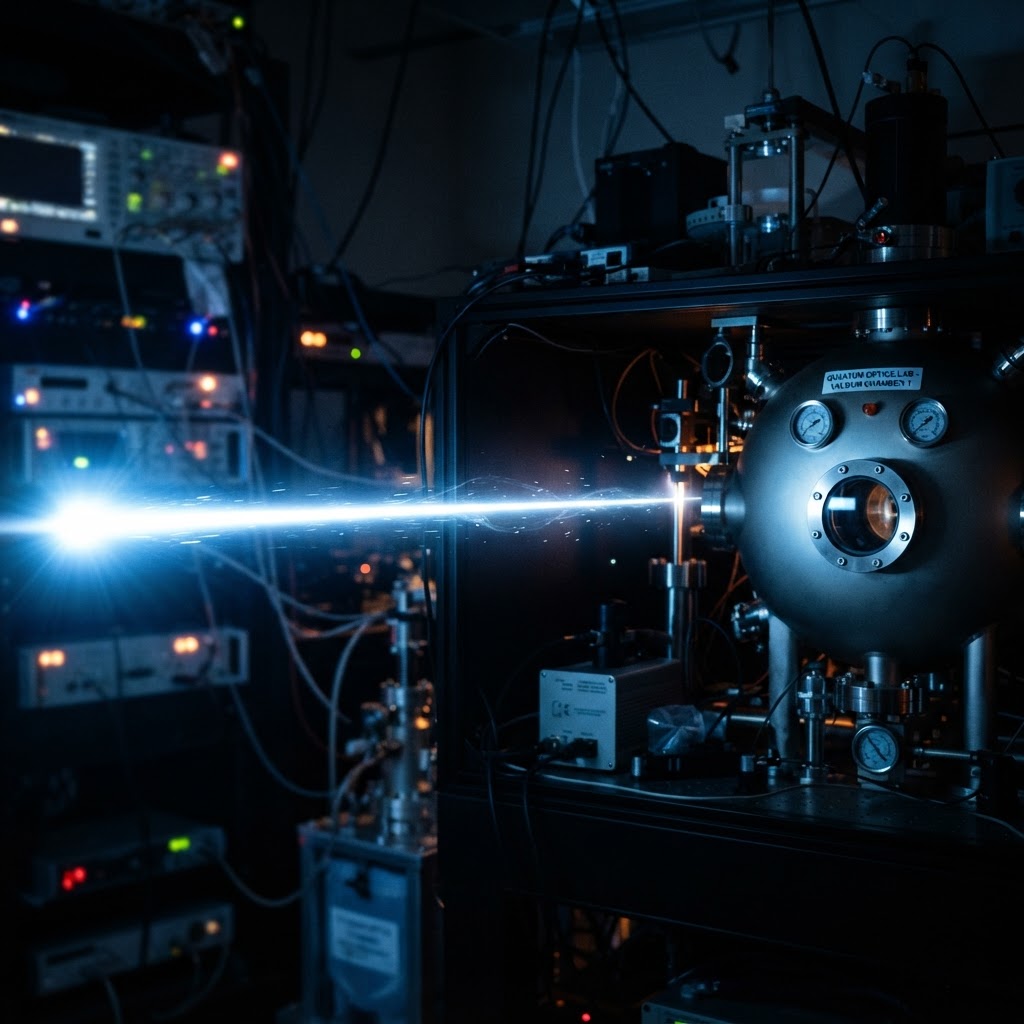
A research team led by physicist Shi-Liang Zhu at South China Normal University developed an optical experiment using single photons.
Their study, published in Science Advances on August 26, 2026, was titled Direct experimental test of Feynman's path integral postulates with single photons.
Researchers Yong-Li Wen, Li-Man Tian, Yunfei Wang and their colleagues developed a method based on measurements of quantum propagators—mathematical quantities describing how a quantum system evolves from one location or state to another.
Instead of attempting to watch a photon physically travel along every possible trajectory—which would fundamentally interfere with the quantum system—the researchers reconstructed the probability amplitudes associated with an enormous collection of possible paths.
And enormous is not an exaggeration.
They reconstructed:
→ 1,419,857 possible paths
That is (17^5) different trajectories for individual photons.
The experiment allowed researchers to compare the reconstructed quantum behavior directly with the assumptions underlying Feynman's path-integral formulation.
What Exactly Did They Test?
Feynman's formulation rests on two particularly important ideas.
Postulate 1: All Possible Paths Contribute
Quantum probabilities emerge from the coherent superposition of all possible paths connecting the initial and final states.
Put more simply:
The final outcome isn't calculated by choosing one secret path that the particle "really" followed.
The contributions from the possible paths must be combined as quantum amplitudes.
And because these amplitudes contain phase information, they can interfere.
Some reinforce one another.
Others cancel one another.
The researchers' measurements supported this prediction.
According to the published study, the experimentally reconstructed behavior showed strong agreement with the theoretical prediction for coherent superposition.
Postulate 2: The Paths Have Equal-Magnitude Amplitudes
Feynman's second assumption becomes even more interesting.
The possible paths contribute amplitudes with equal magnitude, while their phases differ according to something called the classical action.
The classical action is a quantity related to the history of a physical system. In Feynman's formulation, the phase associated with a path is determined by its classical action measured relative to the reduced Planck constant, (\hbar).
Those different phases determine how the paths interfere.
The experiment found evidence consistent with this prediction as well.
The researchers reported that the reconstructed paths had approximately equal-magnitude amplitudes while their phases followed the relationship predicted from classical action.
How Closely Did Experiment Match Theory?
This wasn't simply a visual resemblance between a graph and a prediction.
The researchers quantified how closely their experimental measurements matched Feynman's postulates.
They reported fidelities of roughly:
→ 94.9% for Postulate I
→ 94.7% for Postulate II
The study also reported mean absolute percentage errors of approximately 4.45% and 17.4% for the two tests, respectively.
Those results provided direct experimental evidence supporting the structure Feynman proposed decades ago.
Why Did It Take Nearly 80 Years?
There is an obvious question here.
If Feynman proposed this in 1948, why did scientists have to wait until 2026 to test it this way?
Because quantum systems are incredibly difficult to measure without disturbing them.
Observation in quantum mechanics isn't like watching a baseball fly through the air.
Attempting to determine exactly which path a quantum particle takes can destroy the interference behavior scientists are trying to investigate.
The researchers therefore needed another approach.
Recent developments in quantum measurement—including techniques involving weak values and improved measurements of quantum propagators—made it possible to reconstruct the relevant probability amplitudes without simply performing a conventional "which path?" measurement.
The South China Normal University team had previously worked on experimental methods for measuring propagators and demonstrating the quantum principle of least action. The new experiment pushed those techniques much further, improving measurement accuracy enough to reconstruct more than a million path amplitudes.
Does This Mean Feynman's Theory Was Unproven Until Now?
No.
And this distinction matters.
The path integral has been extraordinarily successful for decades and is mathematically connected to other established formulations of quantum mechanics.
Scientists weren't sitting around for 78 years wondering whether Feynman's equations worked.
They knew they worked.
What had been missing was a direct experimental examination of the specific postulates underlying Feynman's path-based description.
This experiment therefore isn't simply another confirmation that quantum mechanics produces accurate predictions.
It gives scientists a new experimental window into the machinery underneath one of quantum theory's most important formulations.
Are All Those Paths Actually "Real"?
Now we arrive at the philosophical part.
When physicists calculate every possible path, what exactly are those paths?
Are they genuine components of physical reality?
Or are they simply mathematical tools that allow us to calculate the correct answer?
Even Feynman's enormously successful framework does not automatically settle that question.
The researchers argue that modern quantum measurement techniques now allow scientists to investigate this issue experimentally in ways that previously weren't possible.
Their measurements show that photon behavior is consistent with the coherent contribution of this vast collection of possible paths.
But that doesn't necessarily mean we should picture a tiny photon literally splitting into 1.4 million miniature copies of itself and racing through space.
Quantum mechanics has a habit of punishing overly literal interpretations.
Instead, the experiment strengthens the evidence that the path structure encoded in Feynman's mathematics reflects something fundamental about quantum evolution—even if physicists continue debating exactly what that tells us about reality itself.
Why This Experiment Matters Beyond Feynman
There is another part of this story that may ultimately prove just as important as confirming the postulates.
The researchers created an experimental framework capable of probing path-integral physics directly.
That could allow future scientists to investigate more complicated quantum systems.
Researchers may eventually use related techniques to study:
→ Quantum interference in more complex environments
→ Quantum particles traveling through materials
→ More complicated propagators
→ Quantum dynamics that are difficult to investigate using conventional measurements
→ Foundational questions about how classical behavior emerges from quantum mechanics
The team specifically notes that improved propagator measurements could become useful tools for exploring a broad range of complex quantum phenomena.
An Idea From 1948 Meets the Laboratory of 2026
Richard Feynman had a remarkable ability to look at physics differently.
Rather than asking only:
"Which path did the particle take?"
His formulation effectively asks:
"What happens when every possible path contributes?"
For generations, physicists have used that idea to calculate the behavior of quantum systems.
Now experimental technology has advanced enough to probe the structure of that idea directly.
More than 1.4 million reconstructed photon paths later, Feynman's postulates survived the test.
Sometimes science moves quickly.
Other times, an idea waits nearly eighty years for technology to catch up.