Sodom and Gomorrah are the two best-known “cities of the plain” in Genesis 18–19, destroyed when, in the King James wording, “the LORD rained upon Sodom and upon Gomorrah brimstone and fire.” The Bible places them near the Dead Sea, and archaeologists have proposed several real sites there, most recently Tall el-Hammam in Jordan, where a 2021 study claimed a cosmic airburst destroyed a Bronze Age city. That study was retracted in 2025, and no site has been accepted as the biblical Sodom.
The story matters because it sits where scripture, archaeology, geology and alternative history all meet. It has shaped ideas of divine judgment for millennia and is one of the few Genesis episodes tied to a specific, visitable landscape. Separating what the text says from what excavators found, and from what interpreters have added, is the only way to judge any of the competing claims.
What Genesis 18–19 actually says
Genesis 18–19 tells a short, tightly built story of judgment and rescue. In chapter 18, three visitors come to Abraham at Mamre; the LORD tells him that “the cry of Sodom and Gomorrah is great,” and Abraham bargains for the cities, asking whether they will be spared for fifty righteous people, then forty-five, and down to ten. The LORD agrees to spare them for ten.
In chapter 19, two angels arrive in Sodom in the evening. Abraham’s nephew Lot, who had settled there after choosing the well-watered “plain of Jordan” in Genesis 13, insists they stay in his house. The men of the city surround the house and demand that the visitors be brought out. The angels strike the crowd with blindness, warn Lot to leave, and lead him, his wife and two daughters out of the city. Lot asks to shelter in a small town, Zoar, which is spared.
Then comes the destruction: “brimstone and fire from the LORD out of heaven” (19:24). The Hebrew word translated brimstone, gophrit, means sulphur. Lot’s wife looks back and becomes “a pillar of salt” (19:26). The next morning Abraham looks toward the plain and sees “the smoke of the country went up as the smoke of a furnace” (19:28).
The Bible names five cities of the plain across several passages: Sodom, Gomorrah, Admah, Zeboiim and Zoar (also called Bela). Genesis 14 lists their kings and adds a geological detail often cited later: the “vale of Siddim was full of slimepits,” that is, bitumen pits. Deuteronomy 29:23 and Hosea 11:8 recall Admah and Zeboiim as overthrown alongside Sodom and Gomorrah.
Where were the cities of the plain?
The text points to the Dead Sea basin, and two areas have drawn the most attention: the south-east shore of the Dead Sea and the southern Jordan Valley north-east of it. Neither identification is accepted as proven.
Bab edh-Dhra and Numeira
On the south-east side of the Dead Sea, in modern Jordan, lie Bab edh-Dhra and Numeira, Early Bronze Age settlements excavated by Walter Rast and R. Thomas Schaub as part of the Expedition to the Dead Sea Plain. The walled town at Bab edh-Dhra was destroyed at the end of the Early Bronze III period, around 2350 BCE, and it sits beside a vast Early Bronze Age cemetery. Some writers, notably Bryant Wood, argued that these sites and others along the same shore are the cities of the plain; the identification has not won general acceptance.
Tall el-Hammam
Tall el-Hammam is a large mound in Jordan’s southern Jordan Valley, north-east of the Dead Sea, excavated since the mid-2000s by a team led by Steven Collins of Trinity Southwest University. It was a substantial Middle Bronze Age city, roughly 36 hectares, and it has a thick destruction layer. Collins has long argued that Tall el-Hammam is biblical Sodom, a case he set out for general readers in Discovering the City of Sodom (2013, with Latayne Scott). His reasoning rests on the phrase “plain of Jordan” in Genesis 13 and on the site’s size and location.
This remains a minority view. Critics, including other biblical archaeologists, point out that the site’s destruction date does not line up neatly with the chronology the biblical text itself implies for Abraham, and most archaeologists stress that Genesis is a theological narrative, not a site report that can be matched to a single mound.
The 2021 airburst paper and its retraction
The 2021 paper claimed that a cosmic airburst, an exploding meteor or comet fragment, destroyed Tall el-Hammam around 1650 BCE. It appeared in Scientific Reports in September 2021 under the title “A Tunguska sized airburst destroyed Tall el-Hammam a Middle Bronze Age city in the Jordan Valley near the Dead Sea,” with Ted Bunch and Phillip Silvia among its many authors, several of them members of the Comet Research Group that also backs the [Younger Dryas impact hypothesis](/the-younger-dryas-impact-hypothesis-explained-the-evidence-for-and-against).
The authors reported a destruction layer containing melted pottery and mudbrick, shocked quartz, tiny spherules and unusually high salt, and argued that only an airburst comparable to the 1908 Tunguska event in Siberia could explain the combination. The paper suggested the event might lie behind the Genesis story, and press coverage ran with the Sodom link.
Strong criticism followed. Impact physicist Mark Boslough and other researchers challenged the claims on several fronts: whether the melting temperatures really required an airburst rather than ordinary fire, whether the “shocked quartz” was correctly identified, and whether the statistics and images were sound. Image-integrity specialists flagged problems with figures in the paper, and the journal added an editorial notice while it looked into the concerns. In 2025 Scientific Reports retracted the paper, citing errors in its analysis. The destruction layer at Tall el-Hammam is real; the claim that a cosmic body caused it no longer has a peer-reviewed paper behind it.
Earthquakes, bitumen and brimstone: the natural explanations
The most common natural explanation is an earthquake in the Dead Sea rift, followed by fires fed by bitumen and natural gas. The Dead Sea lies on a major fault system, the Dead Sea Transform, and the region has a long record of strong earthquakes. Greek and Roman writers called the Dead Sea Lake Asphaltites for the bitumen that rises from its floor, and the “slimepits” of Genesis 14 fit the same landscape.
In this reading, a quake could have ruptured the ground, released flammable gas and ignited bitumen, producing the “smoke of a furnace” Abraham sees from a distance. Sulphur deposits in the area give a plain source for the association with brimstone. It is a plausible fit for the imagery, but like the airburst idea it cannot be tied to a specific dated event matching the biblical cities.
What about Lot’s wife and the pillar of salt?
The salt pillars visitors see today are natural rock formations, not remains of a person. Mount Sodom, known in Arabic as Jebel Usdum, is a ridge on the south-west shore of the Dead Sea made largely of halite, rock salt pushed up from deep below. Rain and erosion carve it into columns, and one of them has long been pointed out to tourists as “Lot’s wife.”
The story of Lot’s wife is usually read as an origin tale that explains these striking formations while carrying a moral: do not turn back toward what is being judged. Jesus draws on that moral in Luke 17:32 with the short line “Remember Lot’s wife.”
The story as literature: hospitality, injustice and the prophets
Read as literature, Sodom and Gomorrah is a story about hospitality and injustice. Genesis sets Abraham’s generous welcome of strangers in chapter 18 directly beside the mob at Lot’s door in chapter 19, and the contrast is the point. Lot protects his guests under his roof; the city threatens them.
Later biblical writers read it the same way. Ezekiel 16:49 names Sodom’s sin in social terms: “pride, fulness of bread, and abundance of idleness was in her and in her daughters, neither did she strengthen the hand of the poor and needy.” Isaiah addresses Jerusalem’s leaders as “rulers of Sodom” when condemning their neglect of justice, and in Matthew 10:14–15 Jesus compares towns that refuse his messengers unfavourably with Sodom and Gomorrah. Readers who want the wider Genesis context can compare the story with the [Tower of Babel in Genesis 11](/the-tower-of-babel-explained-genesis-11-etemenanki-and-what-archaeology-shows), another account of divine intervention against a city, and the [Nephilim of Genesis 6 and the Book of Enoch](/who-were-the-nephilim-giants-of-genesis-6-and-the-book-of-enoch).
Where the ancient-astronaut reading comes from
The ancient-astronaut reading of Sodom and Gomorrah comes mainly from Zecharia Sitchin, who argued in The Wars of Gods and Men (1985) that the cities were destroyed by nuclear weapons used by the Anunnaki, the gods of Mesopotamian texts whom he interpreted as visitors from another world. Sitchin linked the event to the “evil wind” described in Sumerian laments, which he read as radioactive fallout drifting east over Mesopotamia and bringing down the Third Dynasty of Ur, around 2004 BCE.
The main text he relied on, the Lament for Sumer and Ur, does describe a devastating storm or wind sent by the god Enlil. Assyriologists, including Piotr Michalowski in his edition of the lament, read that storm as poetic language for divine judgment carried out through human armies: the text names Elamite and Gutian enemies, and it records the sack of Ur by invaders, not a blast. Sitchin’s reading is an interpretation laid over the translations, and no physical evidence of a nuclear event has been found anywhere in the region. For more on the gods in question, see the [Anunnaki topic hub](/topics/anunnaki) and the article on [the Elohim, the plural God of Genesis](/who-were-the-elohim-the-plural-god-of-genesis-and-the-anunnaki-question).
Billy Carson’s reading
Billy Carson approaches Sodom and Gomorrah within the ancient-astronaut framework, part of a larger pattern in which the “LORD” and the “angels” of Genesis are best understood as powerful beings who intervened directly in human affairs, the same beings he connects with the Anunnaki of Mesopotamian texts. In that framework the destruction of the cities is presented as a real event carried out with advanced technology rather than a purely moral parable, and Carson draws on the line of interpretation Sitchin popularized.
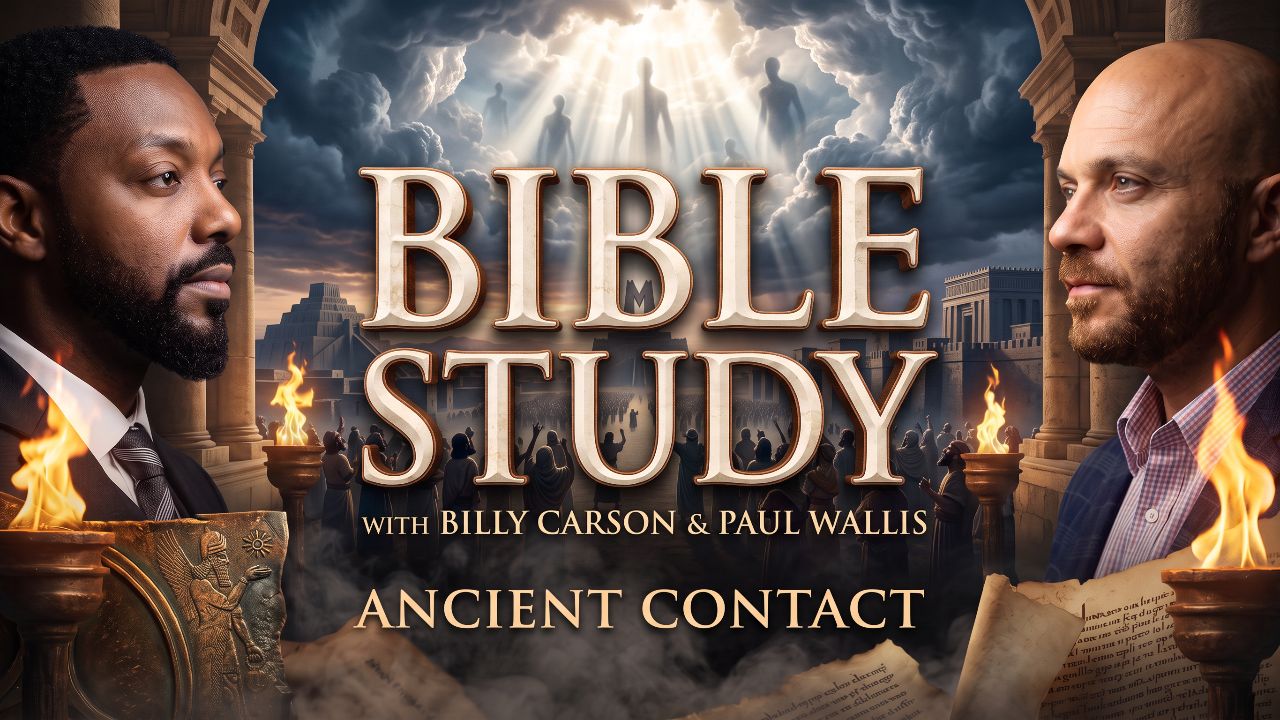
That is his position, not a finding of archaeology or Assyriology. It rests on reading the Genesis account and the Sumerian laments side by side as records of the same kind of beings, which mainstream scholars do not accept. Carson’s approach is to set those texts next to each other and ask readers to weigh the parallels for themselves, and 4BK TV’s [Bible Study series](/watch/bible-study) is the home for that kind of scripture-by-scripture discussion.
Watch, read and go deeper
The [Bible Study series on 4BK TV](/watch/bible-study) is the best place to follow Billy Carson through Genesis and the questions it raises, and the [Best of Billy Carson collection](/watch/best-of-billy-carson) gathers his most-watched talks on ancient texts and lost history. For background on the Mesopotamian gods at the centre of the ancient-astronaut reading, start with the [Anunnaki topic hub](/topics/anunnaki). For the scientific debate over cosmic impacts, the [Younger Dryas impact hypothesis explainer](/the-younger-dryas-impact-hypothesis-explained-the-evidence-for-and-against) covers the same research group’s larger and older claim.
Frequently asked questions
Were Sodom and Gomorrah real places?
The Bible presents them as real towns near the Dead Sea, and the region did have Bronze Age cities that were destroyed, including Bab edh-Dhra and Tall el-Hammam. No inscription or find has confirmed that any excavated site was called Sodom or Gomorrah. Their historical existence is therefore possible but unproven.
Is Tall el-Hammam the biblical Sodom?
The excavator, Steven Collins, argues that it is, but most archaeologists do not accept the identification. Critics note that the site’s destruction date does not fit the chronology the biblical text implies, and that Genesis is a theological narrative rather than a precise geographic record. The question remains open and contested.
Did a meteor destroy Sodom and Gomorrah?
A 2021 paper in Scientific Reports claimed that a cosmic airburst destroyed Tall el-Hammam around 1650 BCE and suggested a link to Sodom. The paper drew sustained criticism over its temperatures, mineral identifications, statistics and images, and the journal retracted it in 2025. There is currently no accepted peer-reviewed evidence that a meteor or comet destroyed the site.
What was the sin of Sodom?
Genesis 19 shows the men of the city threatening Lot’s guests, a violation of the hospitality Abraham shows in chapter 18. The prophet Ezekiel (16:49) names Sodom’s sin as pride, excess and neglect of the poor and needy. Interpretations have varied widely over the centuries, and the biblical texts themselves emphasize injustice and the abuse of strangers.
Is the pillar of salt at the Dead Sea really Lot’s wife?
No. The salt columns at Mount Sodom, or Jebel Usdum, are natural halite formations shaped by erosion, and new ones form and collapse over time. One of them is traditionally called “Lot’s wife,” but that is a local name, not an archaeological identification.
Sources and further reading
- Genesis 13–14 and 18–19; Ezekiel 16:49; Deuteronomy 29:23 (King James Version)
- Walter E. Rast and R. Thomas Schaub, reports of the Expedition to the Dead Sea Plain on Bab edh-Dhra and Numeira
- Steven Collins and Latayne C. Scott, Discovering the City of Sodom (2013)
- Ted E. Bunch, Phillip J. Silvia et al., “A Tunguska sized airburst destroyed Tall el-Hammam a Middle Bronze Age city in the Jordan Valley near the Dead Sea,” Scientific Reports (2021; retracted 2025)
- Piotr Michalowski, The Lamentation over the Destruction of Sumer and Ur (1989)
- The Electronic Text Corpus of Sumerian Literature (University of Oxford), translation of the Lament for Sumer and Ur
- Zecharia Sitchin, The Wars of Gods and Men (1985)