The Book of Enoch, known to scholars as 1 Enoch, is an ancient Jewish text, most of it written in stages between roughly 300 and 100 BCE, that turns the four terse verses of Genesis 6 into a full story: two hundred angels called the Watchers descend to earth, take human wives, father a race of giants known as the Nephilim and teach humanity forbidden arts, until God answers with the flood. It was widely read in the Second Temple period and is quoted in the New Testament, yet it was never accepted into the Jewish, Catholic or Protestant Bible. Its only complete surviving version is in Ge'ez, and it remains scripture in the Ethiopian and Eritrean Orthodox Tewahedo churches.
The book matters because it is one of the oldest sources for ideas many people assume come straight from the Bible: fallen angels, demons as the restless spirits of dead giants, a final judgment, and a heavenly figure called the Son of Man. It also sits at the center of modern debates about the Nephilim, lost knowledge and who, or what, shaped early civilization, which are questions Billy Carson returns to often on the [Anunnaki topic hub](/topics/anunnaki).
What is the Book of Enoch?
The Book of Enoch is not one book but a collection of five separate works attributed to Enoch, the patriarch whom Genesis 5:21–24 describes as walking with God before “he was not, for God took him.” Because Genesis implies that Enoch never died an ordinary death, later Jewish writers treated him as the ideal person to have seen heaven and to carry its knowledge back to humanity. The five parts, in the order they appear in the Ethiopic text, are:
- The Book of the Watchers (chapters 1–36), the oldest section, usually dated to the 3rd century BCE. It contains the story of the fallen Watchers and Enoch's journeys through the cosmos.
- The Parables, or Similitudes (chapters 37–71), visions of final judgment centered on a heavenly figure called the Son of Man, the Chosen One.
- The Astronomical Book (chapters 72–82), a treatise on the movements of the sun, moon and stars revealed to Enoch by the angel Uriel, built around a 364-day year.
- The Book of Dream Visions (chapters 83–90), including the Animal Apocalypse, which retells history from Adam onward with people portrayed as animals.
- The Epistle of Enoch (chapters 91–108), moral exhortation and warnings of judgment, including the Apocalypse of Weeks.
1 Enoch is distinct from 2 Enoch, a later work preserved in Old Church Slavonic, and 3 Enoch, a later Hebrew mystical text.
Where the text came from: Aramaic, Greek and Ge'ez
The Book of Enoch was composed in Aramaic, and the only complete version that survives is a translation in Ge'ez, the classical liturgical language of Ethiopia. Portions also survive in Greek, but for centuries Western Europe knew the book mostly by reputation.
That changed in 1773, when the Scottish traveler James Bruce returned from Ethiopia with Ge'ez manuscripts of the text. The Oxford Hebraist Richard Laurence published the first English translation in 1821. R. H. Charles's translation of 1912 became the standard English edition for most of the twentieth century and is still the version most widely reproduced today. The current scholarly reference is the Hermeneia commentary by George Nickelsburg (2001), completed by a second volume written with James VanderKam (2012).
The Dead Sea Scrolls settled the question of the book's age. Among the manuscripts from Qumran Cave 4 are eleven fragmentary Aramaic copies of Enochic writings, catalogued as 4Q201–4Q212 and published by J. T. Milik in 1976, some of them copied in the 2nd century BCE. They confirm that the Watchers story circulated in Aramaic well before the time of Jesus. One section is conspicuously missing from Qumran: the Parables. That absence is one reason scholars date the Parables later than the rest, generally to around the turn of the era.
The Watchers and the Nephilim: what the story says
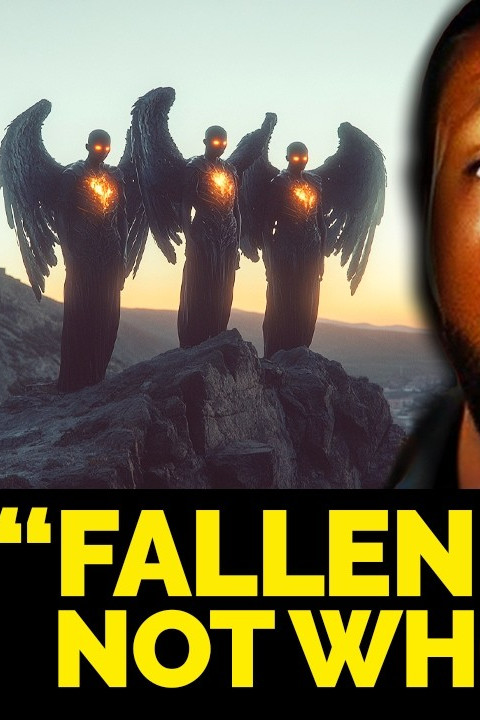
The core story, told in 1 Enoch 6–11, is that two hundred angels called Watchers chose to leave heaven, marry human women and have children with them. Led by Shemihazah (spelled Semjaza in Charles), they descended on Mount Hermon in the days of Jared and bound themselves with a mutual oath so that none would turn back.
Their children were giants. According to the text, the giants consumed everything humans could produce, then turned to devouring people and finally one another. At the same time the Watchers taught forbidden knowledge. Azazel taught people to work metal, forge swords and shields, and make jewelry, cosmetics and dyes. Others taught incantations, the cutting of roots, astrology and the reading of signs in the sun, moon and earth. In the text, this teaching is itself part of the corruption.
The cries of the dying reach heaven, and the archangels, Michael and Gabriel among them, bring the case before God. The response is judgment. Noah is warned of the coming flood. Raphael binds Azazel and casts him into darkness. The giants are set against each other, and Shemihazah and his companions are bound beneath the earth until the final judgment. In chapters 12–16 Enoch himself is sent to announce their doom; the Watchers ask him to intercede, and their petition is refused. The text adds that the spirits of the dead giants remain on earth as evil spirits, one of the earliest Jewish explanations for the origin of demons. Chapters 17–36 follow Enoch on guided journeys to the ends of the earth.
How Genesis 6 compares
Genesis 6:1–4 is the brief biblical parallel. It says that the “sons of God” saw that the daughters of men were beautiful and took wives from among them, that the Nephilim were on the earth in those days and also afterward, and that these were the mighty men of old. Genesis never says the sons of God were angels who sinned, never names them and never mentions forbidden teaching; the next verse moves straight to human wickedness and the flood. Scholars still debate whether the Enoch story expands Genesis or whether both draw on an older tradition. For a closer look at the giants themselves, see our guide to [who the Nephilim were in Genesis 6 and the Book of Enoch](/who-were-the-nephilim-giants-of-genesis-6-and-the-book-of-enoch).
Why was the Book of Enoch left out of the Bible?
The Book of Enoch was left out of the Bible because it never entered the Hebrew canon, and most churches followed that canon for their Old Testament while doubting that a book written before the flood could be genuine. There is no evidence that rabbinic Judaism ever treated it as scripture. The old idea that a single “Council of Jamnia” around 90 CE fixed the Jewish canon is now widely doubted by historians; the process was gradual, and Enoch simply did not make it in.
Early Christians were divided. The New Testament letter of Jude, verses 14–15, quotes 1 Enoch 1:9 as a prophecy of “Enoch, the seventh from Adam,” and many scholars hear echoes of the Watchers story in 2 Peter 2:4, which speaks of angels who sinned being held in chains of darkness. Tertullian defended the book, arguing that Jude's citation gave it weight and that its writings could have been preserved through the flood by Noah. Later voices prevailed. Augustine, in the City of God (book 15, chapter 23), rejected it as too ancient to be authentic and pointed out that it was not in the Jewish canon, and Jerome likewise treated it as apocryphal. Over time the book dropped out of use in the Greek and Latin churches.
The content itself did not help. Its developed angelology sat uneasily with later theology, especially once the “sons of God” in Genesis came to be read as the righteous line of Seth rather than as angels, and its 364-day solar calendar differed from the lunisolar calendar of rabbinic Judaism. The one place it kept its status was Ethiopia, where it is part of the canon of the Ethiopian and Eritrean Orthodox Tewahedo churches, which is why it survives complete in Ge'ez.
What mainstream scholarship says the book is
Mainstream scholarship reads the Book of Enoch as apocalyptic literature, a genre of revealed visions that addressed the religious and political crises of the Second Temple period rather than a historical record of events before the flood. Scholars disagree about which crisis the Watchers story reflects. Nickelsburg proposed that the violent giants mirror the wars fought by Alexander the Great's successors, who claimed divine descent. David Suter read the fallen Watchers as a critique of priests who entered improper marriages. Annette Yoshiko Reed has traced how the story shaped Jewish and Christian ideas about evil and fallen angels over many centuries.
Scholars also see a Mesopotamian background. James VanderKam showed that the figure of Enoch, seventh in the line from Adam and recipient of heavenly knowledge, closely resembles Enmeduranki, the seventh king in Mesopotamian lists of rulers before the flood, who was taught divine secrets by the gods. The Watchers' role as teachers of civilizing arts has likewise been compared to the apkallu, the antediluvian sages of Mesopotamian tradition. For most scholars these parallels point to Jewish authors adapting, and often arguing against, Babylonian learning, not to a shared memory of real visitors.
Billy Carson's reading
Billy Carson reads the Book of Enoch as a record of real events told in the religious language of its time. In his interpretation, the Watchers correspond to the Anunnaki of the Sumerian texts, the forbidden knowledge they taught (metallurgy, weapons, astronomy and the rest) describes actual technology handed to early humans, and the flood was a deliberate reset of a civilization that had gone out of control. He lays out this reading in the podcast episodes the Book of Enoch describes a cosmic war and the beings operating our reality and Book of Enoch: Watchers, fallen angels, forbidden knowledge and human origins, and in the Fallen Angels episode of [Best of Billy Carson on 4BK TV](/watch/best-of-billy-carson).
Carson's case rests on the same parallels scholars notice: a Mesopotamian model for Enoch, divine beings who pass on knowledge, and a flood sent on purpose, which also appears in the Babylonian Atrahasis epic and tablet XI of the Epic of Gilgamesh. Where scholars see literary borrowing between neighboring cultures, Carson sees multiple cultures describing the same beings. That identification is his interpretation; it is not a position held in academic Enochic studies, and no ancient text equates the Watchers with the Anunnaki by name. Readers who want to weigh the Sumerian side directly can start with our explainer on [who the Anunnaki were, comparing the Sumerian texts with ancient astronaut theory](/who-were-the-anunnaki-sumerian-texts-vs-ancient-astronaut-theory).
Watch, read and go deeper
The Fallen Angels episode of [Best of Billy Carson](/watch/best-of-billy-carson) on 4BK TV is the best single place to hear Carson's full argument about the Watchers. For a longer conversation, the podcast episode on Enoch's cosmic war covers the material in depth. The [Anunnaki topic hub](/topics/anunnaki) collects related articles on Sumer, the Nephilim and ancient flood traditions. Readers drawn to Enoch's heavenly journeys and visionary experience will find related material on the [consciousness topic hub](/topics/consciousness).
Frequently asked questions
Is the Book of Enoch in the Bible?
The Book of Enoch is not part of the Jewish, Catholic or Protestant Bible. It is canonical only in the Ethiopian and Eritrean Orthodox Tewahedo churches, which is why its only complete text survives in Ge'ez. Other churches regard it as an important ancient text but not as scripture.
Who were the Watchers in the Book of Enoch?
In 1 Enoch 6–11 the Watchers are two hundred angels, led by Shemihazah, who descend on Mount Hermon, marry human women and father the giants. Azazel and others teach humans metalworking, weapons, cosmetics, sorcery and astrology. God responds by binding the Watchers and sending the flood.
Is the Book of Enoch quoted in the New Testament?
Yes. The letter of Jude, verses 14–15, quotes 1 Enoch 1:9 and attributes it to “Enoch, the seventh from Adam.” Early Christian writers such as Tertullian took this as support for the book, while Augustine and Jerome later rejected it as scripture.
Was the Book of Enoch found in the Dead Sea Scrolls?
Yes. Qumran Cave 4 yielded eleven fragmentary Aramaic manuscripts of Enochic writings, catalogued as 4Q201–4Q212 and published by J. T. Milik in 1976. They include parts of every section except the Parables, which is one reason scholars date that section later.
Which translation of the Book of Enoch should I read?
R. H. Charles's 1912 translation is free and widely available, but it predates the Dead Sea Scrolls discoveries. The Nickelsburg and VanderKam translation, published by Fortress Press with the Hermeneia commentary, reflects current scholarship and draws on the Aramaic and Greek evidence alongside the Ge'ez text.
Sources and further reading
- R. H. Charles, The Book of Enoch or 1 Enoch (Oxford: Clarendon Press, 1912)
- Richard Laurence, The Book of Enoch the Prophet (Oxford, 1821)
- J. T. Milik, The Books of Enoch: Aramaic Fragments of Qumrân Cave 4 (Oxford: Clarendon Press, 1976)
- George W. E. Nickelsburg, 1 Enoch 1: A Commentary on the Book of 1 Enoch, Chapters 1–36; 81–108 (Hermeneia, Fortress Press, 2001)
- George W. E. Nickelsburg and James C. VanderKam, 1 Enoch 2: A Commentary on the Book of 1 Enoch, Chapters 37–82 (Hermeneia, Fortress Press, 2012)
- James C. VanderKam, Enoch and the Growth of an Apocalyptic Tradition (Catholic Biblical Association, 1984)
- Annette Yoshiko Reed, Fallen Angels and the History of Judaism and Christianity (Cambridge University Press, 2005)
- Augustine, City of God, book 15, chapter 23