The Antikythera mechanism is a hand-cranked bronze calculating device, built in the Greek world around 150 to 100 BCE, that used at least 30 interlocking gears to model the movements of the Sun and Moon, predict eclipses and track calendar cycles. Recovered from a Roman-era shipwreck off the Greek island of Antikythera in 1901, it is the oldest known geared machine, and nothing of comparable mechanical complexity survives again until the astronomical clocks of 14th-century Europe. Its 82 surviving fragments are held at the National Archaeological Museum in Athens.
It matters because it settles an argument usually conducted with speculation. Ancient engineering was more capable than textbooks once allowed, and real knowledge was lost, yet the mechanism also shows where that knowledge came from: Hellenistic astronomy, written down and datable. This guide covers what the device is, how it was decoded, which other cases of "lost technology" hold up, and how Billy Carson's view compares with the archaeological account.
How the Antikythera mechanism was found
The mechanism came out of a shipwreck found in 1900 by Greek sponge divers off Antikythera, an island between Kythera and Crete, who reported a seabed scattered with bronze and marble statues. Salvage in 1900 and 1901, one of the first underwater archaeological operations, brought up statues, pottery and a corroded lump of wood and bronze. In 1902 the archaeologist Valerios Stais noticed a gearwheel embedded in one of the pieces.
Coins and pottery place the sinking around 70 to 60 BCE, so the device was already decades old when it went down. Most researchers date its construction to roughly 150 to 100 BCE; others, working from the eclipse dial, argue for around 200 BCE. Either way, it is a product of the Hellenistic world.
What the Antikythera mechanism did
The mechanism was a portable astronomical calculator: turning a handle on its side advanced a date, and the gear trains moved pointers on its dials to show what the sky and the calendar would look like on that day. Roughly the size of a shoebox and housed in a wooden case, it carried a dial on the front, two spiral dials on the back and inscribed plates explaining how to read them.
The front dial showed the zodiac and the 365-day Egyptian calendar, with Sun and Moon pointers and a half-light, half-dark ball showing the Moon's phase. The back dials were calendars of cycles Greek astronomers had worked out from centuries of Babylonian and Greek observation:
- The Metonic cycle, in which 19 solar years almost exactly equal 235 lunar months, used to keep a lunar calendar aligned with the seasons.
- The Callippic cycle of 76 years, four Metonic cycles with a one-day correction.
- The Saros cycle of 223 lunar months, a little over 18 years, after which eclipses repeat. The Saros dial marked predicted solar and lunar eclipses with glyphs.
- The Olympiad dial, a four-year cycle tracking the Panhellenic games, including the Olympic Games.
Its most sophisticated feature is a pin-and-slot mechanism: two gears on slightly offset axes, coupled by a pin sliding in a slot, make the Moon pointer speed up and slow down across the month. That reproduces the lunar anomaly, the Moon's varying speed across the sky, which Greek astronomy associated with the work of Hipparchus. It is a physical model of a mathematical theory, cut in bronze.
How researchers decoded it
The mechanism was decoded over a century, and each advance came from a new way of seeing inside the corroded fragments. Derek de Solla Price, a historian of science at Yale, used gamma-ray images to count gear teeth and published his reconstruction in Gears from the Greeks (1974), identifying it as a calendar computer. Michael Wright, a former curator of mechanical engineering at the Science Museum in London, worked with Alan Bromley in the 1990s using linear X-ray tomography, corrected parts of Price's model and built a working reconstruction that included a planetary display.
The decisive step was the Antikythera Mechanism Research Project, led by Tony Freeth and Mike Edmunds with Greek colleagues. Using high-resolution X-ray computed tomography, the team published in Nature in 2006 a model of the gearing, including the pin-and-slot lunar mechanism, and in 2008 a reading of the back dials, including the Metonic calendar, the Saros eclipse predictor and the games dial. The scans also revealed large amounts of previously hidden inscription, in effect part of the device's user manual.
In 2021 a team led by Freeth at University College London published "A Model of the Cosmos in the ancient Greek Antikythera Mechanism" in Scientific Reports. It proposes a full reconstruction of the front display, showing the positions of the five planets known to the Greeks alongside the Sun and Moon. The planetary gearing itself does not survive, so this part is a reconstruction built from the inscriptions and surviving clues, not a direct observation.
Why the Antikythera mechanism counts as lost technology
The mechanism is lost technology in a precise sense: the craft skill to make it existed, left almost no other trace and was not matched for well over a thousand years. Much simpler geared devices appear later, such as a Byzantine geared sundial-calendar and al-Biruni's description of a geared lunar calendar in the eleventh century, but gearing of this complexity is not seen again until the astronomical clocks of 14th-century Europe.
Yet ancient writers knew such devices existed. Cicero, in De Re Publica, describes a bronze sphere built by Archimedes that showed the motions of the Sun, Moon and planets, carried off to Rome after the fall of Syracuse. In De Natura Deorum he mentions a similar device made by the philosopher Posidonius. The month names on the mechanism's calendar are Corinthian, which suggests it was made for a Corinthian colony, possibly Syracuse itself or one in north-western Greece.
The mechanism does not contain knowledge beyond its age. Its cycles are Babylonian and Greek astronomy, its lunar theory is Hipparchan, and its errors are the errors of that astronomy. What was lost was not an impossible science but a tradition of precision bronze-working, probably held by a few workshops and easy to break when patrons, cities and libraries fell. It is evidence of a sophisticated human culture, not of visitors from elsewhere.
Other examples of lost ancient technology, and what they really show
Several other artefacts are often grouped with the Antikythera mechanism. Some are genuine lost techniques; others are misreadings, and the real cases are strong enough without the weak ones.
Genuine lost or rediscovered techniques
Roman concrete. Roman marine and monumental concrete has outlasted most modern concrete, and the Pantheon dome in Rome is still the largest unreinforced concrete dome in the world. Vitruvius described the materials in De Architectura, but the full method had to be rediscovered. Admir Masic and colleagues (Science Advances, 2023) showed that small white lime clasts, long dismissed as poor mixing, came from hot-mixing with quicklime; when cracks let water in, those clasts dissolve and recrystallise as calcium carbonate, sealing the crack.
Damascus steel. The famous patterned blades were forged from wootz, a crucible steel produced in India and Sri Lanka and worked in the Middle East. The knowledge of how to make the pattern was lost around 1750. In 2006 Marianne Reibold and colleagues reported in Nature traces of carbon nanotubes and nanowires in a 17th-century Damascus sabre, a by-product of the forging cycle rather than a deliberate design. In the 1990s metallurgists John Verhoeven and Alfred Pendray reproduced the pattern by identifying the role of trace impurities in the ore.
Greek fire. The Byzantine incendiary weapon, credited by the chronicler Theophanes to an architect named Kallinikos in the late seventh century, was sprayed from siphons on ships and burned on water. Its recipe was a state secret and was lost; it was probably based on petroleum, but its exact composition is unknown.
The Lycurgus Cup. This fourth-century Roman glass cup in the British Museum looks green in reflected light and red when lit from within, an effect produced by gold and silver nanoparticles in the glass that Roman glassmakers achieved empirically.
Misreadings and claims that do not hold up
The Baghdad battery. These are Parthian or Sasanian clay jars containing a copper cylinder and an iron rod, described by Wilhelm König in 1938. Filled with an acid such as vinegar, replicas produce a small voltage, but no wires or electrical devices have ever been found with them, and similar jars from nearby Seleucia held rolled scrolls. The battery reading is doubtful; scroll storage is the more likely explanation.
The Dendera "light bulb". Reliefs in the crypts of the Ptolemaic-era Temple of Hathor at Dendera show a snake emerging from a lotus flower inside an elongated shape. The hieroglyphic texts beside them describe a mythological scene of creation, not a device, and no electrical infrastructure has been found in Egypt.
The Saqqara bird. A small wooden bird found in a tomb at Saqqara is sometimes presented as a glider model. Egyptologists read it as a bird figure, possibly a toy or a weathervane, and there is no Egyptian text or image of flying machines.
Megalithic engineering that is real, not mysterious
Baalbek. The three blocks of the trilithon at the Temple of Jupiter in Lebanon weigh roughly 800 tonnes each, and even larger blocks lie abandoned in the nearby quarry. Quarry evidence ties the work to Roman builders. Puma Punku, part of the Tiwanaku complex in Bolivia, was built of andesite and red sandstone around 500 to 1000 CE, with precisely cut, standardised blocks joined by metal cramps.
Egyptian core drills. Flinders Petrie documented granite cores with spiral grooves at Giza in the 1880s, and they are often cited as evidence of machine tools. Denys Stocks's experiments, published in Experiments in Egyptian Archaeology (2003), reproduced the cores with copper tube drills and dry sand as the abrasive. For the wider debate on Egyptian building methods, see [how the Great Pyramid of Giza was built](/how-was-the-great-pyramid-of-giza-built-evidence-theories-and-open-questions).
Billy Carson's reading
Billy Carson argues that artefacts like the Antikythera mechanism are fragments of a technologically advanced civilisation that existed before a global cataclysm, and that its knowledge survived only in pieces, carried forward by survivors and later cultures. In his view, the long gap between the mechanism and the next machine like it is one more sign of a pattern in which advanced knowledge surfaces, is lost and resurfaces over very long spans of time.
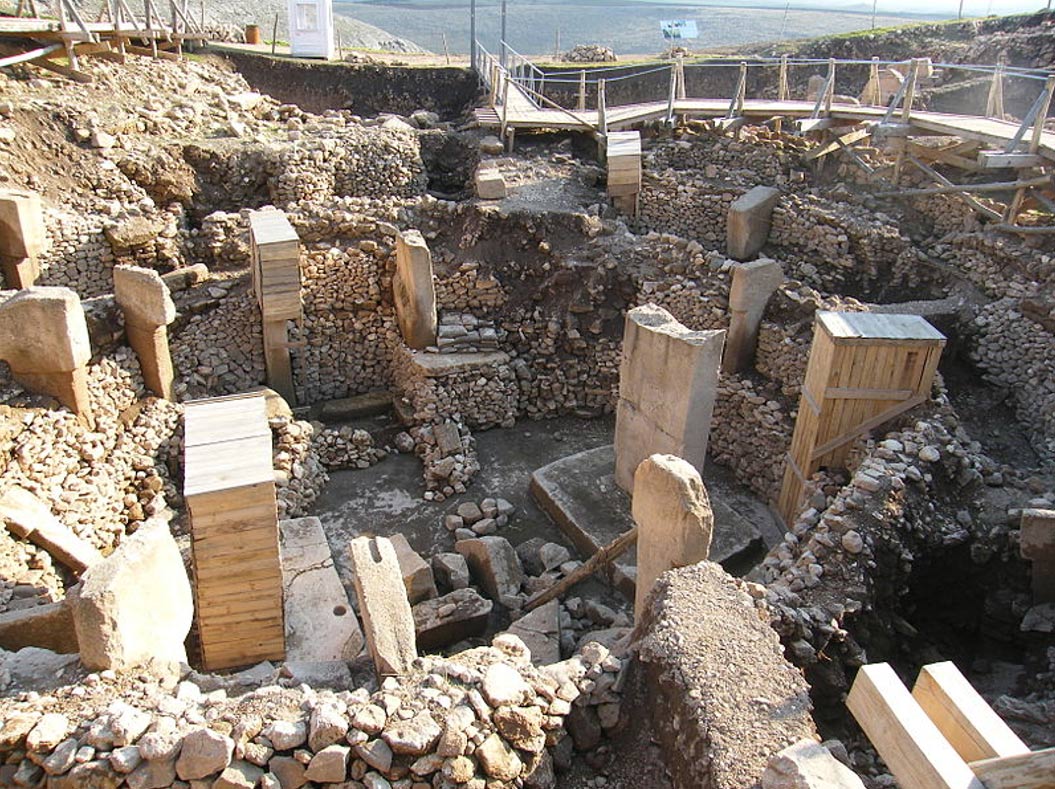
Carson connects that pattern to the themes he develops elsewhere: the flood and reset traditions he reads in [the Atlantis account](/atlantis-explained-plato-locations-and-billy-carsons-anunnaki-connection), the early monumental sites such as [Göbekli Tepe](/gobekli-tepe-explained-oldest-temple-in-the-world), and the knowledge lineage he traces through the Emerald Tablets and ancient Egypt. He has brought researchers together around the question through the 4biddenknowledge event Lost Technology of the Ancients, discussed in the podcast episode Ancient Civilizations Conference to Unveil Lost Technology and Forbidden Knowledge.
This is his interpretation, and it differs from the archaeological account. Mainstream scholarship sees gradual loss and rediscovery: techniques held by small groups, recorded poorly or not at all, and dropped when economies, empires or trade routes collapsed. On that view the Antikythera mechanism is explained entirely by the astronomy and metalwork of its own era. Carson's reading asks how often human knowledge has been reset; the archaeological reading answers where this particular object came from. Readers can weigh both.
Watch, read and go deeper
Billy Carson's own series on 4BK TV, [Billy Carson: 4biddenknowledge](/watch/billy-carson-4biddenknowledge-podcast), covers ancient technology and lost civilisations. The lost technology conference episode of the 4biddenknowledge Podcast sets out the themes of the event, and upcoming conferences and live appearances are listed on the events page. For the Egyptian side of the story, from core drills to the pyramids, start at the [Ancient Egypt topic hub](/topics/ancient-egypt).
Frequently asked questions
How old is the Antikythera mechanism?
Most researchers date its construction to around 150 to 100 BCE, and some argue for a date as early as about 200 BCE. The ship carrying it sank in the first century BCE, around 70 to 60 BCE, so the device was already old when it was lost.
Who made the Antikythera mechanism?
The maker is unknown. Its astronomy follows the Greek tradition associated with Hipparchus, and its Corinthian month names point to a Corinthian colony, possibly Syracuse. Cicero's accounts of geared spheres by Archimedes and Posidonius show that such devices were known in the Greek world.
Is the Antikythera mechanism evidence of alien technology?
No. Every function it performs matches astronomy Greek and Babylonian scholars had already recorded, including their errors. It is evidence of skilled Hellenistic engineering whose tradition was later lost.
Where is the Antikythera mechanism today?
Its 82 surviving fragments are held at the National Archaeological Museum in Athens, where the main pieces are on display alongside reconstructions.
What other ancient technologies were lost?
Well-documented examples include the recipe for Byzantine Greek fire, the method for patterned Damascus steel, lost around 1750, and the full technique behind self-healing Roman concrete, a key mechanism of which researchers explained in 2023.
Sources and further reading
- Derek de Solla Price, Gears from the Greeks: The Antikythera Mechanism, a Calendar Computer from ca. 80 B.C. (1974)
- T. Freeth et al., "Decoding the ancient Greek astronomical calculator known as the Antikythera Mechanism", Nature, 2006
- T. Freeth et al., "Calendars with Olympiad display and eclipse prediction on the Antikythera Mechanism", Nature, 2008
- T. Freeth et al., "A Model of the Cosmos in the ancient Greek Antikythera Mechanism", Scientific Reports, 2021
- Jo Marchant, Decoding the Heavens: Solving the Mystery of the World's First Computer (2008)
- L. M. Seymour, A. Masic et al., "Hot mixing: Mechanistic insights into the durability of ancient Roman concrete", Science Advances, 2023
- M. Reibold et al., "Carbon nanotubes in an ancient Damascus sabre", Nature, 2006
- Denys Stocks, Experiments in Egyptian Archaeology: Stoneworking Technology in Ancient Egypt (2003)