 Travel with Billy Carson —
 The Longyou Caves, also called the Xiaonanhai Stone Chambers, are a group of large, hand-cut underground caverns in Fenghuang (Phoenix) Hill near the village of Shiyan Beicun, on the Qu River in Longyou County, Zhejiang Province, eastern China. Villagers found them in June 1992 by pumping out ponds that turned out to be flooded cavern entrances. No surviving record says who dug them, when or why, and engineering geologists describe them as more than 2,000 years old.
That combination of scale, careful workmanship and missing paperwork is why the site keeps turning up in lists of unexplained places, including the 4biddenknowledge blog's roundup of the most mysterious archaeological discoveries ever made. It is also why the caves are a useful test case. They show how far the evidence goes, where it stops, and how different readers fill the gap that remains.
Where are the Longyou Caves and how were they found?
The caves lie at the foot of Fenghuang Hill by the Qu River, about 3 kilometres north of the Longyou county town in Quzhou prefecture. The story of their discovery is consistent across Chinese and international accounts. In June 1992 local villagers set out to drain a group of small ponds that local lore said were bottomless. According to the Zhejiang Provincial Department of Culture and Tourism, the work took about 17 days. When the water dropped, the "ponds" turned out to be the flooded openings of large, square-cut chambers going deep into the hillside.
Five caverns were opened first. Further surveys identified more chambers nearby, and the figure usually cited is 24. Some later sources report that up to 36 have been found across the wider hillside, and others suggest more may remain undiscovered. The safest statement is that 24 is the commonly cited total and that the count has grown as survey work has continued.
Today the site is a protected heritage area. In 2013 it was listed in the seventh batch of China's National Key Cultural Relics Protection Units, and it operates as a national AAAA-rated scenic area. Only one cavern is open to visitors; the provincial tourism department notes that it was chosen in part for its carvings of a horse, fish and birds.
How big are the caverns?
Each cavern is large. Commonly cited figures give an average floor area of more than 1,000 square metres per chamber and a combined floor area of more than 30,000 square metres. Ceiling heights are reported at up to about 30 metres in some accounts and about 20 metres in others, so the dimensions are best treated as approximate rather than surveyed totals.
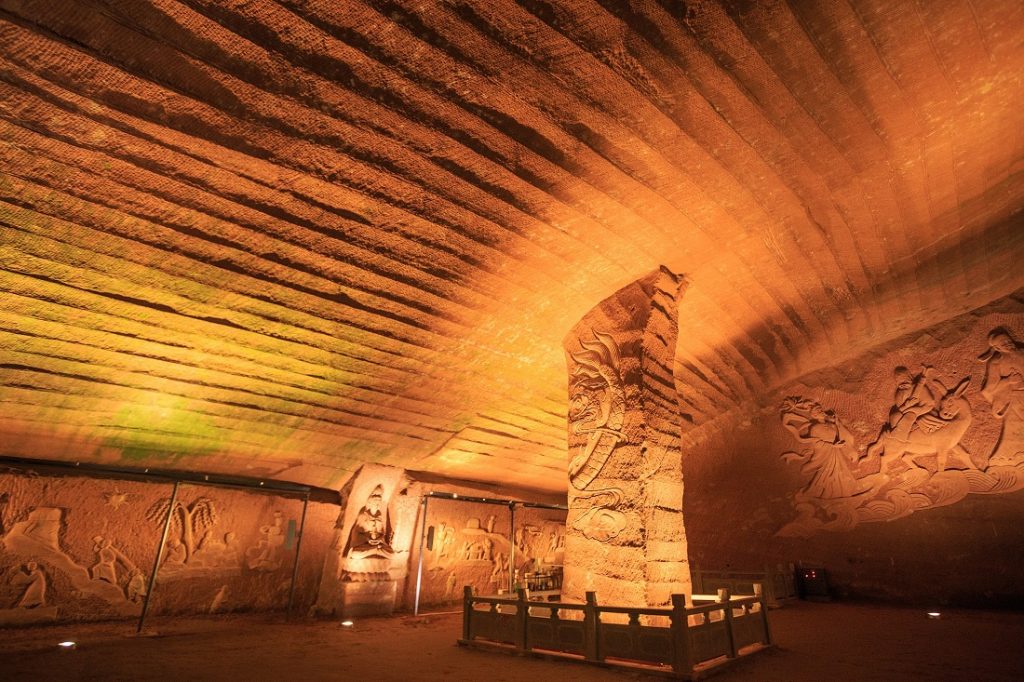
The layout is distinctive. Many chambers are entered from above by an opening and a cut stairway, then open into a sloping space whose ceiling follows the dip of the rock layers. One or more tall stone pillars were left in place to carry the roof, and engineering studies note side walls that lean slightly inward and pillars with an unusual fishtail cross-section. Estimates of the total volume of rock removed vary widely in popular accounts, and no single measured figure has been published as a settled value, so it is left out here.
The caverns are cut into argillaceous (clay-rich) siltstone of the Upper Cretaceous Quxian Formation. Some popular accounts call it sandstone; the engineering literature is more specific. It is a medium-soft rock: firm enough to stand in large spans, soft enough to be worked with iron hand tools.
What do the chisel marks show?
The most photographed feature of the caves is the tooling. Walls, ceilings and pillars are covered in a uniform finish of parallel bands roughly 60 centimetres wide. Each band is filled with fine, parallel chisel strokes set at about 60 degrees to the band, so the whole surface reads like a woven or ribbed texture. Some chambers also carry carved figures, including the horse, fish and birds in the visitor cavern.
The regularity is what draws "lost technology" claims, because the pattern looks almost mechanical over hundreds of square metres. But that kind of uniformity is exactly what experienced stoneworkers produce when they work in a fixed rhythm, angle and direction. Masons and quarrymen across the ancient world left repeating tool patterns because a trained hand, a standard chisel and a set working method produce the same stroke thousands of times. The same discussion comes up around precision stonework in Egypt; see our guide to Egyptian stone vases and drill cores for how that debate plays out with a harder material.
A second puzzle is the spacing. In places the caverns sit close together, with dividing walls reportedly as thin as about half a metre, yet none of them breaks into its neighbour and there are no connecting passages. That points to planning and surveying skill: the diggers knew where each chamber was in relation to the others while working underground. It is an argument for organised, skilled labour. It is not evidence for unknown machines.
How old are the Longyou Caves?
The honest answer is "at least about 2,000 years, probably," with no fixed date. No surviving historical document records the construction or purpose of the caverns, so every age estimate comes from indirect evidence.
The main peer-reviewed engineering study, by L.H. Li, Z.F. Yang, Z.Q. Yue and L.Q. Zhang in Tunnelling and Underground Space Technology (2009), describes them as hand-excavated caverns "more than 2000 years old." Pottery fragments reported from the silt inside the caves have been dated to roughly 206 BCE to 23 CE, the Western Han period and its immediate aftermath, which suggests the chambers already existed by then. A 17th-century poem has also been cited as a possible reference to the site, though it says nothing about who made the caves.
Those clues set a minimum age, not a construction date. Pottery in the silt shows when material washed or was carried in; it does not show when the rock was first cut. Treat the age as an estimate of "at least about 2,000 years" and treat any precise date or named builder as a guess. For comparison, the Huashan Grottoes, a similar group of man-made caverns about 200 kilometres to the northwest, have been dated by lichenometry to the late Ming dynasty, more than 1,500 years later. That is a reminder that this kind of excavation was carried out in the region more than once.
What were the caves for?
Nobody knows for certain, and several explanations have been proposed:
- Stone quarrying. This is the most common mainstream explanation. Leaving pillars to hold up the roof while cutting stone around them is the room-and-pillar method used in quarries and mines around the world, and the sloping chambers follow the rock layers in the way a quarry face would.
- Storage. Large, cool, dry underground spaces could have held grain or goods.
- Military use. Some writers have suggested barracks or hidden garrisons.
- Tombs or ritual spaces. The carvings and careful finish have prompted ideas of imperial halls, tombs or ceremonial sites.
None of these is confirmed. Critics of the quarry idea point out that no buildings made from this stone have been identified, that a clay-rich siltstone is not an especially good building stone, and that entering a quarry from above is awkward. On the other side, stone used for ordinary local building is often hard to trace centuries later, and the pillars, sloping floors and stairways fit a working excavation better than a ceremonial plan. Equally, no grave goods, habitation debris or military finds have been reported that would support the other explanations.
What has scientific research found since 1992?
Since the caves were drained, most research has treated them as an engineering problem rather than an archaeological one. The questions are practical: why did these large, shallow, soft-rock chambers stay stable for two millennia, and why did some start to crack or partly fail once they were pumped dry?
Li and colleagues (2009) documented the geological setting, the groundwater conditions, seepage and fractures in the intact caverns, and the condition of caverns that had already failed, then assessed protective measures. Later work, including studies gathered in the 2015 conference volume Ancient Underground Opening and Preservation, recorded roof cracks, small rock falls, delaminating ceiling rock and damage to pillars and portals. Researchers have warned that some chambers remain at risk of roof collapse without continued reinforcement.
The most discussed result is a 2010 paper by Z.Q. Yue and colleagues at the University of Hong Kong and the Chinese Academy of Sciences, published in Frontiers of Architecture and Civil Engineering in China (now Frontiers of Structural and Civil Engineering). It asked why the interior walls looked free of old cracks when they were first drained in 1992, even though new cracks appeared afterwards. The authors proposed that the siltstone "self-healed" small cracks while it was flooded. In their tests the rock was weakly alkaline and the local rainwater weakly acidic, and reactions between them formed new minerals such as calcite that filled and sealed cracks. If that is right, the clean surfaces that impressed early visitors are partly a product of centuries under water, not evidence of an unusual cutting method.
What do proponents of lost technology claim?
Some writers, websites and television programmes describe the Longyou Caves as evidence of lost or even non-human technology. The argument usually rests on three points: the scale of the excavation, the precision and regularity of the tool marks, and the absence of any written record from a culture known for keeping records. Some versions add claims about the darkness of the deep chambers and the lack of surviving tools or lamps.
These are fair questions, and the absence of documents is real. But each point has a grounded answer. Scale reflects organised labour over time; the tool marks match hand tools used in a set pattern; the missing record means the project was not written up, or that the record has not survived, which is common for practical works. The caves are also not unknown to Chinese archaeology. They are a listed national heritage site studied by geologists, engineers and historians. Claims that they are millions of years old, alien-made or machine-cut are not supported by any published evidence. For the wider debate, see our explainer on ancient astronaut theory, and for a genuine case of surprising ancient engineering, the Antikythera mechanism.
Billy Carson's reading
Billy Carson has not published a dedicated video or episode on the Longyou Caves, so no specific position on them should be attributed to him. The site appears on the 4biddenknowledge blog in April Carson's list of the most mysterious archaeological discoveries ever made, which highlights that no document records how the caverns were made.
His closest documented views come from related sites. In the Derinkuyu companion, Billy treats underground refuges on several continents as part of a wider human response to ancient cataclysm. In the stone vases companion, he argues that precision stonework points to knowledge inherited from an earlier civilisation. Read in that light, Longyou raises the kind of questions he asks elsewhere: who planned caverns this large without breaking one into another, what they were meant to protect or produce, and why the record is silent. Those are his questions and his framework, not conclusions the evidence at Longyou has settled. For another Chinese site discussed on the 4biddenknowledge blog, see the post on ancient Chinese pyramids and the North Star.
Watch, read and go deeper
On 4BK TV, the Ancient Enigmas series covers the sites and unanswered questions that sit at the edge of mainstream history. For another underground complex with a clearer paper trail, start with the Derinkuyu explainer. The Anunnaki topic hub gathers Billy's articles, episodes and reading on the earliest civilisations and the lost-knowledge debate.
Frequently asked questions
Who built the Longyou Caves?
No one knows. No inscription, document or burial names the builders, and no tools have been reported from the caverns. The workmanship points to an organised local workforce using hand tools, most likely more than 2,000 years ago.
How many Longyou Caves are there?
The commonly cited figure is 24 caverns, five of which were drained first in 1992. Some later sources report up to 36 across the hillside. The number has grown as surveys have continued, so it may change again.
Can you visit the Longyou Caves?
Yes. The site near Shiyan Beicun in Longyou County, Zhejiang, is open as a scenic area. Only one cavern is open to visitors, and it includes carvings of a horse, fish and birds. Access is by stairways, so it is not suited to wheelchairs.
Were the Longyou Caves made by machines?
There is no evidence of machine cutting. The walls carry parallel bands of fine chisel strokes, the pattern skilled masons produce with hand tools in a set rhythm. The rock is a medium-soft siltstone that can be worked by hand.
Why were the caves full of water?
After the caverns were abandoned, rainwater and groundwater filled them, and their entrances looked like ordinary ponds until 1992. Researchers think the long flooding helped preserve the caverns and may have allowed small cracks in the rock to seal themselves with new minerals such as calcite.
Sources and further reading
- L.H. Li, Z.F. Yang, Z.Q. Yue and L.Q. Zhang, "Engineering geological characteristics, failure modes and protective measures of Longyou rock caverns of 2000 years old," Tunnelling and Underground Space Technology 24, no. 2 (2009): 190–207.
- Z.Q. Yue, S. Fan, Z. Yang, L. Li, L. Zhang and Z. Zhang, "A hypothesis for crack free interior surfaces of Longyou caverns caved in argillaceous siltstone 2000 years ago," Frontiers of Architecture and Civil Engineering in China 4, no. 2 (2010): 165–177.
- Yang and Tanimoto (eds.), Ancient Underground Opening and Preservation (CRC Press, 2015), including Han and colleagues on roof cracks in the Niuchang cave at Longyou.
- C. Zhu and colleagues, "Lichenometric dating and the nature of the excavation of the Huashan Grottoes, East China," Journal of Archaeological Science 40, no. 5 (2013): 2485–2492.
- Zhejiang Provincial Department of Culture and Tourism, "Longyou Grottoes" (site information).