 Travel with Billy Carson —
 Caral, officially the Sacred City of Caral-Supe, is a monumental settlement of pyramids, sunken circular plazas and residential quarters on a desert terrace above the Supe River on Peru's north-central coast, about 182 km north of Lima. Radiocarbon dates place its development between roughly 3000 and 1800 BCE, and UNESCO describes it as about 5,000 years old. Built by a society with no pottery, it is often called the oldest city in the Americas.
Caral matters because it moves the start of urban life in the Andes back by more than a thousand years. Its earliest construction phases are broadly contemporary with Egypt's first pyramids and with the cities of Sumer, yet it grew up independently, thousands of kilometres from either. For the debate over whether ancient monuments point to one lost source or to many local ones, few sites matter more.
Where is Caral and what is the Sacred City of Caral-Supe?
Caral lies in the middle Supe valley, roughly 23 km inland from the Pacific and about 350 m above sea level. UNESCO describes it on "a dry desert terrace overlooking the green valley" of the Supe River.
The World Heritage Committee inscribed the Sacred City of Caral-Supe on the World Heritage List in June 2009, at its 33rd session in Seville, under criteria (ii), (iii) and (iv). The protected property covers about 626 hectares, surrounded by a buffer zone of more than 14,600 hectares. The urban core covers roughly 66 hectares.
Caral is one of about 18 settlements of the same period that Ruth Shady's team recorded in the Supe valley. Together with sites in the neighbouring Pativilca and Fortaleza valleys, they form what archaeologists call the Caral-Supe or Norte Chico tradition. It predates the Nazca, who made their famous desert lines more than two thousand years later, and it is older than the Inca by over four thousand years.
How old is Caral, and where does the 2627 BCE date come from?
Caral was built and occupied between roughly 3000 and 1800 BCE, in what archaeologists call the Late Archaic period of the Central Andes. The specific date often quoted for its early monuments, about 2627 BCE, comes from the first radiocarbon study of the site.
That study, "Dating Caral, a Preceramic Site in the Supe Valley on the Central Coast of Peru," was published in Science in April 2001 by Ruth Shady Solís, Jonathan Haas and Winifred Creamer. Its 18 radiocarbon dates calibrate to a range of about 2627 to 1977 BCE. The site dates well because of how it was built: the platforms were filled with stones carried in bags woven from reeds and plant fibre, known in Peru as shicras. Those bags were left inside the fill, so the organic material sealed within a building records when that phase of construction took place.
A wider picture followed in 2004, when Haas, Creamer and Alvaro Ruiz published "Dating the Late Archaic occupation of the Norte Chico region in Peru" in Nature. Working mainly in the Pativilca and Fortaleza valleys, they reported 95 new radiocarbon dates from 13 of more than 20 large early sites, placing the emergence of the whole complex between about 3000 and 1800 BCE.
Those dates put Caral in remarkable company. Around the time Caral's builders were raising their first platforms, Egyptians were moving from the step pyramid to the true pyramids of the Fourth Dynasty, and southern Mesopotamia already had walled cities. Our ancient civilizations timeline sets these horizons side by side.
Is Caral really the oldest city in the Americas?
Caral is widely described as the oldest city in the Americas, and UNESCO calls it "the oldest centre of civilization in the Americas," but the more careful phrasing is that it is one of the oldest. It was the first Norte Chico site excavated on a large scale and published with strong dates, which is why the title stuck.
Other sites of the same tradition are at least as old. Áspero, a fishing settlement with platform mounds at the mouth of the Supe River, was first recorded by Max Uhle in 1905 and has early dates of its own. In the Fortaleza valley, Huaricanga has been put forward as older still: Charles C. Mann's 1491, drawing on the Haas and Creamer fieldwork, gives around 3500 BCE for its earliest settlement. Because the Norte Chico sites rose together as a network, the safest statement is that Caral belongs to the earliest urban complex in the Americas rather than that it alone is proven first.
What did Ruth Shady discover at Caral?
Ruth Shady Solís, an archaeologist at the National University of San Marcos in Lima, turned a set of long-ignored mounds into one of the best-documented early cities in the world. Earlier visitors had noticed the site without recognising its age. Max Uhle surveyed the Supe valley in the early 20th century, and the American historian Paul Kosok described the ruins in 1948, but the mounds were not understood as preceramic monuments.
According to the Caral Archaeological Zone's own institutional history, Shady began surveying the Supe valley in 1993, working on weekends for two years and recording 18 archaeological settlements; the survey was completed in 1996. She then chose Caral for excavation, beginning with a small grant from the National Geographic Society. The absence of pottery on the surface was an early clue that the site was very old, since ceramics appear in Peru only after about 1800 BCE.
The work grew into a state institution. In February 2003, Supreme Decree 003-2003-ED created the Caral-Supe Special Archaeological Project. In 2010, when Peru's new Ministry of Culture absorbed the National Institute of Culture, the project became the Caral Archaeological Zone, which still manages the site. Her team has since excavated Áspero and other settlements in the valley.
What is inside the city: pyramids, plazas and homes
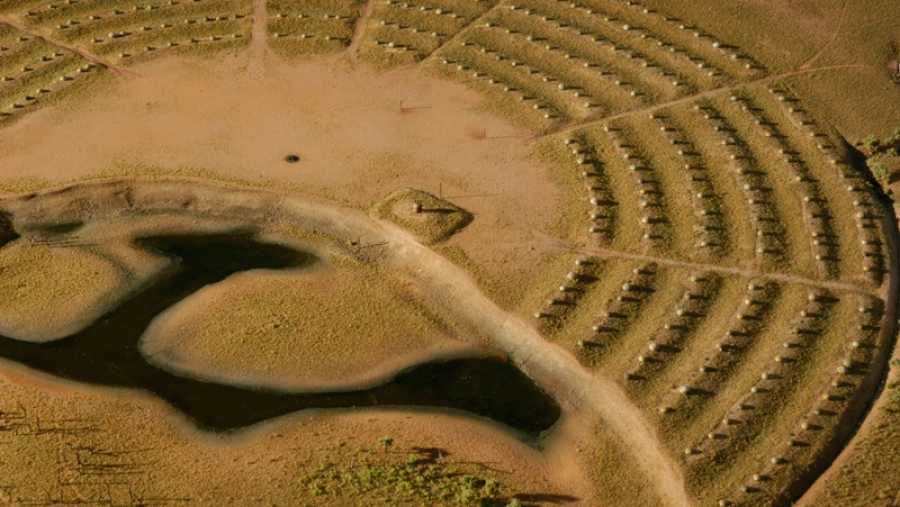
The city is organised around six large pyramidal platform mounds, along with sunken circular plazas, smaller public buildings and residential groups. The largest, the Pirámide Mayor or Great Pyramid, is usually given as about 150 by 110 metres at the base and around 28 metres high, though early reports quoted somewhat smaller figures. A stairway climbs to it from a sunken circular plaza.
Caral's builders raised their platforms in repeated phases of stone and fill. The residential areas show differences in status, with larger, better-built houses near the monuments and simpler dwellings on the edges. Population estimates for the city itself run to about 3,000 people, and some researchers suggest a total of perhaps 20,000 across the Supe valley's settlements. These are estimates, not counts. To compare Caral's platforms with pyramid traditions elsewhere, see our guide to pyramids around the world.
How did Caral's people live? Cotton, fish, music and the question of war
Caral's economy rested on irrigated farming in the valley and exchange with fishing communities on the coast. Its people grew cotton, squash, beans and other crops using canals fed by the Supe River. They did not make pottery. Cotton mattered most, because coastal fishing depended on cotton nets.
The protein came largely from the sea. Caral's own researchers report that anchoveta, the Peruvian anchovy, was the fish most consumed at the site, along with shellfish brought inland from settlements such as Áspero. Shady's model is one of interdependence: inland farmers supplied cotton and plant foods, coastal communities supplied fish, and the exchange produced surpluses that supported specialists and leaders.
Music clearly mattered. In the Temple of the Amphitheatre excavators found a cache of 32 transverse flutes made of condor and pelican bone, many decorated with animal designs, along with dozens of cornets made of deer and camelid bone.
Excavators have also reported no clear evidence of warfare at Caral: no defensive walls, no weapons stockpiles and no signs of mass violence. Shady reads this as evidence of a society held together by religion, ritual and trade rather than conquest. That is her interpretation of what has, and has not, been found. Absence of evidence is not proof of permanent peace, and researchers working elsewhere in the Norte Chico have noted cases of violence and possible sacrifice, including child burials reported at Áspero.
The Caral quipu: what was found and what it might mean
In 2005 Shady's team announced the discovery of a quipu, the knotted-cord recording device best known from the Inca empire. It consists of brown cotton cords wound around thin sticks. Shady said it had been placed as an offering on a stairway of a public building at Caral, the Pyramid of the Gallery, and then buried when a new floor was laid over the structure.
On the strength of that building context, Shady dated the quipu to the Caral period, around 5,000 years ago, and called it the oldest quipu known. If that holds, it is thousands of years older than the earliest quipus previously known, which date to around 650 CE. Two cautions apply. First, the date rests on where the object was found, not on direct radiocarbon dating of the cords. Second, no one knows what an early quipu like this recorded. Inca quipus encoded numbers and probably other information, and Shady has suggested Caral's may have tracked goods and obligations, but the Caral example has not been read and should not be described as decoded.
Billy Carson's reading
Billy Carson has not, to date, released a dedicated episode on Caral. His documented position on Peru comes from his talk "Could Peru be One of the Lost Atlantian Civilizations?", where he argues that "Atlantis was not just a ring city. Atlantis was a global civilization," reading recurring features in Peru, Egypt and Mexico as parts of one planetary story. That talk centres on Sacsayhuamán and the megalithic walls of the Cusco region, which he argues were built by an earlier, more advanced culture than the Inca. The companion article, Was Peru Part of Atlantis?, sets out that argument in full, including his reading of the Anunnaki and Thoth.
Caral raises the kind of questions Carson asks of the ancient world: how did a society without pottery or writing as we know it organise the labour to raise six pyramids around 2600 BCE, and why do pyramid-building, astronomy-minded cultures appear on several continents in the same broad window? For readers following his idea of a lost global civilization, the timing of Caral is a natural point of interest.
The archaeological record points in a different direction, and it should be stated plainly. Excavation at Caral, Áspero and the Fortaleza sites shows the Norte Chico complex growing out of local Late Archaic farming and fishing communities, with its own building methods, its own crops and a clear sequence of construction phases. Readers can weigh Carson's questions against that evidence. Those who want to see Peru's sites in person can look at the 4biddenknowledge Peru tours, which focus on the Inca-era and megalithic sites he discusses.
Watch, read and go deeper
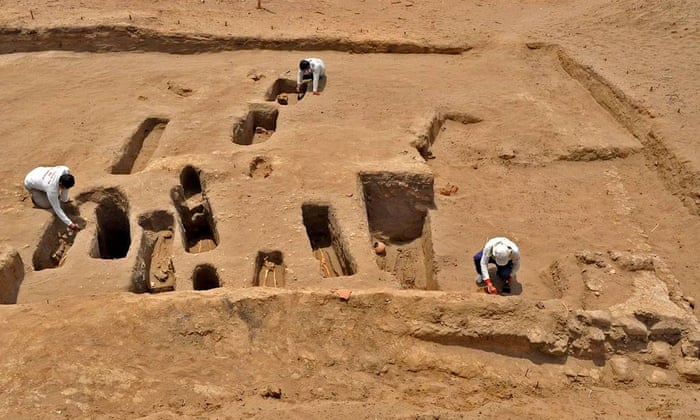
Billy Carson's full talk on Peru and Atlantis is on the podcast as Could Peru be One of the Lost Atlantian Civilizations?, and 4BK TV's Megalithic Mysteries explores the stonework debates he raises. For Peru's later archaeology, read about the discovery of ancient pre-Inca tombs. The Anunnaki topic hub gathers Carson's wider work on ancient civilizations and the lost-civilization debate.
Frequently asked questions
How old is Caral in Peru?
Caral was built and occupied between roughly 3000 and 1800 BCE, according to radiocarbon dating, which is why UNESCO describes it as about 5,000 years old. The often-quoted date of around 2627 BCE comes from the 2001 Science study by Ruth Shady Solís, Jonathan Haas and Winifred Creamer, which dated plant material from the site.
Who discovered Caral?
Max Uhle and Paul Kosok noted the mounds in the 20th century without recognising their age. The Peruvian archaeologist Ruth Shady Solís of San Marcos University surveyed the Supe valley from 1993 and began excavating Caral after completing the survey in 1996. Her work established it as a major preceramic city.
Is Caral older than the Egyptian pyramids?
Caral's early monuments are broadly contemporary with Egypt's first pyramids rather than clearly older. Its main construction dates cluster around 2600 BCE, the same century as the early Fourth Dynasty pyramids. Some other Norte Chico sites have occupation dates that are earlier.
Did Caral have writing?
Caral had no known script. Shady's team found a quipu, a knotted-cord recording device, dated by its building context to the Caral period, which suggests a system for keeping records. What it recorded is unknown, and it has not been decoded.
Is Caral connected to the Inca or the Nazca?
No direct connection has been shown. Caral was abandoned around 1800 BCE, long before the Nazca culture or the Inca empire. Some Andean traditions, such as the quipu, may have long histories, but Caral itself predates both by millennia.
Sources and further reading
- UNESCO World Heritage Centre, "Sacred City of Caral-Supe" (World Heritage List entry 1269, inscribed 2009), and ICOMOS advisory body evaluation
- Ruth Shady Solís, Jonathan Haas and Winifred Creamer, "Dating Caral, a Preceramic Site in the Supe Valley on the Central Coast of Peru," Science 292 (2001)
- Jonathan Haas, Winifred Creamer and Alvaro Ruiz, "Dating the Late Archaic occupation of the Norte Chico region in Peru," Nature 432 (2004)
- Zona Arqueológica Caral, Ministry of Culture of Peru, institutional history and research publications
- Charles C. Mann, 1491: New Revelations of the Americas Before Columbus (Knopf, 2005)
- Michael E. Moseley, The Incas and Their Ancestors: The Archaeology of Peru (Thames & Hudson, revised edition 2001)