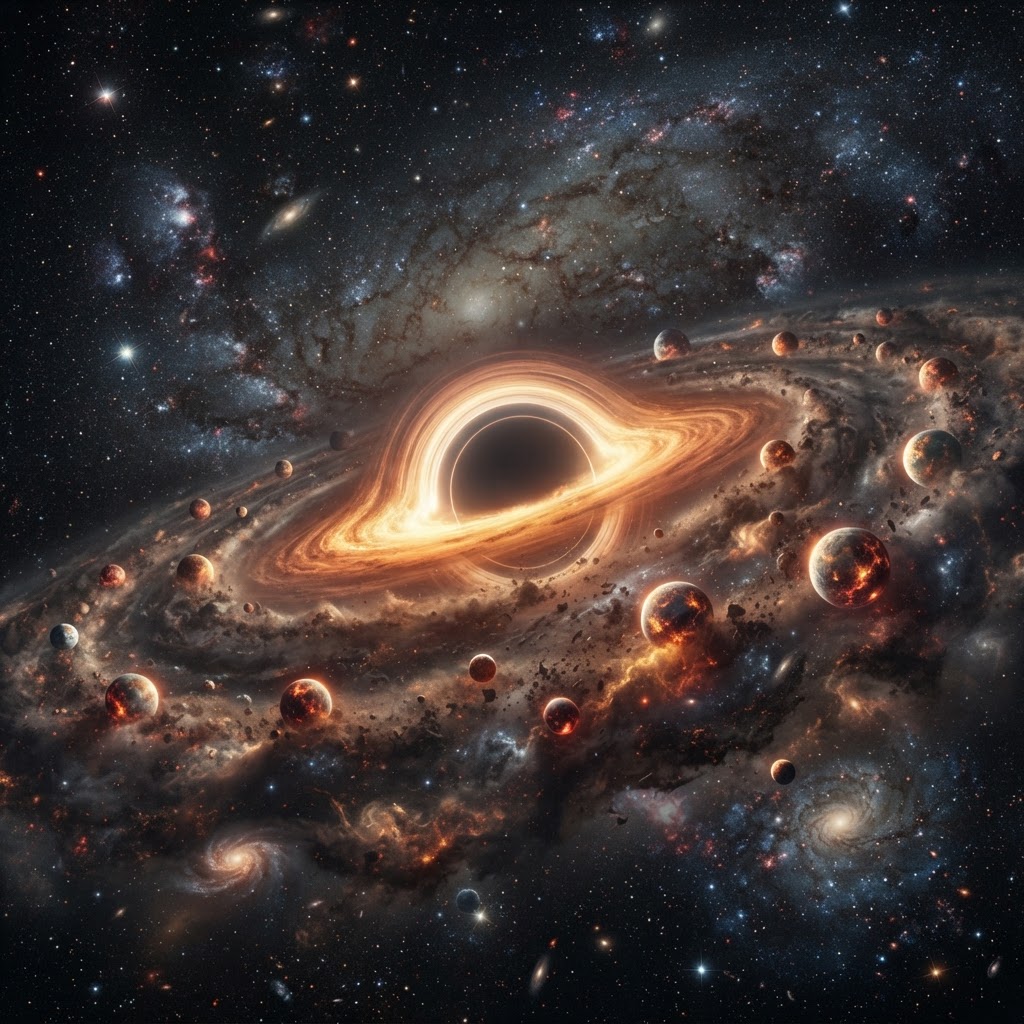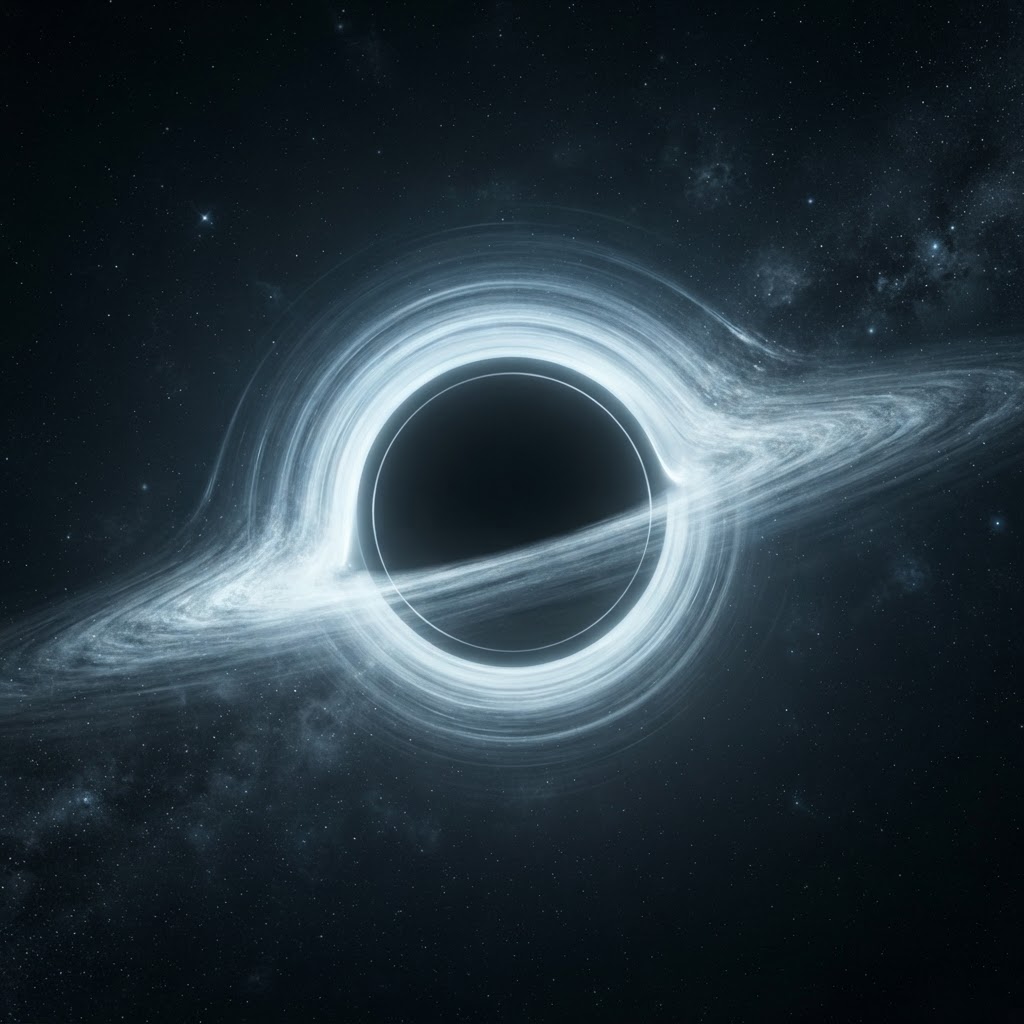
Black holes already have a reputation for pushing physics to uncomfortable places. They bend spacetime, trap light, hide information behind event horizons and force quantum mechanics and gravity into the same conversation.
But there is a particularly strange class of black holes that creates another problem.
They can have a temperature of absolute zero.
For decades, physicists had strong reasons to believe that although equations allowed these objects to exist, nature should prevent an ordinary black hole from actually becoming one. That idea was closely tied to the third law of black-hole thermodynamics.
Now, research published in 2026 has demonstrated something physicists had long thought should be impossible: under certain conditions, an existing black hole can evolve into an extremal, zero-temperature black hole in a finite amount of time.
And if that sounds like a technical loophole, it isn't.
It could force physicists to reconsider just how universal the laws of thermodynamics really are.
First, Why Do Black Holes Have a Temperature?
For a long time, black holes were viewed as almost perfectly cold objects. Anything could fall inside, but nothing could escape.
Then the work of physicists Jacob Bekenstein and Stephen Hawking completely changed that picture.
Bekenstein proposed that a black hole possesses entropy and that this entropy is related to the area of its event horizon. Hawking later showed that quantum effects cause black holes to emit thermal radiation — what we now call Hawking radiation.
Suddenly, black holes weren't just gravitational objects.
They were thermodynamic systems.
That means we can talk about them using familiar concepts:
→ Mass represents energy
→ Event-horizon area is connected to entropy
→ Surface gravity is connected to temperature
→ Hawking radiation allows black holes to exchange energy with their surroundings
This connection became one of the most important clues suggesting that gravity, quantum mechanics and thermodynamics may be pieces of a deeper theory.
Robert B. Mann of the University of Waterloo noted in a 2026 review that black-hole thermodynamics has now been studied for roughly half a century, yet major puzzles remain — including possible violations of the third law, the microscopic origin of black-hole entropy and the information paradox.
And that brings us to the strange black holes at the center of this story.
Meet the Extremal Black Hole
Some black holes don't just have mass.
They can also rotate and carry electric charge.
In general relativity, there are limits to how much angular momentum or charge a black hole can possess relative to its mass. Push one of those properties all the way to its theoretical boundary, and something unusual happens.
The black hole becomes extremal.
Its surface gravity drops to zero.
And because Hawking temperature is proportional to surface gravity:
Its temperature becomes zero.
Not just extremely cold.
Absolute zero.
This has created an awkward situation for physics for decades because ordinary thermodynamics tells us that reaching absolute zero should be impossible through a finite physical process.
The Third Law Says You Should Never Get There
You've probably heard of the first and second laws of thermodynamics, but the third law receives less attention.
One common version of it says that absolute zero cannot be reached through a finite number of physical operations.
You can get closer.
And closer.
And ridiculously closer.
But you should never actually arrive.
Black-hole physicists developed an analogous principle. In simple terms:
A non-extremal black hole should not be transformable into an extremal black hole through a finite physical process.
Jacob Bekenstein recognized this connection early in the development of black-hole thermodynamics. As a black hole gets increasingly close to its extremal state, processes that push it closer should become less and less effective.
The universe appeared to be protecting the boundary.
For example, calculations involving rotating black holes suggested that attempts to spin them all the way to extremality would stall before reaching the exact limit. Earlier astrophysical work indicated that accretion could push a black hole extremely close to maximum rotation without actually reaching it.
Physics seemed to be saying:
You can approach zero temperature, but you can't touch it.
Then researchers found a way to touch it.
The Black Hole That Wasn't Supposed to Form
In 2026, physicists John R. V. Crump, Maxime Gadioux, Harvey S. Reall and Jorge E. Santos published a study in Physical Review Letters investigating the third law of black-hole mechanics.
Their result was striking.
Using numerical calculations, the researchers demonstrated solutions in five-dimensional vacuum gravity in which an initially non-extremal Schwarzschild black hole evolves into an extremal rotating black hole in finite time.
That distinction matters.
This wasn't simply an extremal black hole appearing as a mathematical solution.
The researchers demonstrated a process in which one could actually form from a preexisting black hole.
Even more importantly, the violation did not require exotic matter with unusual properties.
It appeared in vacuum gravity itself.
The authors describe their result as the first example of a violation of the third law of black-hole mechanics in vacuum gravity.
That turns a decades-old assumption on its head.
Does This Mean Thermodynamics Is Broken?
Not exactly.
This is where the story becomes more interesting.
The researchers' result concerns a particular gravitational setting involving five spacetime dimensions, rather than the familiar four-dimensional universe of three spatial dimensions plus time.
So this discovery does not mean scientists have found astrophysical black holes in our universe sitting at absolute zero.
It also doesn't mean your refrigerator is about to start violating thermodynamics.
What it does mean is that something physicists regarded as a general principle of black-hole mechanics is not universally valid.
And in theoretical physics, finding the precise place where a principle fails can be more valuable than confirming it again.
It tells researchers where the deeper theory may be hiding.
There's Another Problem With Zero-Temperature Black Holes
Temperature isn't the only strange thing about extremal black holes.
Entropy makes the situation even more confusing.
The familiar Bekenstein-Hawking relationship tells us that black-hole entropy is proportional to the area of its event horizon.
An extremal black hole can therefore have:
→ Zero temperature
→ A finite event-horizon area
→ Nonzero entropy
That doesn't fit neatly with one traditional formulation of the third law of thermodynamics, which associates zero temperature with entropy approaching zero or a universal constant independent of other thermodynamic parameters.
Physicist Robert Wald explored this problem in detail in 1997, pointing out that rotating black holes do not satisfy the usual Nernst formulation of the third law. Interestingly, Wald also showed that certain ordinary thermodynamic systems can violate that formulation, raising questions about whether that particular version of the third law should be regarded as fundamental in the first place.
So extremal black holes aren't simply breaking a rule.
They may be exposing ambiguity in what we thought the rule actually meant.
Why Black Holes Keep Finding the Cracks in Physics
This is why I find black-hole physics so fascinating.
Every time we think we've built a clean boundary between different areas of physics, black holes seem to walk straight across it.
Gravity says one thing.
Quantum mechanics adds another.
Thermodynamics steps in.
Information theory raises its hand.
And suddenly a seemingly simple object defined by mass, charge and rotation becomes a laboratory for some of the deepest questions in science.
Black-hole thermodynamics already gave us the extraordinary idea that the geometry of spacetime can behave like thermodynamics.
Bekenstein connected horizon area with entropy.
Hawking showed black holes possess temperature and radiate.
Today, researchers are still trying to understand what those discoveries are really telling us about the microscopic structure of spacetime.
Could This Point Toward Quantum Gravity?
Possibly — although we should be careful not to jump further than the research allows.
One of the biggest unsolved problems in modern physics is creating a consistent theory that combines general relativity with quantum mechanics.
Black holes sit directly at that intersection.
Their thermodynamic behavior is therefore more than an interesting coincidence. Many physicists suspect it provides clues about whatever deeper framework eventually becomes a theory of quantum gravity.
If the traditional third law of black-hole mechanics isn't universal, researchers now have another boundary condition that a deeper theory may need to explain.
A successful theory may have to tell us:
→ Why black holes have entropy at all.
→ What microscopic states that entropy represents.
→ What really happens to information that crosses an event horizon.
→ Whether extremal black holes can exist physically in our universe.
→ Whether zero-temperature black holes behave differently at the quantum level.
→ Why thermodynamics emerges so naturally from the geometry of spacetime.
Those aren't small questions.
They go straight to the architecture of reality.
The Bigger Picture
Physics advances in a strange way.
Sometimes scientists discover a new particle or detect a new object.
Other times, progress comes from discovering that something we thought couldn't happen actually can.
Extremal black holes may belong to that second category.
For decades, the third law of black-hole mechanics suggested that nature should prevent a black hole from reaching the zero-temperature extremal state through any finite physical process.
The new calculations show that the rule has exceptions — at least within certain higher-dimensional gravitational systems.
That doesn't destroy thermodynamics.
But it does something arguably more useful.
It shows us where thermodynamics begins to bend.
And black holes have a long history of turning those cracks into clues.
The universe may not be breaking its own rules.
We may simply be discovering that the rules were never as complete as we thought.