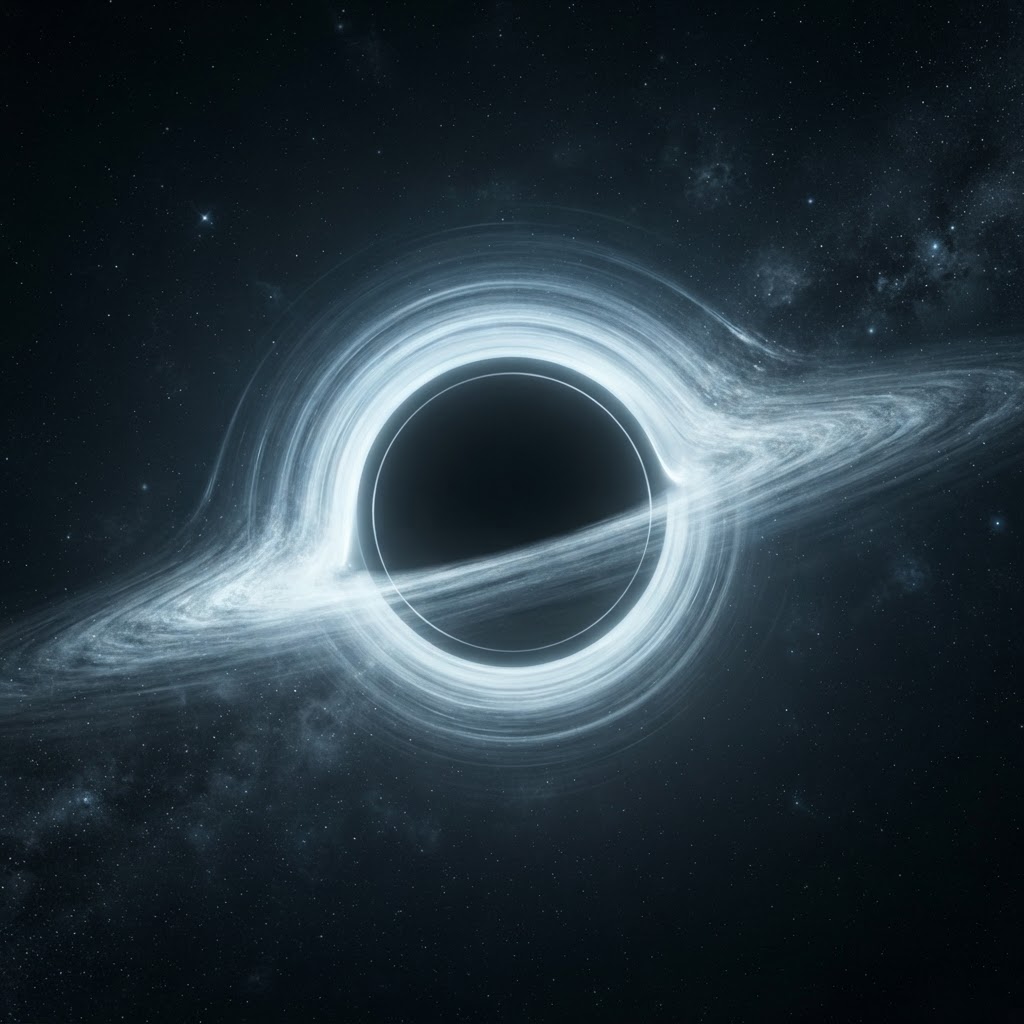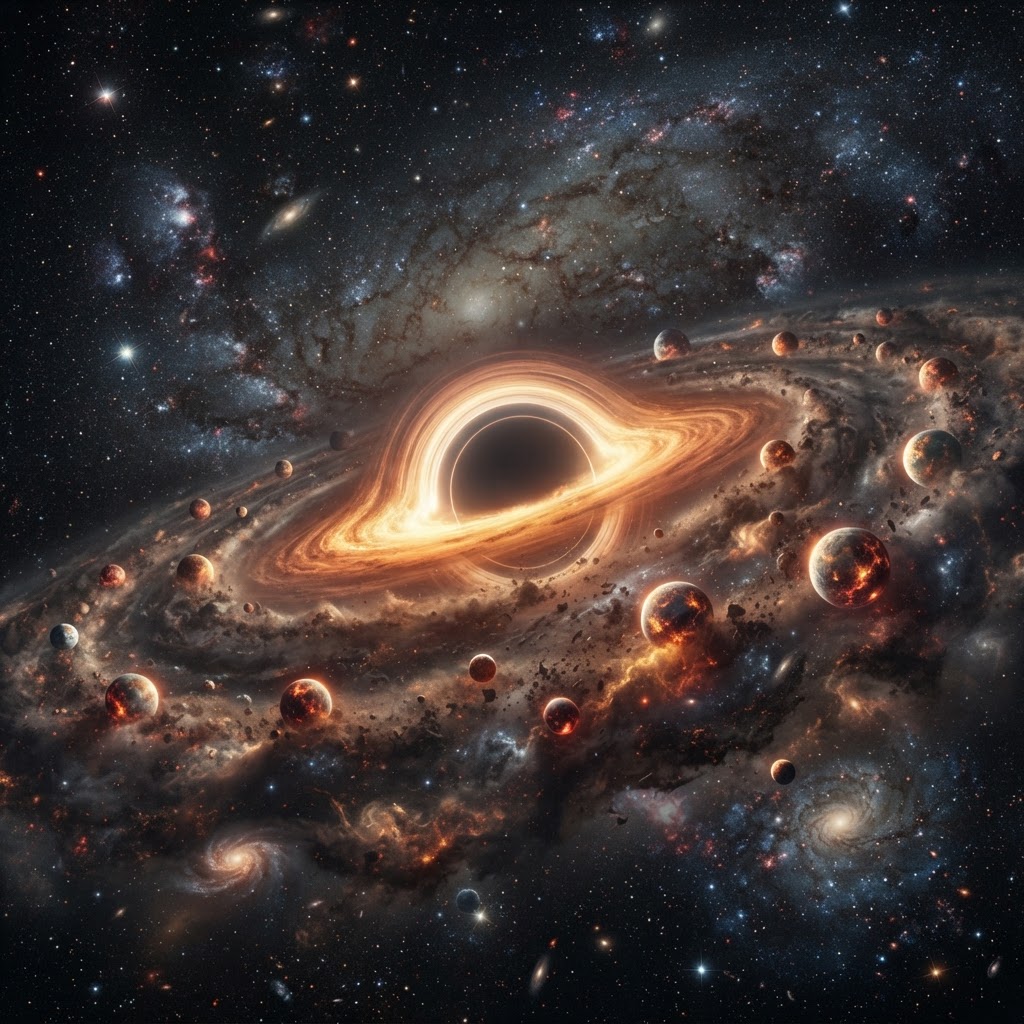
When we picture a black hole, we usually imagine destruction.
Matter falls in. Light struggles to escape. Stars can be torn apart by extreme gravity.
But new research is revealing a much stranger possibility: the environments surrounding some supermassive black holes may not only destroy objects — they may also create them.
A 2026 study suggests that the enormous disks of gas and dust surrounding active supermassive black holes could potentially produce millions of planets and planet-like objects. Some could become enormously massive, with continued growth potentially pushing certain objects into the realm of stars.
That turns our usual picture of a black hole on its head.
Instead of imagining only a cosmic graveyard, scientists are beginning to investigate whether the outskirts of these environments could also function as enormous cosmic nurseries.
First, What Is an Active Galactic Nucleus?
At the center of most large galaxies lies a supermassive black hole, containing millions or even billions of times the mass of our Sun.
When one of these black holes is actively consuming surrounding material, the region is known as an active galactic nucleus, or AGN.
Gas and dust spiral around the black hole before some of that material eventually falls inward. This creates an incredibly energetic environment.
But here's where things get interesting.
The entire disk isn't equally hot.
Farther away from the black hole, portions of the surrounding disk can become cool enough for solid dust grains to exist and grow. Researchers have found that these outer regions can share important characteristics with the protoplanetary disks around young stars — the environments where ordinary planets are born.
In other words:
→ Young stars can have disks of gas and dust.
→ Active supermassive black holes can also be surrounded by enormous disks of gas and dust.
→ Under the right conditions, dust inside either environment may begin clumping together.
And once dust begins clumping, planet formation becomes possible.
From Dust Grains to Entire Worlds
The basic idea isn't completely different from how scientists think Earth formed.
According to NASA's current explanation of planet formation, worlds begin with tiny grains of dust inside disks surrounding young stars. Those particles collide and stick together, eventually producing pebbles, rocks, planetesimals and, ultimately, planets.
Around an active galactic nucleus, researchers believe another process known as streaming instability could help concentrate enormous amounts of dust.
Think of it as cosmic traffic.
Instead of dust remaining evenly spread throughout the disk, interactions between gas and solid particles can cause particles to gather into dense regions. Once enough material becomes concentrated, gravity can take over.
Those concentrations can collapse into planet-sized bodies.
The scale predicted by the new research is extraordinary.
Researchers led by Bhupendra Mishra, alongside Wladimir Lyra, Barry McKernan, Mordecai-Mark Mac Low, K. E. Saavik Ford and Harrison E. Cook, modeled conditions inside AGN dust tori. Their calculations suggest dust filaments could contain solar masses of material and fragment into tens of millions of planetesimals, ranging from roughly Earth-mass objects to bodies exceeding Jupiter's mass.
That's not a solar system.
That's potentially an entire population of worlds surrounding a single galactic nucleus.
Some Could Become Enormous
Planet formation might only be the beginning.
Once these objects form, they can continue sweeping up surrounding material through processes such as pebble accretion and gas accretion.
The researchers calculated mass-doubling times ranging from roughly 1,000 to 10 million years, depending on the conditions. Because active galactic nuclei can persist long enough for substantial growth, some objects could become extraordinarily massive.
Wladimir Lyra of New Mexico State University described objects approximately 1,000 times Earth's mass made from dust, with some potentially approaching stellar masses.
That leads to one of the strangest implications of the research:
An object could begin through a planet-like formation process and potentially grow massive enough to become a star.
Normally, stars are thought to form when enormous clouds of molecular gas collapse under their own gravity.
This research raises the possibility of another pathway — beginning with the accumulation of solid material in an AGN disk.
Scientists Have Suspected "Black Hole Planets" Before
The 2026 research didn't appear out of nowhere.
In 2019, astrophysicists Keiichi Wada, Yusuke Tsukamoto and Eiichiro Kokubo investigated whether planets could form inside the dusty disks surrounding supermassive black holes.
Their calculations suggested that icy dust particles outside an AGN's "snow line" could stick together and gradually grow into planetary bodies.
Eiichiro Kokubo of the National Astronomical Observatory of Japan estimated that tens of thousands of planets roughly 10 times Earth's mass could potentially form around 10 light-years from a supermassive black hole.
Later work from the same researchers explored these hypothetical objects in greater detail and gave them an unforgettable nickname:
"Blanets" — black hole planets.
Their models suggested that blanets could form outside the snow line around relatively low-luminosity active galactic nuclei over tens of millions of years.
The newer research takes the idea even further by suggesting that under different AGN disk conditions, the number and potential mass of these objects could be dramatically greater.
Why Don't They Just Fall Into the Black Hole?
This is probably the first question that comes to mind.
If millions of planets formed around a black hole, wouldn't the black hole simply swallow them?
Not necessarily.
Black holes aren't cosmic vacuum cleaners pulling everything in from unlimited distances.
Objects can orbit black holes just as planets orbit stars, provided they have the appropriate velocity and remain outside dangerous regions close to the event horizon.
These hypothetical planets would form far from the black hole itself, in the outer regions of the AGN disk.
The earlier Wada, Tsukamoto and Kokubo calculations placed potential planetary formation several parsecs from the central black hole. A parsec is approximately 3.26 light-years.
So we're talking about planets potentially orbiting light-years away from the event horizon, not worlds hovering right beside it.
But There's an Important Catch
As fascinating as all of this sounds, we haven't discovered millions of planets orbiting a black hole.
These are theoretical predictions based on computer models.
And there are still major questions.
→ Can dust grains survive long enough in realistic AGN environments?
→ How does intense radiation affect their growth?
→ How frequently do the necessary disk conditions actually occur?
→ Do newly formed objects remain in stable orbits?
→ How many eventually migrate toward or away from the black hole?
→ Could astronomers actually detect them?
Some researchers have already identified potential problems. A 2021 study led by Nguyen Chau Giang and Thiem Hoang found that radiation from an active galactic nucleus could spin up and disrupt dust grains under certain conditions, potentially interfering with blanet formation. Their work concluded that planet formation remains possible in some models but could be strongly restricted in others.
That's an important reminder that this remains an emerging area of astrophysics.
The universe hasn't handed us a photograph of a black-hole planetary system yet.
How Could We Ever Find One?
Detecting these worlds would be extremely difficult.
Ordinary exoplanets are often discovered because astronomers observe their effects on the stars they orbit. But a planet orbiting a supermassive black hole presents an entirely different observational challenge.
Researchers have suggested that gravitational microlensing could eventually provide one possible method.
When a massive object passes between Earth and a distant light source, its gravity bends and magnifies the background light. A planet can produce a small additional signature within that lensing event.
Future observations may therefore reveal unusual populations of compact objects around active galactic nuclei.
But separating a black-hole planet from stars, brown dwarfs and other objects would be difficult.
For now, these worlds remain predictions waiting for observational evidence.
What This Could Change About Planet Formation
For most of modern astronomy, planets have been closely associated with stars.
Star forms.
Disk forms.
Planets emerge from the disk.
But nature may not care about keeping the categories that simple.
If planets can form inside the disks surrounding supermassive black holes, then perhaps the deeper requirement for planet formation isn't necessarily a star.
Maybe what matters is having the right combination of:
→ Dust
→ Gas
→ Temperature
→ Gravity
→ Time
→ A mechanism capable of concentrating solid material
Give the universe those ingredients, and planet formation might emerge in places we once considered impossible.
A Black Hole Doesn't Have to Be the End of the Story
There is something almost poetic about this possibility.
Supermassive black holes are among the most destructive objects we know. They can consume stars, heat surrounding gas to extreme temperatures and influence the evolution of entire galaxies.
Yet the same enormous structures surrounding them may contain regions where dust quietly gathers.
Grain by grain.
Pebble by pebble.
World by world.
If the latest models are correct, some active galactic nuclei could contain millions of planets, including massive worlds unlike anything in our solar system — and perhaps even objects that continue growing until they cross the boundary between planet and star.
The bigger lesson may be even more interesting:
Planet formation might not belong exclusively to stars.
The universe may be capable of building worlds almost anywhere the physics allows it.
And apparently, even the neighborhood of a supermassive black hole might be enough.