When we imagine life on Mars, most of us probably picture something unmistakably alien.
But what if one of our best clues to Martian life is already living here on Earth—in environments so salty and extreme that most organisms wouldn't stand a chance?
A 2026 laboratory study has found that Haloferax volcanii, a salt-loving microorganism known as a halophilic archaeon, can do something especially interesting: it can actively grow and metabolize under a combination of conditions designed to resemble potentially habitable environments beneath the Martian surface.
That distinction matters.
Scientists have known for years that some extremophiles can survive conditions associated with Mars. Survival, however, isn't the same thing as growth.
This microorganism didn't simply hang on and wait for better days.
It kept living.
First, Meet Haloferax volcanii
Haloferax volcanii is an archaeon—a microorganism belonging to a domain of life separate from bacteria and eukaryotes.
It thrives in extremely salty environments and was originally isolated from the Dead Sea region.
That already makes it interesting to astrobiologists.
→ It tolerates salt concentrations that would kill many organisms.
→ It can live without oxygen under certain conditions.
→ It has metabolic strategies suited to environments very different from the ones humans require.
→ Previous research showed that it could survive low pressures relevant to Mars and grow anaerobically using compounds such as nitrate and perchlorate.
And perchlorates are especially important because these salts have been detected on Mars.
In other words, researchers aren't randomly torturing microbes in a laboratory to see what happens. They're recreating combinations of environmental conditions that could help us understand whether certain Martian niches are biologically possible.
The Martian Surface Is a Terrible Place to Live
Let's get one thing out of the way.
Present-day Mars is not exactly welcoming.
Its surface presents life with several major problems:
→ Extremely low atmospheric pressure
→ Intense radiation
→ Very little accessible liquid water
→ Cold temperatures
→ A thin atmosphere dominated by carbon dioxide
→ Oxidizing chemicals, including perchlorates
That's why scientists have increasingly looked below the surface.
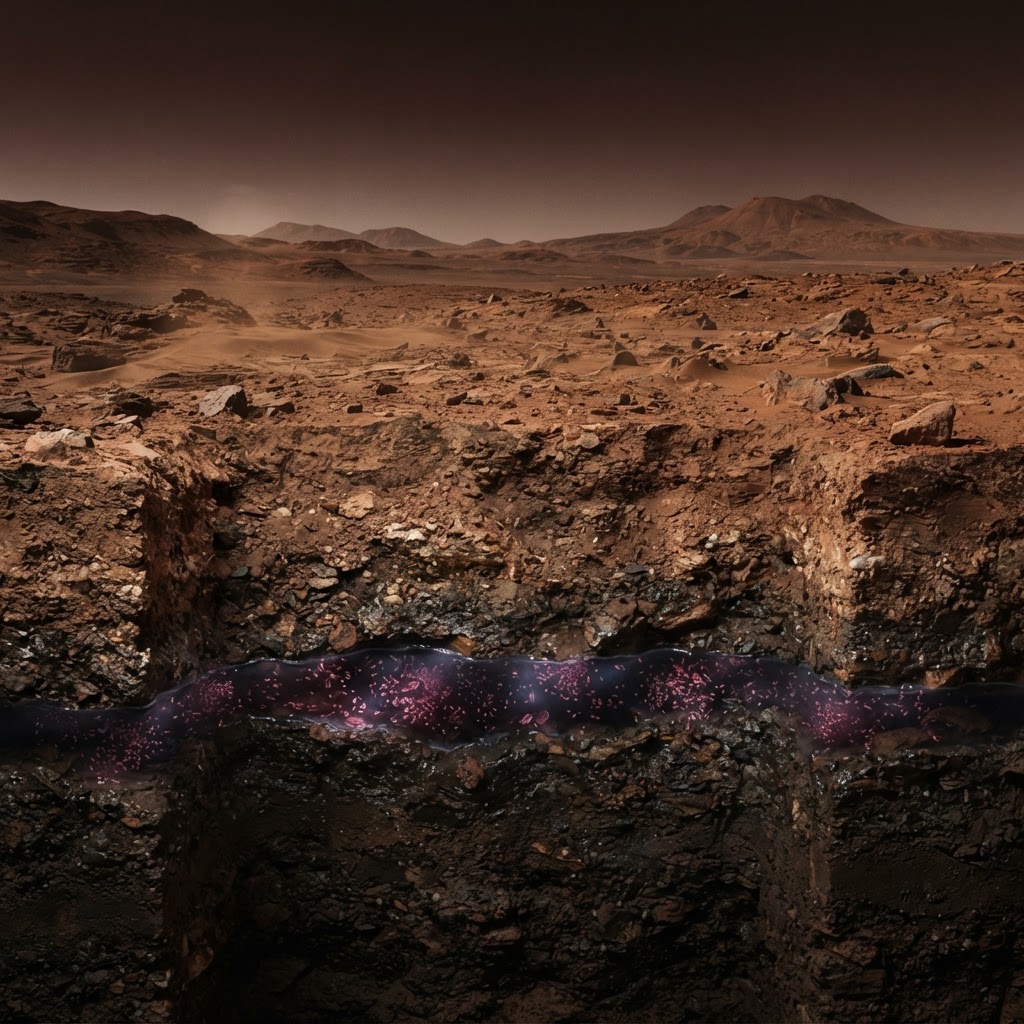
A few centimeters—or potentially much farther—beneath the Martian regolith, conditions begin to change. Material above can provide some shielding from radiation, while salts may help small amounts of water remain liquid as concentrated brines.
Researchers have previously shown that hygroscopic salts found or expected near the Martian surface can absorb moisture and potentially create temporary brines through a process called deliquescence. Experiments with salt-tolerant microbes have even demonstrated renewed microbial growth after these organisms were rehydrated in such brines.
So if Mars has a hiding place for modern microbial life, the subsurface remains one of the places worth investigating.
Scientists Put a Salt-Loving Microbe Through a Mars Test
In the 2026 study, researchers Adam Robinson, Shannon McQuaig-Ulrich, Tyler Dondero, Aaron Celestian and Scott M. Perl exposed H. volcanii cultures to a combination of conditions relevant to hypothetical shallow subsurface Martian environments.
The experiment included:
→ Low atmospheric pressure of about 24 millibars
→ A carbon-dioxide-enriched atmosphere
→ No oxygen
→ Highly saline liquid
→ Nitrate or perchlorate as potential electron acceptors
→ Incubation lasting 160 days
This is important because habitability isn't determined by one environmental factor.
A microorganism might tolerate extreme salt under normal Earth pressure but fail when the pressure drops. Another might withstand low pressure but die when exposed to perchlorates.
Mars combines multiple extremes at once.
Researchers wanted to know whether H. volcanii could actually grow while dealing with several of them simultaneously.
And it did.
It Wasn't Just Surviving
This may be the most interesting part of the experiment.
Researchers reported growth in all of the low-pressure treatments.
They also detected biological reduction of nitrate and perchlorate, providing evidence of ongoing microbial metabolism. Microscopy revealed extensive biofilm formation, while Raman spectroscopy detected carotenoid biosignatures after the long incubation period.
The hypersaline brines were also surprisingly stable.
Water loss remained below 4 percent throughout the experiment, suggesting that sufficiently salty liquid environments could potentially remain stable for extended periods under the conditions being modeled.
That's a very different result from saying:
"We put a microbe in Mars-like conditions and some cells didn't die."
Instead, the evidence points toward an organism continuing biological activity under a combination of stresses relevant to a potential Martian subsurface habitat.
Why Salt Could Actually Help Life on Mars
We normally think of extreme salt as hostile to life.
On a cold planet, however, salt has another useful property: it lowers the freezing point of water.
That means salty water can remain liquid at temperatures where pure water would freeze.
Research into Mars- and ocean-world-relevant brines has shown that several salt-tolerant Earth bacteria can grow at surprisingly high concentrations of magnesium, potassium and sodium salts. Scientists have also found that habitability depends not simply on "how salty" something is, but on the specific ions present and how they interact with water availability.
That makes Martian brines complicated—but potentially very important.
A salty underground pocket that looks miserable to us could be considerably more attractive to a microorganism adapted to extreme environments.
Scientists Have Been Building Toward This for Years
The new results don't exist in isolation.
Astrobiologists have been testing extremophiles against Martian conditions for decades.
Research involving Planococcus halocryophilus, a cold- and salt-tolerant bacterium originally isolated from Arctic permafrost, showed that it can grow at temperatures as low as about −15°C and tolerate substantial concentrations of sodium perchlorate.
Researchers Florian Carlo Fischer, Dirk Schulze-Makuch and Jacob Heinz have also investigated microorganisms under simulated shallow Martian subsurface conditions involving low pressure, cold temperatures, carbon dioxide, UV radiation and Martian-relevant salts. Their work found that survival could improve with regolith depth and that chlorate-containing environments were generally less damaging than perchlorate-containing ones.
Another archaeon, Halorubrum lacusprofundi, which comes from an extremely salty Antarctic environment, has demonstrated the ability to grow anaerobically in the presence of perchlorate. Researchers Victoria Laye and Shiladitya DasSarma argued that organisms like this offer useful models for understanding how life might function in cold, salty extraterrestrial environments.
Piece by piece, we're learning that the biological limits we once assumed were fairly rigid are much more flexible than they appear.
Does This Mean There Is Life on Mars?
No.
And this is where it's important not to let an exciting experiment run ten miles ahead of the evidence.
Scientists did not discover Martian life.
They demonstrated that an Earth organism can actively grow under a particular laboratory combination of conditions relevant to a hypothetical Martian environment.
There are still enormous unknowns.
→ Do stable liquid brines currently exist in accessible parts of the Martian subsurface?
→ Are they present long enough to sustain biological activity?
→ Are nutrients available?
→ How would microorganisms cope with radiation over geological timescales?
→ Could Martian life—if it ever evolved—have adapted to conditions even more extreme than anything living on Earth?
Those questions remain unanswered.
The 2026 study itself is also currently a bioRxiv preprint, meaning the results should be treated as preliminary until they have gone through formal peer review.
Still, the experiment changes what we can reasonably consider possible.
There's Another Reason Scientists Care: Contamination
There's an interesting twist here.
If Earth microorganisms can grow in certain Martian environments, then scientists have to worry not only about finding Martian life—but about accidentally bringing Earth life there.
This is known as forward contamination.
Previous experiments with salt-tolerant microorganisms have demonstrated survival and renewed growth after cycles of drying and rehydration in Mars-relevant brines. Researchers have specifically warned that these abilities increase concerns about microbes hitching rides aboard spacecraft and potentially contaminating extraterrestrial environments.
That creates an enormous challenge for future Mars exploration.
Imagine discovering microorganisms underneath Martian soil only to have scientists ask:
Are these Martians—or extremely stubborn Earth hitchhikers?
Planetary protection exists partly to make sure we never have to answer that question the hard way.
Earth Keeps Changing Our Definition of "Habitable"
This may be the bigger lesson.
For much of human history, our definition of a livable environment was understandably based on ourselves.
Moderate temperatures. Oxygen. Fresh water. Sunlight.
Extremophiles shattered that assumption.
We've discovered microorganisms thriving in hypersaline lakes, Antarctic environments, acidic conditions, deep underground ecosystems and other places that once seemed completely incompatible with life.
Mars may not need to look like Earth today to contain something alive.
It may only need the right microscopic refuge.
A little protection.
A little chemistry.
A little liquid water.
And enough time.
The more we study Earth's strangest organisms, the more we realize that searching for extraterrestrial life isn't only about asking where humans could survive.
It's about asking something much bigger:
How far can life bend before it finally breaks?
So far, Earth's extremophiles keep moving that line.