Chariots of the Gods, the 1968 book by Swiss author Erich von Däniken, argues that extraterrestrials visited Earth in prehistory and that ancient texts, monuments and art record those visits in religious language. In this video, von Däniken makes that case again in a full lecture at the book's 50th-anniversary celebration in England, moving from the Mahabharata and the Book of Ezekiel to the Book of Enoch, Palenque, the Nazca lines and the Great Pyramid. Billy Carson does not speak in the footage; the 4biddenknowledge channel presents it as a record of the argument that launched the modern ancient-astronaut field.
The topic matters because nearly every later version of the idea, from television series to authors who credit him at this event, starts from von Däniken's method: take an ancient description at face value, swap religious words for technical ones, and ask what changes. Judging it fairly means checking his examples one by one against what specialists say. For a wider overview, see the site's guide to ancient astronaut theory.
What the video covers
Cities in heaven and the war in heaven (from about 1:00)
Von Däniken opens with the Mahabharata. He retells how the hero Arjuna is carried up by a smaller craft, piloted by Matali, to cities in heaven, and witnesses a war in which two of three cities are destroyed. Setting Lucifer's rebellion beside it, he asks how a war could happen in a place of perfect happiness, and answers with a change of vocabulary: "I suggest we must change the word heaven into the word space." Angels, he adds, fought, fell and even had children with humans, so "We should change the word angel into extraterrestrial." He cites 2 Kings 19:35, where an angel of the Lord kills 185,000 Assyrians, as one such episode. The Indian sky-craft he mentions, the vimana, has its own explainer on the site.
Ezekiel's craft and the measured building (from about 9:00)
The longest section is on Ezekiel. Von Däniken describes the captive priest by the river Chebar seeing an object descend with noisy wings, metal legs and wheels that move in every direction without steering. He recounts how Josef Blumrich, a NASA engineer in Huntsville, set out to disprove him and instead wrote The Spaceships of Ezekiel (1974), reconstructing a lander served by an orbiting mothership. He then turns to Ezekiel chapters 40 to 48, where the prophet is taken to a very high mountain and told to measure a vast building. He says a German engineer redrew the building from those measurements, that the craft fits inside it, and that the original Hebrew names neither God nor Jerusalem here. The site's Ezekiel's wheel explainer covers the chapter-one vision in detail.
Enoch and the Watchers (from about 29:00)
Next comes Enoch, described in Genesis in two lines and at length in the Ethiopian Book of Enoch. Von Däniken retells Enoch being bathed, anointed and dressed by two beings until he looks like them, then taken to a great hall; he reads the anointing as disinfection and the hall as a mothership. He quotes the account of 200 "sons of heaven" who descended on Mount Hermon in the days of Jared and took human wives, sets it beside Genesis 6:1–4, and treats both as memories of visitors, not angels. The Book of Enoch explainer sets out where that text comes from.
Rock art, Palenque and Borobudur (from about 41:00)
He then shows Val Camonica in the Alps, Hopi panels in Arizona, the Nazca hillside figure nicknamed the astronaut, the Tassili figures in the Sahara, the Wandjina of Australia's Kimberley, Japanese dogū figurines, Hopi katsina figures and the descending god of Tulum, asking why cultures with no contact drew sky beings with helmets and rays. He revisits the carved lid of Pakal's tomb at Palenque, first published in Chariots of the Gods as a pilot at the controls, and says the epigraphers David and George Stuart now read it as Pakal leaving Earth for the cosmos. He closes with Borobudur's bell-shaped stupas, which one Buddhist reading treats as a small vehicle carrying a person to the great one.
Nazca (from about 55:00)
On Nazca he insists the long straight lines and flattened hilltops, not the animal figures, are the real puzzle. After listing the explanations offered over the decades, he restates his own: a probe once landed and the people who saw its trace kept making lines and, later, figures as offerings. He stresses he never called Nazca a spaceport. The Nazca lines explainer covers the archaeology.
The Great Pyramid (from about 1:03:00)
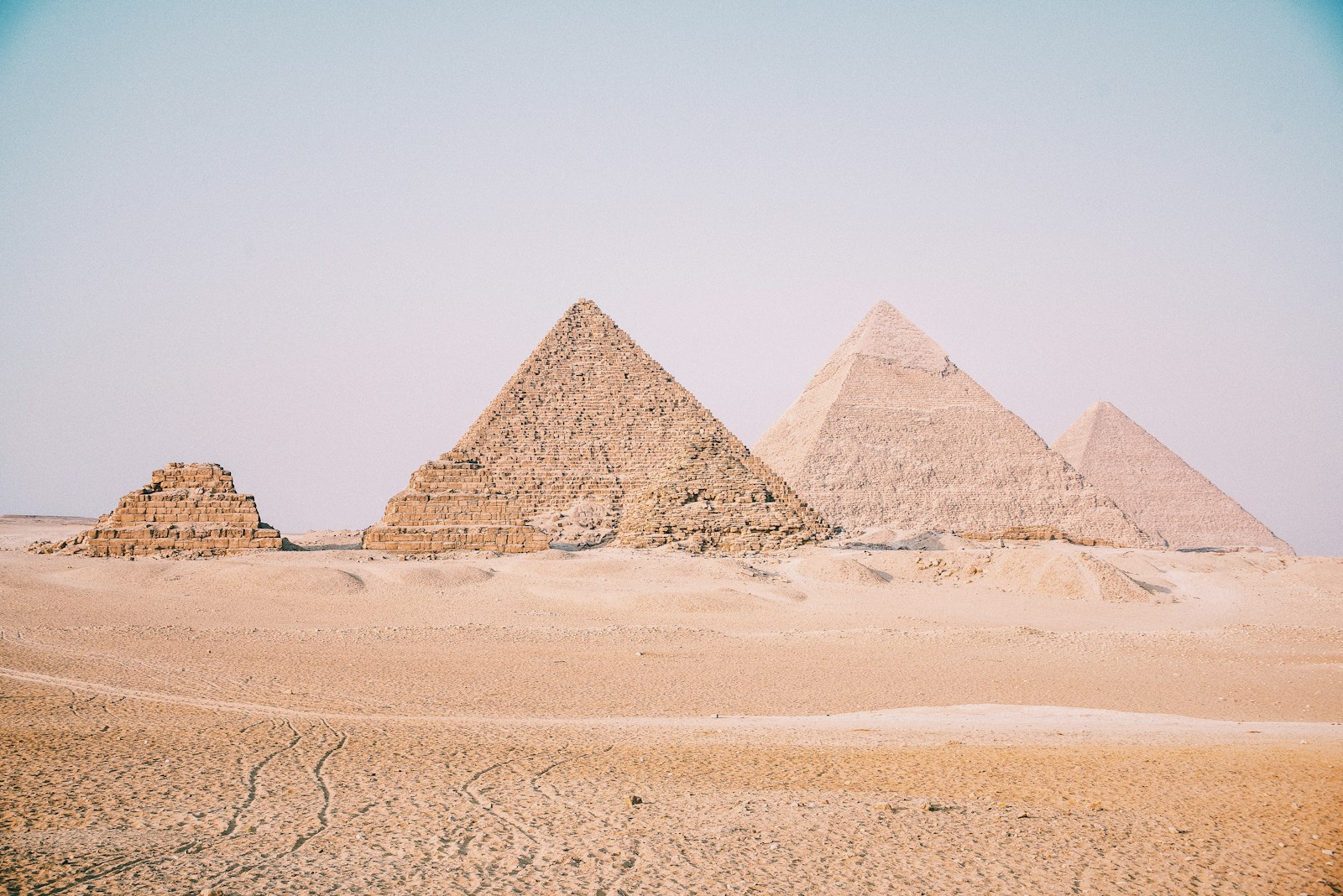
For the Great Pyramid he questions the ramp theory, notes the Orion correlation idea, and claims the spacing of the three chambers mirrors the three inner planets. He walks through the narrow Queen's Chamber shafts, Rudolf Gantenbrink's robot, and the later drilling and camera surveys beyond the first blocking stone. He argues a tyrant like Khufu would have filled it with inscriptions, and cites medieval Arab historians who credited it to Surid, a pre-flood king identified with Enoch. He also shows a water-filled shaft with a sarcophagus, linking it to Herodotus. The site's Great Pyramid construction guide gives the mainstream picture.
The return, the journey and the present (from about 1:24:00)
The lecture ends looking forward. He says the welcome given to Cortés, Pizarro and Cook shows a worldwide expectation of returning sky beings. Against the distance objection he offers generation ships at 2 percent of light speed, colonising the Milky Way in about 10 million years. He cites Svante Arrhenius's panspermia to explain why visitors could resemble humans, then shows the 2013 Aguadilla thermal video and mentions crop circles. His closing line on belief is plain: "You have to believe nothing."
Key takeaways
- Von Däniken's core method is to replace about ten religious words, such as heaven and angel, with technical ones and reread the texts.
- His strongest textual material is Ezekiel 1 and 40–48 and the Watchers story of 1 Enoch, both treated as eyewitness accounts.
- He presents global rock art and sky-god imagery as a shared memory across cultures that had no contact.
- He denies ever calling Nazca a spaceport and treats it as a cult that imitated a probe's landing trace.
- He argues interstellar travel is slow but possible, and that humans resemble the visitors because both descend from the same seeded life.
Billy Carson's reading
Carson does not comment in this footage, so the channel's interest is best read through his own published work. His books and the pillar articles on this site start from the same instinct von Däniken popularised: ancient texts may describe real encounters with advanced beings, and the religious framing came later. Where von Däniken speaks of anonymous extraterrestrials, Carson's work names them through the Sumerian Anunnaki and the Watchers of the Book of Enoch, and he reads the Emerald Tablets as a teaching text from that lineage. The Anunnaki topic hub collects that work.
What mainstream scholarship says
Biblical scholars read Ezekiel 1 as a prophetic throne vision, the root of Jewish merkabah mysticism. The Hebrew text does name God: Ezekiel 1:28 calls the sight "the glory of the LORD" using the divine name, Ezekiel 8:3 says the prophet was brought "in the visions of God to Jerusalem", and Ezekiel 40:2 places the very high mountain "in the land of Israel". Biblical Hebrew marks aspect rather than simple tense, so a future rendering is a grammatical judgment. Genesis 5:24 says only that God "took" Enoch; the fiery chariot belongs to Elijah in 2 Kings 2:11. The bathing, anointing and new garments come from 2 Enoch 22, a separate Slavonic text, where the archangel Michael performs them. The Ethiopic 1 Enoch reached Europe through James Bruce in 1773, was translated into English by Richard Laurence in 1821, and Aramaic fragments of it were found among the Dead Sea Scrolls. Arjuna's journey to Indra's heaven sits in the epic's third book, the Vana Parva, and Indologists read it as mythic poetry.
Archaeologists answer the site claims directly. Pakal's lid, found by Alberto Ruz Lhuillier in 1952, shows the king at death and rebirth above the jaws of the underworld, beneath a world tree; the Stuarts' reading is cosmological in Maya terms, not spaceflight, and the far-future date in the inscriptions is an anniversary of Pakal's accession falling in AD 4772. The Nazca lines were made by the Nazca people by clearing dark surface stones, and recent drone surveys keep adding new figures. Khufu, of the Fourth Dynasty around 2560 BC, was the son of Sneferu, who built three large pyramids, so the craft did not appear from the Stone Age. Work-gang marks naming Khufu survive in the relieving chambers above the King's Chamber, and the papyri of the inspector Merer, found at Wadi al-Jarf, record limestone shipments for the pyramid. The water-filled shaft he shows is the so-called Osiris Shaft under Khafre's causeway, dated by its excavators to long after Khufu. The 2011 Djedi camera found red ochre marks read as builders' marks.
On the wider claims, historians such as Matthew Restall and Camilla Townsend argue the "returning god" story around Cortés was written after the conquest. Doug Bower and Dave Chorley showed in 1991 how crop circles were made. The Aguadilla video, filmed from a US Customs and Border Protection aircraft, remains disputed, with skeptics arguing it fits drifting lanterns. Critics such as Kenneth Feder add that these readings credit outsiders with work the evidence assigns to the peoples who built the sites.
Watch, read and go deeper
Start with the ancient astronaut theory guide, then compare von Däniken's Ezekiel argument with the Ezekiel's wheel explainer. The Anunnaki topic hub collects Billy Carson's work on ancient visitors and the Sumerian texts. On 4BK TV, Ancient Enigmas covers more of the sites raised in the lecture.
Frequently asked questions
What is Chariots of the Gods about?
Chariots of the Gods, first published in German in 1968 and in English in 1969, argues that extraterrestrials visited Earth in prehistory and were remembered as gods. It became an international bestseller and an Oscar-nominated documentary.
Did Erich von Däniken say the Nazca lines were a spaceport?
In this lecture he says he never claimed the lines were a landing field and that he proposed a cult imitating the trace of a landed probe. Critics point out that the 1968 book did compare the Nazca plain to an airfield. Archaeologists attribute the lines to the Nazca culture and link many to water and ritual.
Does the Book of Ezekiel describe a spaceship?
Josef Blumrich's 1974 book argued that Ezekiel 1 describes a landing craft, and von Däniken builds on it. Biblical scholars read the chapter as a prophetic throne vision whose imagery draws on Near Eastern art and temple symbolism. The text itself names God and places the later temple vision in the land of Israel.
What do archaeologists say about ancient astronaut theory?
Archaeologists reject it because each site has its own evidence of local builders, tools, quarries and dates, and because the theory leans on images out of context and on mistranslation.
Sources mentioned
Von Däniken cites the Mahabharata, the Book of Ezekiel, 2 Kings, Genesis 6, and the Book of Enoch in the German apocrypha edition. He also cites Josef Blumrich's The Spaceships of Ezekiel (1974), the Palenque work of David and George Stuart, Herodotus's Histories, medieval Arab historians on King Surid, Rudolf Gantenbrink's shaft survey and Svante Arrhenius on panspermia. The tribute segment includes Chandra Wickramasinghe, Giorgio Tsoukalos, who presents a Stellar Citizen Award, and Graham Hancock, who credits the book for Fingerprints of the Gods while adding, "I don't agree with you on everything you say." Standard references include Kenneth Feder's Frauds, Myths, and Mysteries, Ronald Story's The Space-Gods Revealed (1976), Mark Lehner and Zahi Hawass's Giza and the Pyramids, and Matthew Restall's When Montezuma Met Cortés.