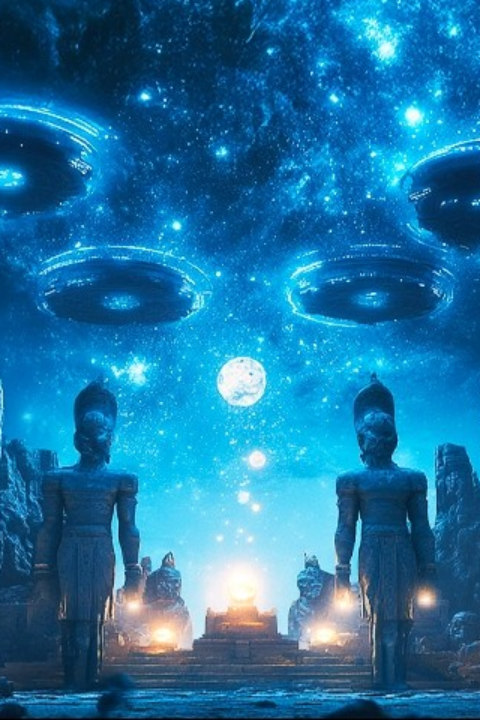
Ezekiel's wheel is the "wheel within a wheel" in the opening vision of the Book of Ezekiel, part of a fiery throne carried by four winged creatures that the prophet saw by the river Chebar in Babylonia around 593 BCE. The text itself calls the sight "the appearance of the likeness of the glory of the LORD" (Ezekiel 1:28), and Jewish tradition came to call it the merkavah, the divine chariot. Since the late 1960s a second reading has circulated alongside the religious one: that Ezekiel was describing a landing spacecraft.
The vision matters because it sits at a crossroads. It shaped two thousand years of Jewish mysticism and became the best-known biblical passage in ancient-astronaut writing after a NASA engineer published a book about it. Knowing what the chapter says, what it meant to its first readers and where the spaceship idea came from lets readers weigh each interpretation on its own terms.
Who was Ezekiel?
Ezekiel was a priest of Jerusalem who was taken into exile in Babylonia when the Babylonian king Nebuchadnezzar captured the city in 597 BCE and deported King Jehoiachin with the elite of Judah. He lived among the exiles at Tel Abib on the Chebar (Kebar), a canal near the city of Nippur in southern Mesopotamia.
The book opens with an unusually precise date. Ezekiel 1:2 places the first vision in "the fifth year of the exile of King Jehoiachin" (NRSV), which works out to about 593 BCE, and verse 3 locates it "in the land of the Chaldeans by the river Chebar."
What Ezekiel 1 actually describes
Ezekiel 1 describes, from bottom to top, a storm, four living creatures, four wheels, a crystal dome and a throne carrying a figure of fire. Quotations follow the NRSV.
The vision begins with "a stormy wind" from the north, "a great cloud with brightness around it," fire flashing, and at its centre "something like gleaming amber." The Hebrew word is hashmal, a rare term whose exact meaning is uncertain and which modern Hebrew later borrowed as its word for electricity.
Out of the fire come four "living creatures" (hayyot). Each has four faces, those of a human being, a lion, an ox and an eagle, and four wings. Their legs are straight, their feet are "like the sole of a calf's foot," and they sparkle "like burnished bronze."
Next to each creature stands a wheel. The wheels gleam "like beryl," and their construction is "something like a wheel within a wheel," so that they can move "in any of the four directions without veering." Their rims are "full of eyes all round," and they rise and move with the creatures "for the spirit of the living creatures was in the wheels."
Above the creatures' heads stretches "something like a dome, shining like crystal." Above the dome is "something like a throne, in appearance like sapphire" (the ancient stone so named was probably lapis lazuli), and on the throne sits a figure with a human likeness, glowing like amber and fire, surrounded by a radiance "like the bow in a cloud on a rainy day." Then the text names what Ezekiel is seeing: "This was the appearance of the likeness of the glory of the LORD." The Hebrew has the divine name, YHWH, at that point, so the claim sometimes repeated online that the original Hebrew never mentions God is not correct.
Ezekiel 10: the wheels return at the Temple
Ezekiel 10 repeats the vision in Jerusalem, at the Temple, and this time the prophet identifies the creatures: "These were the living creatures that I saw underneath the God of Israel by the river Chebar; and I knew that they were cherubim" (10:20).
A few details shift. The wheels are given a name, galgal (10:13), a word linked to whirling that the NRSV renders "the wheel-work" and other translations "the whirling wheels." The ox face of chapter 1 is now called "the face of the cherub" (10:14). Most important, "the glory of the LORD went out from the threshold of the house" (10:18), and the cherubim rise from the earth with the wheels beside them and carry it to the east gate (10:19).
This is the theological point of the book. The divine presence leaves the Temple before Jerusalem falls, and the same glory had already appeared to the exiles in Babylonia. God is not tied to one building or one land, and goes with his people into exile. Readers have also long noticed the Temple setting: the inner sanctuary of Solomon's Temple held two great cherubim of olivewood, "each ten cubits high" (1 Kings 6:23), so the cherubim of Ezekiel 10 appear where cherubim images already stood. A similar heavenly throne with cherubim and wheels appears in 1 Enoch 14, covered in the Book of Enoch pillar.
How mainstream scholars read the vision
Most biblical scholars read Ezekiel 1 and 10 as a throne-chariot vision built from the royal and temple imagery of the ancient Near East, describing the presence of Israel's God in the visual language of kingship.
Winged hybrid guardians were common across the region. In Mesopotamia, colossal human-headed winged bulls and lions (lamassu) guarded palace and temple gateways, and Ezekiel was living in the land where such figures stood. The Hebrew kerub is often linked to the Akkadian karibu, "one who blesses" or intercedes, although the etymology is debated. The four faces are often read as the four quarters of the world, and a rabbinic tradition in the Talmud (Hagigah 13b) explains them as the noblest of each kind of creature: humans among creatures, the lion among wild animals, the ox among domestic animals and the eagle among birds. Christian writers later assigned the same four faces, by way of Revelation 4, to the four evangelists.
On this reading the eyes, fire, throne and rainbow are symbols of an all-seeing sovereign surrounded by light, and the layered phrasing ("the appearance of the likeness of") stresses that what Ezekiel saw could not be described directly.
The merkabah tradition
The merkabah tradition is the body of Jewish interpretation and mystical practice that grew out of Ezekiel's vision. The Hebrew merkavah means "chariot," but the word does not occur in Ezekiel 1. It is used of "the chariot of the cherubim" in 1 Chronicles 28:18, and the Wisdom of Ben Sira (49:8) says Ezekiel saw a vision of glory above the chariot of the cherubim. From there the name stuck.
The rabbis treated the passage as powerful and risky. Mishnah Hagigah 2:1 rules that the "work of the chariot" (ma'aseh merkavah) may not be expounded even to a single student unless he is a sage who already understands on his own. The Hekhalot ("palaces") literature, most of it composed between about 200 and 700 CE, describes mystics ascending through heavenly palaces to the throne: Hekhalot Rabbati centres on the ascent of Rabbi Ishmael, Hekhalot Zutarti on that of Rabbi Akiva. Ezekiel 1 is still read in synagogues as the prophetic reading (haftarah) on the first day of Shavuot.
Gershom Scholem's Major Trends in Jewish Mysticism (1941) brought this material into modern scholarship as the earliest stage of Jewish mysticism. The modern "Mer-Ka-Ba" meditation, with its spinning star tetrahedron, is a separate idea of the late twentieth century, explained in the Merkaba pillar.
Where the spaceship reading comes from
The spaceship reading of Ezekiel is a modern interpretation, popularised by Erich von Däniken's Chariots of the Gods? (German original Erinnerungen an die Zukunft, 1968), which argued that ancient texts record visits by technologically advanced beings and that Ezekiel saw a landing craft.
Ancient-astronaut writers read the chapter as an eyewitness trying to describe machinery without the vocabulary for it. The storm wind and great cloud become exhaust and dust at touchdown, the fire and gleaming amber the glow of an engine, the creatures with burnished-bronze legs the landing gear or the crew, the wheels that move in any direction without turning a kind of omnidirectional undercarriage, and the crystal dome a cockpit canopy. Later scenes are read as flights: in Ezekiel 8 the spirit lifts the prophet "between earth and heaven" and brings him to Jerusalem, and in Ezekiel 40 he is set down "on a very high mountain." Both passages say this happened "in visions of God," which is the detail mainstream readers stress.
Josef Blumrich and The Spaceships of Ezekiel
The most influential version of the spaceship reading came from Josef F. Blumrich (1913–2002), an engineer who was chief of the systems layout branch in the Program Development Office at NASA's Marshall Space Flight Center. By his own account he set out to refute von Däniken and ended up persuaded.
His book appeared in German as Da tat sich der Himmel auf (Econ, 1973) and in English as The Spaceships of Ezekiel (Bantam, 1974). It offered engineering drawings of a craft with a central body carried by four helicopter-like units, each with a wheel, and read Ezekiel's later journeys as flights in it. Blumrich separately held US patent 3,789,947 for an "Omnidirectional wheel," issued on 5 February 1974 (NASA case MFS-21309-1). The patent is real, but the omni-wheel idea was not new: J. Grabowiecki had patented a vehicle wheel of this kind in 1919 (US 1,305,535). Claims that Blumrich invented the omni wheel from Ezekiel, or that NASA endorsed his reading, are not supported; the book was his personal work.
Critics were blunt. Ronald Story, in Guardians of the Universe? (1980), called the book "an extreme form of rationalisation." Jerome Clark, in The UFO Book (1998), described it as "a creative but misplaced effort to translate the metaphorical biblical account into a properly engineered spacecraft." Biblical scholars add that eyes, faces, fire, a throne and a rainbow are the vocabulary of visionary and temple symbolism, and that the text states plainly what it is showing: the glory of God.
Billy Carson's reading
There is no Ezekiel-specific lecture by Billy Carson in the 4biddenknowledge archive, so his angle is best understood from his wider work on the Bible. In his case that the Bible drew on older texts, Carson argues that Genesis reworks stories first written on Sumerian and Babylonian tablets, and he reads the gods of those texts as the Anunnaki, real beings rather than myths. His look at the Elohim, the plural God of Genesis, and the Watchers of the Book of Enoch follows the same line.
Applied to Ezekiel, that frame raises questions rather than settling them. Was a priest in sixth-century BCE Babylonia describing something real for which he had no technical vocabulary? Why does the account dwell on metal, fire, wheels and movement in any direction? Carson's site explored the von Däniken and Blumrich reading in a 2021 post, Is Ezekiel's Vision of the Wheel Evidence of UFOs in the Bible?, which closes by asking whether the case is real proof or an inventive hypothesis. Two points in that post need correcting: the Hebrew of Ezekiel 1:28 does name God, and Blumrich did not derive the omni wheel from Ezekiel. The spaceship reading remains a modern interpretation, set beside the scholarly throne-chariot reading for readers to test against the text.
Watch, read and go deeper
Carson's teaching on scripture continues in the Bible Study series on 4BK TV, where he reads biblical passages alongside older Near Eastern sources. For the Sumerian background behind his reading of the Bible's divine figures, start with the Anunnaki topic hub. Readers who want the ancient-astronaut case in its earlier form can set the 2021 post linked above beside Ezekiel 1 and 10 and judge the two readings directly.
Frequently asked questions
What is the wheel within a wheel in Ezekiel?
It is the description of the four wheels beside the living creatures in Ezekiel 1:16, built "something like a wheel within a wheel" so they could move in any of four directions without turning. Mainstream scholars read it as part of a symbolic throne-chariot showing God's presence moving freely in every direction.
Does the word merkabah appear in Ezekiel?
No. The Hebrew merkavah, "chariot," is not used in Ezekiel 1 or 10. It is applied to the cherubim chariot in 1 Chronicles 28:18 and to Ezekiel's vision in Ben Sira 49:8, and later Jewish tradition made it the standard name for the vision.
What are the cherubim in Ezekiel 10?
Ezekiel 10:20 identifies the four living creatures of chapter 1 as cherubim, winged guardian beings associated with God's throne and with the Temple, whose inner sanctuary held two large carved cherubim. In chapter 10 they carry the glory of God out of the Temple before Jerusalem's fall.
Did a NASA engineer prove Ezekiel saw a spaceship?
No. Josef F. Blumrich, a NASA engineer, argued in The Spaceships of Ezekiel (1974) that the vision describes a craft, but this was his personal interpretation, not a NASA finding, and it has not been accepted by biblical scholars. Critics such as Ronald Story and Jerome Clark described it as rationalisation of a metaphorical text.
Is Ezekiel's vision a UFO sighting?
The text presents it as a vision of "the likeness of the glory of the LORD," and mainstream scholarship reads it as a throne-chariot vision drawn from ancient Near Eastern royal and temple imagery. The UFO reading is a modern interpretation dating from the late 1960s.
Sources and further reading
- The Book of Ezekiel, chapters 1, 8, 10 and 40, in the New Revised Standard Version and the Jewish Publication Society Tanakh (1985).
- Mishnah Hagigah 2:1 and Babylonian Talmud Hagigah 13b.
- Gershom Scholem, Major Trends in Jewish Mysticism (1941).
- Josef F. Blumrich, The Spaceships of Ezekiel (Bantam, 1974).
- Erich von Däniken, Chariots of the Gods? (1968 German original).
- Ronald Story, Guardians of the Universe? (1980).
- Jerome Clark, The UFO Book (1998).