 Billy's Colloidal Silver + Starfire Gold duo —
What if reality isn’t limited to what your eyes can see… but what your brain can learn to perceive?
For decades, the idea of a “fourth dimension” has lived somewhere between science fiction and advanced physics lectures. But today, scientists aren’t just theorizing about it—they’re actively building ways to observe and simulate higher dimensions in controlled environments.
Let’s break this down in a way that feels less like a textbook… and more like unlocking a hidden layer of reality.
→ What Do Scientists Mean by the “Fourth Dimension”?
When researchers talk about the fourth dimension, they’re usually referring to an additional spatial dimension beyond the three we live in: length, width, and height.
→ In physics, time is often called the fourth dimension (thanks to Albert Einstein’s theory of relativity) → But in modern experiments, scientists are exploring a fourth spatial dimension—a direction we physically can’t move through, but can mathematically describe
Think of it like this:
→ A 2D being (flat on paper) can’t fully understand “up” → We might be those 2D beings… just one dimension higher
→ The Breakthrough: Building a “Window” Into Higher Dimensions
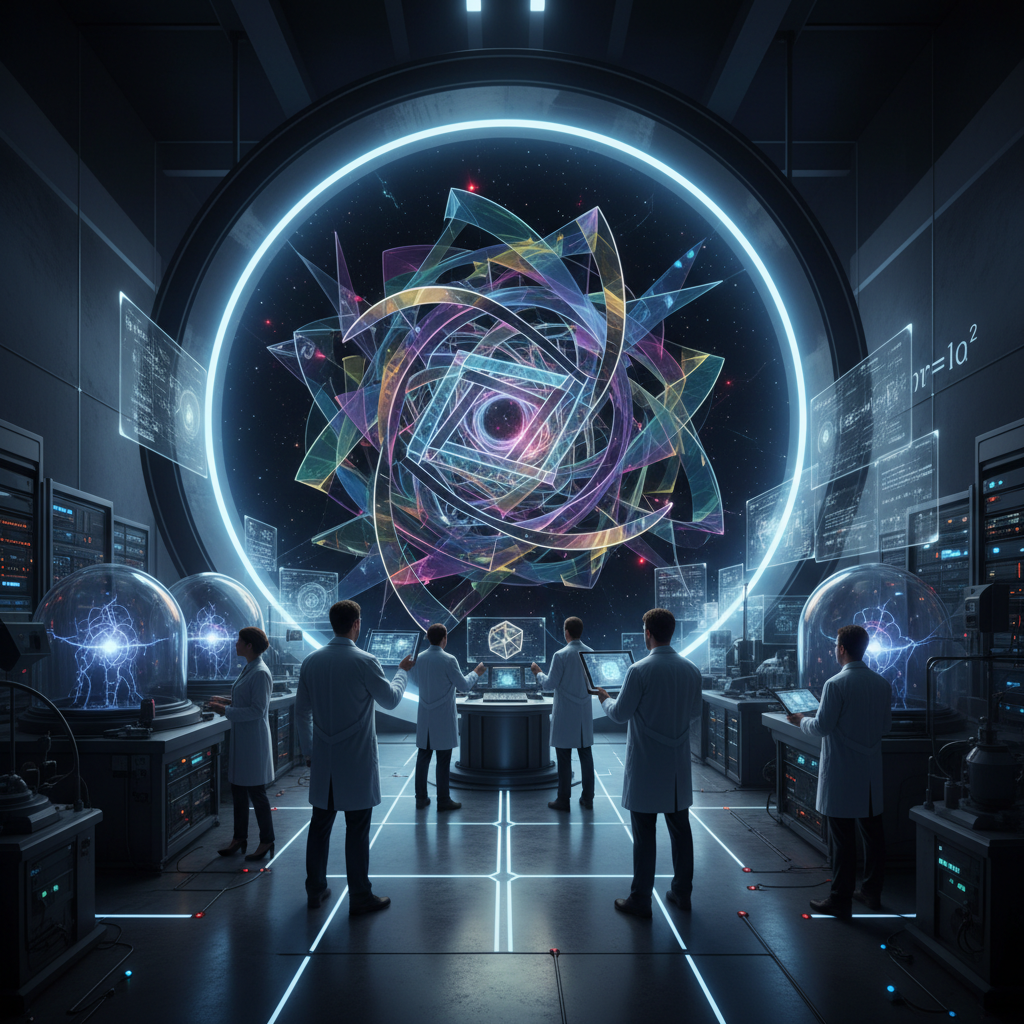
In recent years, teams of physicists and engineers have created experimental systems that simulate four-dimensional spaces.
One of the most notable approaches comes from researchers working in quantum physics and photonics:
→ Scientists use ultra-cold atoms, lasers, and synthetic lattices to mimic higher-dimensional structures → These systems allow particles to behave as if they exist in four dimensions
Researchers like Mikhail Lukin at Harvard University have contributed to experiments where quantum systems simulate dimensions beyond our physical world.
Another breakthrough came from work published in journals like Nature, where scientists demonstrated:
→ Light traveling through specially designed materials can exhibit behavior that only makes sense in four-dimensional geometry → These setups act as a “window,” letting us observe effects that shouldn’t exist in 3D space
→ How Do You See Something You Can’t See?
You don’t. Not directly.
But you can measure its fingerprints.
Here’s how scientists do it:
→ They track how particles move through engineered systems → They observe patterns that cannot exist in three dimensions alone → They translate those patterns into models of 4D behavior
Physicist Lisa Randall, known for her work on extra dimensions, explains that higher dimensions may not be visible—but their effects can still shape reality in measurable ways.
→ Why This Matters (More Than You Think)
This isn’t just abstract science. It has real-world implications:
→ Quantum computing: Higher-dimensional systems could store and process information in entirely new ways → Material science: Designing materials with properties that don’t exist in normal 3D structures → Fundamental physics: Understanding the true structure of the universe
Theoretical frameworks like string theory, explored by physicists such as Edward Witten, suggest that the universe may contain multiple hidden dimensions—far beyond four.
These experiments? They’re the first real steps toward testing those ideas.
→ The Mind-Bending Reality
Here’s the part that lingers:
→ You are a three-dimensional being… interpreting a potentially multi-dimensional universe → Your brain filters reality into something survivable—not necessarily something complete
As Carl Sagan once illustrated, a being from a higher dimension could interact with our world in ways that would seem impossible—appearing inside closed rooms, seeing through objects, existing beyond our perception.
Sound familiar? That’s because the limits aren’t out there—they’re in how we perceive.
→ So… Have Scientists Really Found the Fourth Dimension?
Not exactly.
But they’ve done something arguably just as powerful:
→ They’ve built systems where the rules of a fourth dimension can be observed, tested, and measured → They’ve turned theory into something experimental
And that changes everything.
→ Final Thought
Science doesn’t always give you answers. Sometimes, it gives you a doorway.
Right now, we’re standing at one—peering into a dimension we can’t enter, but are finally beginning to understand.
And if history has taught us anything… it’s that today’s invisible dimension might be tomorrow’s everyday reality.