 Billy's Colloidal Silver + Starfire Gold duo —
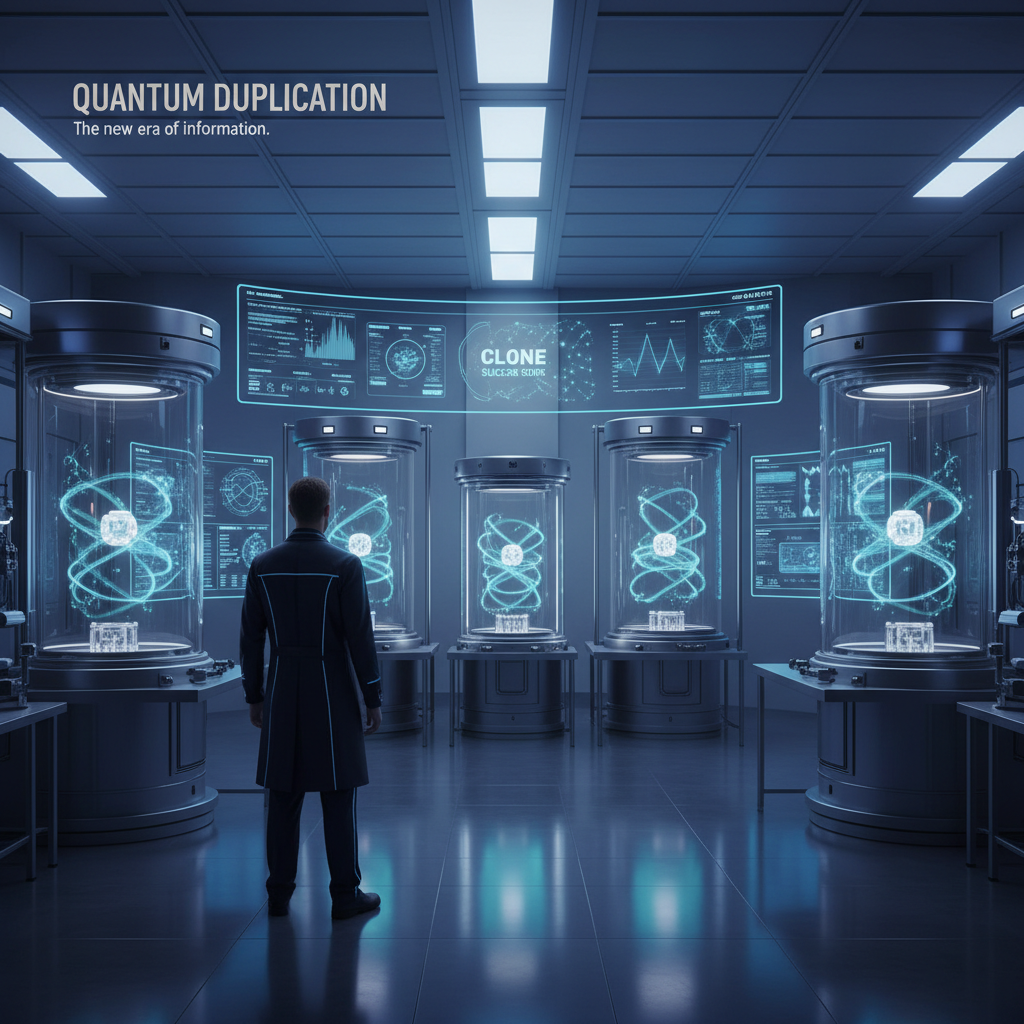
For decades, the rules of quantum physics have been clear and uncompromising: you cannot copy quantum information. This principle—known as the no-cloning theorem—has been a cornerstone of quantum computing and quantum cryptography.
But now, researchers are quietly rewriting that narrative.
A growing body of work suggests that while perfect cloning remains impossible, there may be clever ways to replicate quantum information under specific conditions—a loophole that could reshape how we think about quantum systems.
Let’s break this down without the headache.
What the No-Cloning Theorem Actually Says
First, the foundation:
→ The no-cloning theorem, proven in 1982 by physicists Wootters and Zurek and independently by Dennis Dieks, states:
→ It is impossible to create an identical copy of an unknown quantum state
Why?
→ Quantum information isn’t like a file you can copy and paste → Measuring it changes it → And without knowing the exact state, duplication breaks the laws of quantum mechanics
This is what makes quantum encryption so powerful—and so secure.
So… What Changed?
Here’s where things get interesting.
Recent research doesn’t “break” the no-cloning theorem—but it bends around it.
Scientists have found that:
→ You can approximate a quantum copy → You can clone specific types of quantum states → You can distribute information across systems in a way that behaves like cloning
This is not cheating physics—it’s exploiting its fine print.
The Loophole: Not Perfect, But Powerful
Instead of asking:
“Can we make an identical copy?”
Researchers asked:
“What if we don’t need it to be perfect?”
That shift unlocked new possibilities:
- Approximate Quantum Cloning
→ Copies are not identical, but extremely close → Introduced by Vladimir Bužek and Mark Hillery in the 1990s
→ Their work showed that quantum states can be duplicated with high fidelity, just not perfectly
- Probabilistic Cloning
→ Perfect copies can be made—but only sometimes → Success is not guaranteed
→ When it works, it’s exact → When it fails, the system essentially collapses
- Quantum Error Correction as “Shadow Cloning”
→ Information is spread across multiple qubits → No single qubit holds the full data
→ This creates a system where information can be reconstructed → It looks like cloning, but it’s actually distribution
Why This Matters for Quantum Computing
This isn’t just theoretical physics—it has real implications:
→ Improved stability in quantum computers → Better error correction, which is one of the biggest challenges in the field → New ways to transmit quantum information without violating core laws
According to physicist Scott Aaronson, quantum mechanics often “forbids what seems obvious but allows what seems impossible”—and this is a perfect example.
The Fine Line Between Possible and Impossible
Let’s be clear:
→ Perfect cloning of unknown quantum states is still impossible → The no-cloning theorem still stands
But…
→ The spirit of the rule is being challenged → The application of the rule is evolving
This is where science gets poetic.
Not by breaking laws—but by understanding them deeply enough to move along their edges.
What Researchers Are Saying
Physicists in the field emphasize that:
→ These methods don’t violate quantum mechanics → They reveal how flexible the theory actually is
As Nicolas Gisin has noted in his work on quantum information:
→ “Quantum theory limits what can be known and copied, but it does not eliminate the possibility of extracting usable information in clever ways.”
The Bigger Picture
This “loophole” isn’t just about copying quantum data.
It represents something deeper:
→ A shift from rigid thinking to creative problem-solving in physics → A reminder that impossibility often has conditions → And proof that even the strictest laws can have nuance
Final Thought
Quantum physics doesn’t hand out easy answers. It whispers in contradictions.
You can’t clone a quantum state. But you can get close. Close enough to change everything.
And in a field where precision is everything— “almost” might be the most powerful word we have.