 Billy's Colloidal Silver + Starfire Gold duo —
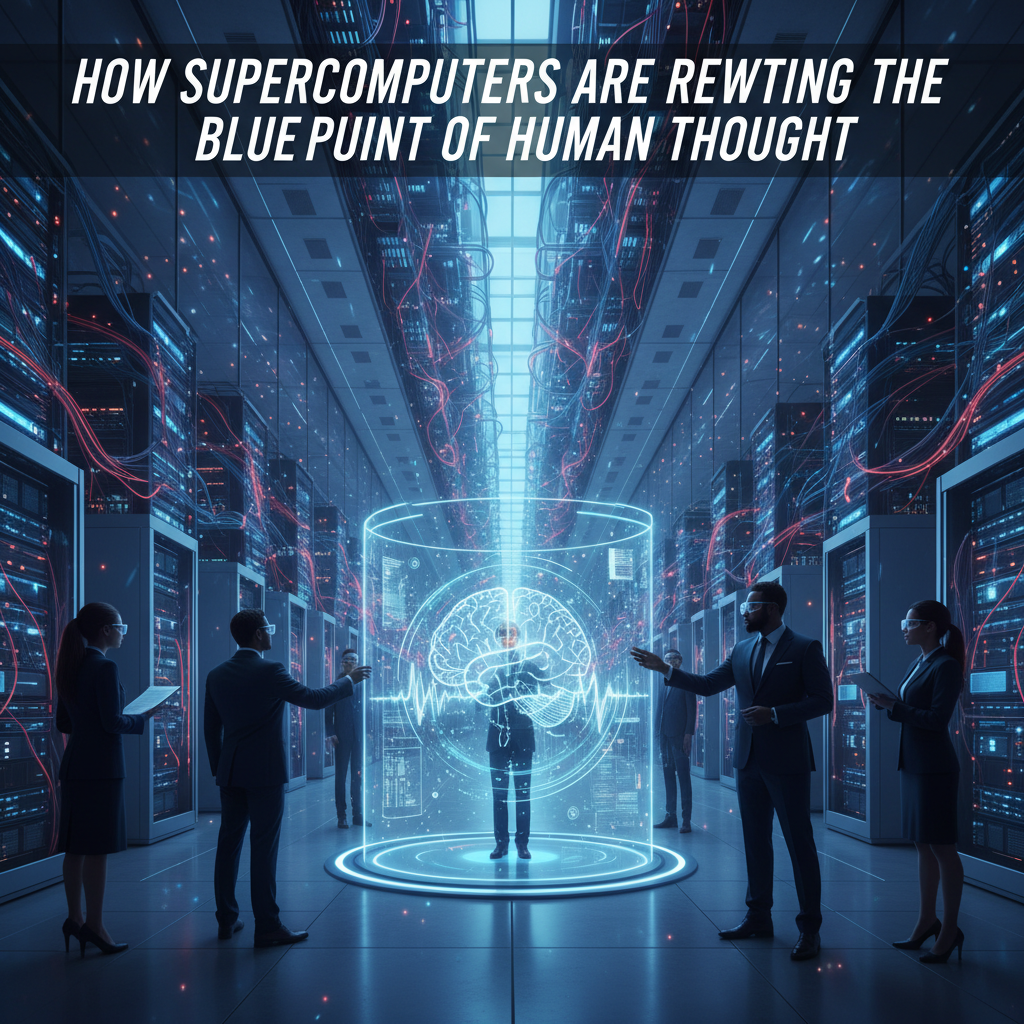
There’s something both thrilling and unsettling about this moment in science. We’re no longer just studying the human brain—we’re beginning to rebuild it, piece by piece, inside machines powerful enough to mirror its complexity.
Not metaphorically. Not theoretically. But neuron by neuron.
→ What Does It Mean to “Simulate a Brain”?
At its core, brain simulation is the attempt to digitally recreate the structure and activity of the human brain using advanced computational systems.
→ The human brain contains roughly 86 billion neurons, each forming thousands of connections → These connections create dynamic electrical and chemical signaling patterns → Supercomputers are now capable of modeling billions of these neurons simultaneously
According to neuroscientist Henry Markram, the goal is not just to map the brain, but to reconstruct it digitally:
“If we build it, we will understand it.”
That statement carries weight. Because for decades, understanding the brain meant observing it. Now, it means recreating it.
→ The Supercomputers Leading the Charge
Modern brain simulations rely on some of the most powerful machines ever built:
→ Frontier supercomputer — currently among the fastest in the world → Fugaku supercomputer — used for large-scale neural and biological simulations → Blue Brain Project — pioneering digital brain reconstruction
These systems can process quintillions of calculations per second, allowing researchers to simulate neural circuits at a scale that was impossible just a decade ago.
→ Why Simulate the Brain at All?
This isn’t just a technological flex. It’s a scientific necessity.
→ Understanding neurological disorders Simulations help researchers study conditions like Alzheimer’s, Parkinson’s, and epilepsy in controlled digital environments
→ Testing treatments safely Before human trials, therapies can be tested on simulated neural networks
→ Decoding consciousness One of the biggest unanswered questions: How does awareness emerge from biology?
Neuroscientist Christof Koch has long explored this question, arguing that consciousness arises from complex information integration within neural systems.
Simulating the brain may be the closest we’ve ever come to testing that idea.
→ The Billion-Neuron Milestone
Recent simulations have already crossed major thresholds:
→ Researchers have simulated over a billion neurons with realistic connectivity → Models can now replicate brain rhythms and signaling patterns → Some simulations mimic sensory processing and decision-making pathways
According to work published through initiatives like the Human Brain Project, these models are becoming increasingly biologically accurate.
But let’s be clear: We are still far from a full human brain simulation.
Still… we’re not where we used to be either.
→ The Ethical Edge: When Simulation Starts Feeling Real
Here’s where things shift from science to something deeper.
If we successfully simulate a human brain:
→ Could it develop awareness? → Would it experience anything? → Where do we draw the line between model and mind?
Philosopher and cognitive scientist David Chalmers has argued that if a system mirrors the functional processes of the brain, it may also replicate conscious experience.
That’s not science fiction. That’s a real debate happening right now.
→ Where April Carson Steps In (Because This Isn’t Just Science—It’s Personal)
Let’s bring this out of the lab for a second.
We spend so much time trying to understand ourselves—our thoughts, our triggers, our healing, our patterns.
Now imagine a world where:
→ Your anxiety can be modeled and studied in real time → Trauma responses can be mapped and predicted → Healing isn’t guesswork—it’s data-informed, personalized, and precise
That’s where this is heading.
Not replacing humanity—but understanding it at a level we’ve never reached before.
And if you’ve ever sat with your own thoughts, trying to untangle why you feel what you feel… this kind of research hits different.
Because it’s not just about brains.
It’s about us.
→ The Road Ahead
We are standing at the edge of something transformative.
→ Brain simulations will become more detailed and more accurate → AI and neuroscience will continue to merge → The line between biological intelligence and artificial systems will blur
As Sebastian Seung puts it:
“You are your connectome.”
And now, for the first time in history, we are learning how to recreate that connectome outside the human body.
→ Final Thought
We used to look at the brain as a mystery we might never solve.
Now we’re building it.
Not perfectly. Not completely. But enough to start asking better questions.
And maybe that’s the real breakthrough.
Not that we can simulate the brain— but that we’re finally learning how to understand the mind without losing the humanity inside it.