What did the Atlanteans leave behind? In this 2019 conference lecture Billy Carson's answer is: the record. He argues that the Emerald Tablets, the Enuma Elish, the Atrahasis epic, the Mahabharata and the Sumerian King List are the surviving accounts of a global civilisation he calls Atlantean or Anunnaki, that its monuments, the Great Pyramid and the Sphinx among them, still stand, and that its wreckage can be seen in NASA imagery of Mars and even Venus. The lecture runs from the Pleiades to the Giza plateau to the Martian surface in eighty minutes, and ends with Carson's own catalogue of planetary anomalies.
Carson frames the talk as a mission to create researchers rather than followers, and lists his sources on screen so viewers can check them. This companion keeps his order, states each claim as his, and flags where the mainstream reads the same evidence differently.
Where does Carson say the Atlanteans came from?
From the Pleiades, by way of a war. Carson tells the audience his research led him to a "galactic war" in the Pleiadian cluster that he insists was physical, fought in the third dimension, and that the planet-destroying weapon used in it, the Brahmastra of the Bhagavad Gita, is where George Lucas got the Death Star. A destroyed planet throws debris toward its sun, he explains, and anyone living on a neighbouring world becomes a refugee or a casualty. The survivors spread to Sirius, Orion and Aldebaran and founded "breakaway civilisations."
One group, he says, settled a planet orbiting a brown dwarf that was later captured by our Sun, the Nibiru of the Enuma Elish. He claims astronomers now accept that we live in a binary system with a brown dwarf on a 4,200-year orbit. That is not the case: the WISE infrared survey specifically searched for a companion and ruled out anything larger than Jupiter within a wide radius. The 2012 VP113 clip he plays describes a dwarf planet with a 4,300-year orbit, not a star. We cover the astronomy in Nibiru and Planet X explained.
Why is the Enuma Elish the key text?
Carson calls the Seven Tablets of Creation the source of most of the Old Testament, "copied, some mostly word for word," and reminds the audience that they were excavated at Nineveh by Austen Henry Layard in 1849 and translated decades before Zecharia Sitchin was born. He is unusually direct about Sitchin: a fine researcher who "didn't translate any tablets" but assembled existing translations into a story, and who may not have got everything right. In Carson's summary the tablets describe a war, a planet running out of resources, a need for gold, and a genetic modification of an existing hominid to make a labour force. He stresses that he does not believe anyone "created" humans from nothing; the Anunnaki, in his view, modified a cousin species already here.
He pairs the Enuma Elish with the Atrahasis epic, which he says tells the same story in a different period, and with the planet Tiamat, which he places just outside Mars and describes as a water world four to six times Earth's size whose destruction made the asteroid belt and whose surviving half became Earth. He suggests Mars was once Tiamat's moon and that out-of-place artefacts found deep in mines are debris from Tiamat's civilisation folded into Earth's strata. Assyriologists read Tiamat as a sea goddess and the Genesis parallels as shared Near Eastern motifs; our guide to Carson's reading of the Enuma Elish gives both sides.
What does the Mahabharata add?
Carson gives the epic's scale, 100,000 couplets and about 1.8 million words, and argues that nobody writes that much about nothing. He draws out the vimanas, flying machines whose construction he says survives in a 1923 drawing of the Shakuna vimana, powered by a mercury "ferrofluid vortex engine" spun inside a steel torus under 250,000 atmospheres, yielding an anti-gravity effect he puts at about seventy percent weight reduction. He says this is the research focus of his own technology company and the likely basis of the TR-3B.
He then quotes Oppenheimer's "Now I am become Death, the destroyer of worlds" from the Bhagavad Gita and argues the bomb's inventors drew on the epics, with Hitler's search for ancient texts and Operation Paperclip as the pipeline. The Paperclip figure he gives, about 1,600 people, matches the historical total; the claim that the atomic programme came from Sanskrit texts is his. Our explainer on vimanas separates the epic's flying palaces from the twentieth-century engineering drawings.
How does Carson read the Bible?
As technology described by people who lacked the words. Exodus 19 and 33, the pillar of cloud that stood between the armies and descended at the tent, he reads as a craft and its beam. He gives a count he has made of the Bible's "flying" language, 70 verses describing clouds as vehicles, 160 on lights and fire, 17 on spinning wheels, and insists that Elohim is plural, "a galactic collection of people," mistranslated as a single God "on purpose" under the order of Marduk, whom he identifies with Amun-Ra. The Deuteronomy 13 and Ezekiel 9 commands to destroy whole towns he attributes to that same being.
He also reads a Sumerian passage describing Enki laying out five cities, a "bond heaven-earth" control centre, "tablets of destinies" and a "chariot place" from Nibiru to Earth, which he interprets as a stargate, and he says he stood at an indentation at Tula in Mexico where Quetzalcoatl was said to vanish through such a gate. The city-planning passage is paraphrased from Sitchin's "The Lost Book of Enki," a modern composition, rather than a single excavated tablet.
What is Zep Tepi?
Egypt's "first time," when, in the Edfu texts, the Neteru came from the sky and founded the land. Carson reads the Neteru as the same people as the Anunnaki, the Elohim and the Atlanteans, and reads the Edfu temple's carvings as portraits of them. He cites a passage about a worldwide "pyramid temple system" tuned with sound to stabilise the planet and a "Jedi" priesthood that "used the language of light," which he attributes to the Egyptian record. That passage is from a 1990s New Age text, not from Edfu; the Edfu Building Texts do describe a primeval mound and ancestral builder gods, which is the kernel Carson builds on.
What physical evidence does he show?
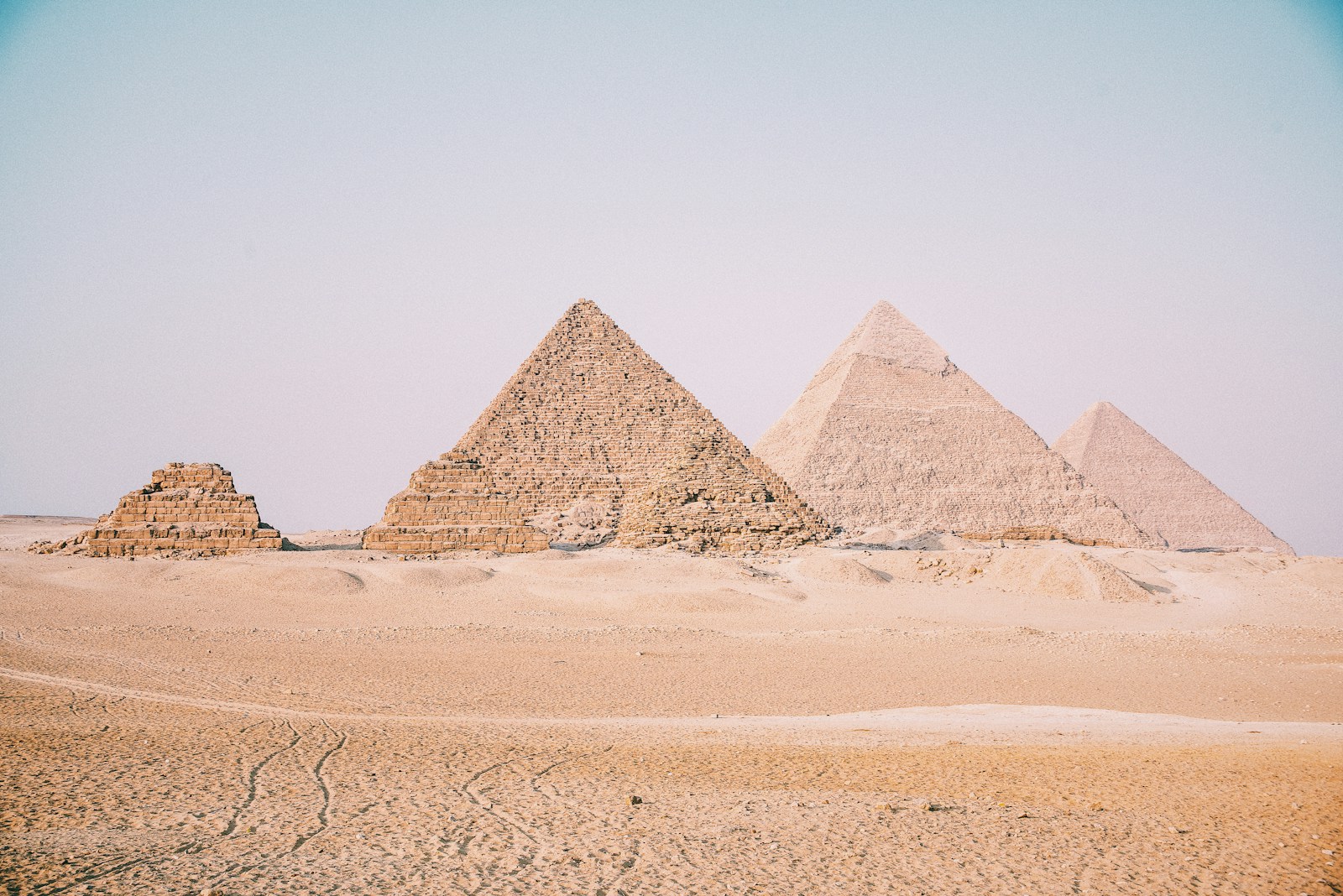
Three kinds. First, war damage: vitrified ruins he attributes to Uruk, the bodies and "radiation" of Mohenjo-daro, and the glass found in Egyptian sand, which he says came from a "pyramid war" and was carved into scarabs. The Mohenjo-daro radiation claim comes from ancient-astronaut literature and has not been found by excavators; Libyan desert glass is dated at about 29 million years and attributed to an impact. Second, the Sumerian King List in the Ashmolean Museum, which he reads aloud: eight kings in five cities ruling 241,200 years before the flood, with single reigns of 28,800 and 36,000 years. Our walkthrough of the King List explains how Assyriologists interpret those numbers. Third, the Sphinx: using the Leo alignment and the erosion pattern, Carson rejects both the 4,500-year date and Robert Schoch's 13,000-year one, reasoning that nobody builds during an ice age or an extinction event, and pushes back one more precessional cycle to 36,000 to 39,000 years, which matches the age he gives the Emerald Tablets. See how old is the Sphinx for the geology.
What do the Emerald Tablets say Thoth built?
Carson reads the passage he returns to in every talk: "Builded I the Great Pyramid... in it I builded my knowledge of magic science... while I sleep in the Halls of Amenti my soul roaming free will incarnate." He describes chambers beneath the pyramid, "hundreds of rooms about a mile deep," where Thoth kept avatar bodies and transferred his consciousness between them, surviving close to 100,000 years. He adds that the tablets order Thoth's followers to duplicate what was built in Kemet everywhere on Earth, which is his explanation for sphinxes and pyramids on every continent and the Bucegi Sphinx in Romania. The English tablets are Maurice Doreal's 1939 text, with no originals produced; the Emerald Tablets explained sets out what is known about them.
What are the Mars and Venus anomalies?
The final section is Carson's own work and that of the United Family of Anomaly Hunters group. From raw NASA, ESA and Caltech images, he shows what he describes as a lunar ziggurat (AS11-38-5564), a weathered pyramid and sphinx on Mars' "presidential plateau," an ankh, bodies "like Mohenjo-daro," a tank, a battleship found by Joe White, figures that "turn to look at the rover," a four-storey Egyptian-style head in Victoria crater, and, from USGS radar of Venus, what he calls cities. He is candid that "maybe it's just rocks that have faces," while saying he personally believes some are alive.
He supports the Mars-war idea with the Sumerian claim that the Igigi ran a base on Mars and with Mars' title "god of war." Planetary scientists attribute the shapes to pareidolia and wind erosion, and our piece on the Face on Mars shows how the most famous example resolved under higher resolution.
Watch, read, listen
Watch the lecture above or on the 4biddenknowledge Podcast page. The ideas were filmed as the series Anunnaki: Ancient Secrets Revealed on 4BK TV. Go deeper on the Emerald Tablets topic hub and the Anunnaki and Sumer hub.
Frequently asked questions
Who were the Atlanteans according to Billy Carson?
A global, technologically advanced civilisation whose ring-city capital was one of many, and whose people are the same beings the Sumerians called Anunnaki and the Egyptians called Neteru. Thoth, author of the Emerald Tablets, is their best-known figure in his telling.
Does the Sumerian King List really record reigns of 36,000 years?
Yes, the antediluvian section lists eight kings over 241,200 years. Assyriologists see the numbers as sexagesimal formulas with symbolic meaning; Carson reads them as literal lifespans made possible by the rejuvenation technology described in the Emerald Tablets.
Is the Sun part of a binary system with a brown dwarf?
No. The WISE all-sky survey found no companion star or brown dwarf out to tens of thousands of astronomical units. The 2012 VP113 discovery Carson cites is a small icy dwarf planet.
What is Zep Tepi?
The Egyptian "first time," the mythic age when the gods ruled Egypt, described in the Edfu temple texts. Carson equates the Neteru of Zep Tepi with the Anunnaki and the Atlanteans.
Are the Mars anomalies real structures?
Planetary scientists attribute them to pareidolia and erosion, and higher-resolution images of the Cydonia "face" showed a natural mesa. Carson publishes the image IDs so viewers can examine the raw frames themselves and says he could be wrong.
Sources mentioned
Burnham's Celestial Handbook and Star Names: Their Lore and Meaning; the Enuma Elish and the Atrahasis epic; the Mahabharata; Exodus 19 and 33, Deuteronomy 13 and Ezekiel 9; the Edfu texts; the Sumerian King List (Ashmolean Museum); Maurice Doreal, "The Emerald Tablets of Thoth the Atlantean"; NASA, ESA and USGS imagery; and Billy Carson, "Compendium of the Emerald Tablets."