The Phoenix Lights were a series of lights seen by thousands of people across Arizona and southern Nevada on the night of 13 March 1997. There were two separate events: a V-shaped formation of lights that crossed the state between roughly 8:00 and 8:45 pm, and a row of bright, slowly sinking lights over the Phoenix area around 10:00 pm that was widely photographed and videotaped. The 10 pm lights are explained by military illumination flares dropped over the Barry M. Goldwater Range; the earlier formation was attributed by investigators to a flight of A-10 aircraft, while many witnesses, including a sitting governor, say what they saw was a single enormous craft.
The case matters because it is one of the best-documented mass sightings on record. Robert Sheaffer, writing in the Skeptical Inquirer, called the 10 pm display "perhaps the most widely witnessed UFO event in history." It has hard data on one side (a named squadron, frame-by-frame video analysis) and sincere, consistent eyewitness testimony on the other, which makes it a useful test case for judging any modern UAP claim.
What happened on 13 March 1997
The first reports came in just before 8 pm, when a witness in Henderson, Nevada, reported a large V-shaped object heading southeast. Around 8:15 pm a former police officer in Paulden, Arizona, reported reddish-orange lights, and reports followed from Prescott Valley. In all, lights of varying descriptions were reported between about 7:30 and 10:30 pm along a corridor of roughly 300 miles, from the Nevada line through Phoenix to the edge of Tucson.
The most detailed early account came from Tim Ley, his wife Bobbi, his son Hal and grandson Damien Turnidge in Prescott Valley. As recorded by Donald Prothero and Timothy Callahan in their 2017 book, the family first saw five lights in an arc about 65 miles away. As the lights approached they formed an upside-down V, and the family described a shape like a 60-degree carpenter's square with the five lights set into it, moving so slowly it seemed to hover as it passed toward Phoenix.
The actor Kurt Russell, an amateur pilot, later said he was the pilot who reported lights to air traffic control that night. Then, at around 10 pm, a second wave began: people across the Phoenix area described a row of brilliant lights hanging in the southwestern sky or slowly falling. This is the event most people picture, because several residents caught it on camcorder.
The 8 pm "boomerang": what witnesses describe
The 8 pm sighting is the heart of the mystery. Many observers describe not separate lights but one solid object: a dark, silent, V-shaped or boomerang-shaped craft blotting out the stars. These descriptions are why the case has never settled, because they are hard to square with a few aircraft flying past.
Among the best-known witnesses is Dr Lynne Kitei, a Phoenix physician whose book "The Phoenix Lights: A Skeptic's Discovery That We Are Not Alone" was published by Hampton Roads in 2004. Kitei reports seeing amber orbs in formation over Phoenix as early as February 1995, and says she photographed and filmed lights. She later executive-produced the 2005 documentary "The Phoenix Lights...We Are Not Alone," featuring astronaut Edgar Mitchell and former Governor Fife Symington. Kitei rejects the flare explanation, and her work remains the most widely read case for the lights being genuinely anomalous.
The official and skeptical explanation for the 8 pm formation
The mainstream explanation for the first event is a formation of A-10 Thunderbolt II jets. According to Sheaffer and to astronomer and retired Air Force pilot James McGaha, five A-10s from Operation Snowbird, a winter pilot-training program run by the Air National Guard out of Davis-Monthan Air Force Base in Tucson, were returning from Nevada along an assigned corridor under visual flight rules. Because they were flying in formation, Sheaffer notes, they showed steady formation lights rather than the familiar blinking collision lights. The flight crossed Phoenix and landed at Davis-Monthan at about 8:45 pm.
The strongest single piece of testimony for this reading came from the ground. Mitch Stanley, an amateur astronomer in Scottsdale, watched the formation through a 10-inch Dobsonian telescope at about 60x magnification. He told the Phoenix New Times, in Tony Ortega's 1998 investigation "The Hack and the Quack," that each light split into pairs on the tips of squarish wings: "They were planes. There's no way I could have mistaken that." Skeptics argue that the "solid object" many people describe is the brain joining isolated points of light into a shape, a well-known effect at night when distance and size cannot be judged. A minority of skeptics have floated an experimental V-shaped airship instead, though no evidence for one over Phoenix that night has been documented.
The 10 pm lights: Maryland Air National Guard flares
The 10 pm lights are the best-explained part of the case. They were illumination flares dropped by A-10s of the Maryland Air National Guard, also flying out of Davis-Monthan under Operation Snowbird, during a night training sortie over the Barry M. Goldwater Range in southwestern Arizona. The Arizona Republic first reported the Maryland unit's role in July 1997, and in 2007 Lt Col Ed Jones, a Maryland pilot, confirmed to the Arizona Republic that he had flown in the formation that dropped flares that night.
The flares were parachute-retarded LUU-2 series illumination flares. In their 2015 Skeptical Inquirer review, McGaha and folklorist Joe Nickell describe them as burning at about 1.8 million candlepower for around four minutes after release at roughly 15,000 feet. Heat rising from each burning flare inflates its parachute, slowing the fall, which is why the lights seemed to hover.
The decisive work was done on the videos themselves. For a Discovery Channel program, the image-processing firm Cognitech, led by Leonid Rudin, compared resident Mike Krzyston's night footage with a daytime photograph taken from the same spot, which showed the Sierra Estrella range southwest of Phoenix, invisible in the dark. Matching the two frame by frame, Rudin found the lights sat above the mountains and blinked out as they reached the ridgeline, as Ortega summarized, "precisely as distant flares would." That is why the lights seemed to vanish one by one: each flare dropped behind terrain the cameras could not see.
Governor Fife Symington: the joke and the reversal
Fife Symington, then Governor of Arizona, turned the sightings into a national story twice. In June 1997, with public pressure growing, he called a press conference announcing that the culprit had been found, then had his chief of staff, Jay Heiler, led in wearing an alien costume and unmasked. Many witnesses felt mocked.
Ten years later Symington changed his account. In March 2007, after questions from documentary filmmaker James Fox, he told reporters that he had seen the object himself that night. The Arizona Daily Star quoted him: "I'm a pilot and I know just about every machine that flies. It was bigger than anything that I've ever seen." In a November 2007 commentary for CNN, he described a large delta-shaped craft moving silently over Squaw Peak, now Piestewa Peak, and said the 1997 press conference was meant to lighten the mood of the state. He accepted that flares may have been in the sky that evening but rejected them as the explanation for what he saw, writing that "flares don't fly in formation."
Skeptics answer that Symington was describing the 8 pm event, which no one attributes to flares, and McGaha told the Arizona Daily Star that the former governor was "not a trained observer."
The 2007 and 2008 repeat lights
The lights came back, which helped the explanations as much as the mystery. On 6 February 2007, Phoenix residents reported and a local Fox station recorded a string of lights; military officials and the Federal Aviation Administration said they were flares dropped by F-16 Fighting Falcons training out of Luke Air Force Base. On 21 April 2008, lights were reported again over north Phoenix and appeared to shift from a square to a triangle. Luke said it had no aircraft in the area, and within two days a resident admitted he had tied flares to helium balloons and released them from his back yard, an account a police helicopter crew backed up. Both episodes showed how readily ordinary lights are read as a single structured craft.
Why the Phoenix Lights case endures
The case endures because the two events were blended into one story from the start. The flare explanation is strong, but it explains the 10 pm lights, the ones on video. The testimony that makes the case compelling describes the 8 pm formation, which no camera captured clearly. Each side can point to the half of the evidence that suits it, which is why the arguments rarely meet.
Other factors keep it alive. Thousands of ordinary witnesses saw something real, and many felt dismissed. The flare explanation surfaced months later, through a newspaper. The governor's joke and later reversal gave the story a second act. The case sits alongside other long-running cases such as the Roswell incident and the Rendlesham Forest incident, where an official explanation exists but never fully closed the file.
Billy Carson's reading
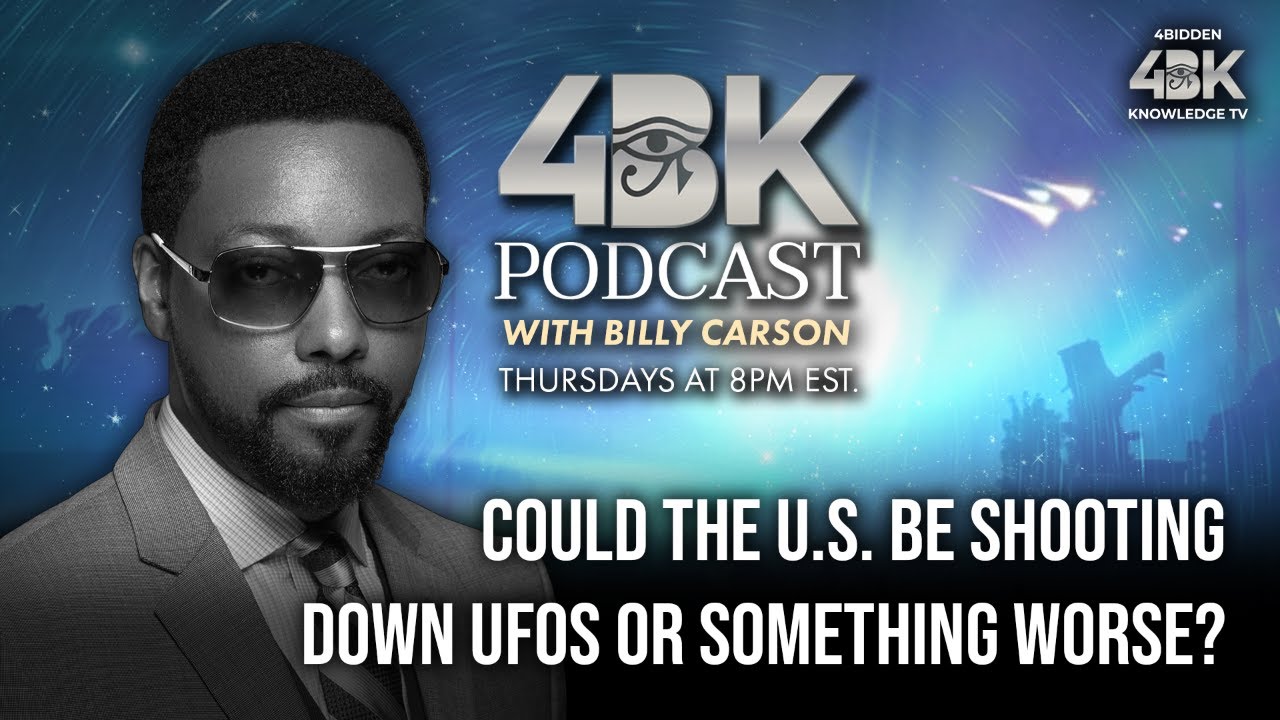
Billy Carson has not given a case-specific verdict on the Phoenix Lights in the material published on this site, so this section sets out his framework rather than putting words in his mouth. In his breakdown of the difference between UAPs and UFOs, Carson works with a two-tier model. At the top are genuine non-human craft, which he believes have been observed for centuries and have shown no hostile intent. Underneath are human programs, built partly with classified and black-budget money, that he sees as the larger source of risk.
That second tier is directly relevant to Phoenix. Carson places flying triangles, the Tic Tac and recent drone sightings in the human-made category, saying of them, "Those objects are actually made by us," and he associates the triangle shape with the TR-3B, a craft he believes came out of black-budget aerospace programs. He also argues that the vaguer government label "UAP" makes any sighting easier to wave away and harder for the public to separate genuine anomalies from secret aircraft paid for with tax money.
Applied to 13 March 1997, that framework sorts the evidence into three possibilities rather than two: conventional aircraft and flares, a classified human craft, or a genuine visitor. It is a reminder that "not flares" does not automatically mean "not human." Mainstream investigators, for their part, point to the A-10 flight and the astronomer's telescope view as reason to need neither of the last two options. For where the official side has landed on such questions, see the editorial team's guide to the UAP hearings from 2017 to 2026.
Watch, read and go deeper
For a historian's long view of cases like this one, watch Richard Dolan's UFO Chronicles on 4BK TV, which follows the modern UFO record and how governments have handled it. Billy Carson's own position on terminology, the Disclosure Project witnesses and black-budget craft is laid out in his UAP vs UFO breakdown. For the wider question of contact and visitation across history, start at the Anunnaki and ancient contact topic hub, and compare Phoenix with the official files on Rendlesham Forest.
Frequently asked questions
What were the Phoenix Lights?
The Phoenix Lights were lights seen by thousands of people over Arizona and Nevada on 13 March 1997. They involved two events: a V-shaped formation that crossed the state between about 8:00 and 8:45 pm, and a row of hovering lights over Phoenix around 10:00 pm. The second event was caught on video and is the one most often shown.
Were the Phoenix Lights flares?
The 10 pm lights were illumination flares dropped by Maryland Air National Guard A-10s over the Barry M. Goldwater Range, according to the Air Force, a pilot who flew that night and a frame-by-frame video analysis by Cognitech. The flares appeared to wink out as they fell behind the Sierra Estrella mountains. The earlier 8 pm formation is a separate event that flares do not explain.
What did Governor Fife Symington say about the Phoenix Lights?
In June 1997 Symington mocked the sightings at a press conference where his chief of staff appeared in an alien costume. In 2007 he said he had seen a huge craft himself, describing it as bigger than any aircraft he knew and "other-worldly." He accepted that flares were in the sky that night but said they did not explain what he saw.
What caused the V-shaped formation at 8 pm?
Investigators including James McGaha and Robert Sheaffer attribute it to five A-10 jets flying in formation to Davis-Monthan Air Force Base, showing steady formation lights. Amateur astronomer Mitch Stanley watched the lights through a telescope and said they were clearly individual planes. Many witnesses reject this and describe a single, solid, silent craft.
Have the Phoenix Lights happened again?
Similar lights were reported in February 2007 and April 2008. The 2007 lights were identified by military officials and the FAA as flares from F-16s training out of Luke Air Force Base. The 2008 lights were flares tied to helium balloons released by a Phoenix resident, who admitted it within days.
Sources and further reading
- James McGaha and Joe Nickell, "Alien Lights? At Phoenix, Stephenville, and Elsewhere: A Postmortem," Skeptical Inquirer, vol. 39, no. 2 (March/April 2015).
- Robert Sheaffer, "The 'Phoenix Lights' Become an 'Incident'," Skeptical Inquirer (November 2016).
- Tony Ortega, "The Hack and the Quack," Phoenix New Times (5 March 1998).
- Lynne D. Kitei, The Phoenix Lights: A Skeptic's Discovery That We Are Not Alone (Hampton Roads, 2004).
- Fife Symington, "Symington: I saw a UFO in the Arizona sky," CNN commentary (9 November 2007).
- Tom Beal, "UFOs flew over Phoenix in '97, Symington says," Arizona Daily Star (23 March 2007).
- Donald R. Prothero and Timothy D. Callahan, UFOs, Chemtrails, and Aliens: What Science Says (Indiana University Press, 2017).