The Rendlesham Forest incident is a series of reported sightings of unexplained lights, and an alleged craft landing, in Rendlesham Forest in Suffolk, England, in the early hours of 26 and 28 December 1980. The witnesses were United States Air Force personnel from the twin bases of RAF Woodbridge and RAF Bentwaters, including the deputy base commander, Lieutenant Colonel Charles Halt, whose memo and real-time tape recording make it one of the best-documented UFO cases on record.
It matters because both sides of the UFO debate claim it. Believers see trained military observers, physical traces, radiation readings and an official memo sent to the Ministry of Defence. Sceptics see a meteor, a lighthouse, bright stars and rabbit diggings, assembled into a story that grew with each retelling. That is why it is called "Britain's Roswell", and why reading the files, rather than the legend, is the fair way in.
What happened in Rendlesham Forest in December 1980?
At around 03:00 on 26 December 1980, a security patrol near the East Gate of RAF Woodbridge saw lights that appeared to descend into the forest. The men first thought an aircraft had come down. Three airmen, Jim Penniston, John Burroughs and Ed Cabansag, went into the trees to investigate. Halt's later memo records that they saw a glowing object, metallic in appearance with coloured lights, which seemed to move through the trees, and that animals on a nearby farm "went into a frenzy".
Shortly after 04:00 the Suffolk police attended and reported that the only light they could see was the Orford Ness lighthouse on the coast. After daybreak, servicemen found three shallow impressions in a small clearing near the forest edge, along with marks on nearby trees. Police called back at 10:30 thought an animal could have made them.
In the early hours of 28 December, Halt went into the forest with a small team, took radiation readings and dictated what he saw onto a micro-cassette recorder. The group saw a flashing red light to the east, and later three star-like lights low in the sky, two to the north and one to the south. Halt reported that the brightest hovered for two to three hours and seemed to beam down a stream of light from time to time.
Why were Americans involved?
The bases carried RAF names but in 1980 were operated by the United States Air Force. Rendlesham Forest, a Forestry Commission plantation about eight miles east of Ipswich, wraps around RAF Woodbridge, with RAF Bentwaters just to the north. The wing commander was Colonel Gordon Williams, the base commander Colonel Ted Conrad, and Halt was Conrad's deputy.
That arrangement shaped what followed: the witnesses were American, the land British, and the report went from a USAF officer via the RAF liaison commander, Squadron Leader Donald Moreland, to the Ministry of Defence.
What does the Halt memo say?
The Halt memo is a one-page report dated 13 January 1981 and headed "Unexplained Lights", sent through Squadron Leader Moreland to the Ministry of Defence. It reached the MoD more than a fortnight after the events, and it dates the two nights to 27 and 29 December, one day later than the witness statements and police records support.
In plain military language it describes the glowing object of the first night, the three depressions found the next day and the second-night sightings, and states that beta/gamma readings of 0.1 milliroentgens were recorded, peaking in the depressions. The original is held at the National Archives in Kew, and the historian David Clarke lists it among the most significant UFO documents in the collection. The case reached the public in October 1983, when the News of the World ran the front page "UFO lands in Suffolk – and that's official".
What is on Halt's tape?
Halt's tape is a micro-cassette recording made live during the second-night investigation, narrating the radiation survey, the search of the site and the lights. Copies were first released to researchers in 1984. Halt has explained that each tape ran about 20 minutes, so it is a set of excerpts rather than a continuous record.
It matters because it was not shaped by memory: it captures a reading of 0.07 at the centre of the site and the flashing light across the field, and its timings let researchers test what that light was.
What did Jim Penniston and John Burroughs say they saw?
Penniston's account is the most dramatic part of the story. He has said that on the first night he came close to a landed craft of unknown origin, touched it, found it warm and saw symbols like hieroglyphs on its side, which he sketched in his notebook. No close encounter with a landed craft was publicised at the time, and no other witness has corroborated the touching.
The notebook is contested. Penniston first showed it in a Sci Fi Channel documentary broadcast in December 2003. Around the 30th anniversary in December 2010 he added a new claim: that the day after the encounter he had written pages of binary digits received telepathically, which supporters later decoded as a message. The sceptic Ian Ridpath points out that the notebook's date and time do not match the event, and that Burroughs, a few yards from Penniston throughout, told him in 2006 that Penniston "was not keeping a notebook as it went down". Penniston also made plaster casts of the ground impressions, which have been shown at conventions and on television.
The original 1980 statements are more restrained. Burroughs and Cabansag described following a light through the forest until they could see it came from a lighthouse; Cabansag called it "only a beacon light off in the distance". In 2014 Penniston and Burroughs co-wrote Encounter in Rendlesham Forest with Nick Pope.
What is the Orford Ness lighthouse explanation?
The lighthouse explanation holds that the flashing light seen on both nights was Orford Ness lighthouse, about five miles beyond the forest edge and then one of the brightest in Britain. It was first proposed by Vince Thurkettle, a forester who lived within a mile of the site, and developed by the science writer Ian Ridpath, who filmed the lighthouse from the forest for BBC Breakfast Time within days of the 1983 story.
Thurkettle plotted the direction the airmen described and found they were looking straight into the lighthouse beam. He told Ridpath the landing marks were rabbit diggings several months old, covered in pine needles, and the tree marks were axe cuts made by foresters. Timings on Halt's tape show his light flashed every five seconds, the lighthouse's flash rate.
The rest fits the same pattern, sceptics argue. The first-night lights coincided with a bright fireball seen over southern England at about 03:00 on 26 December, and the brightest star-like object Halt saw to the south matched the position of Sirius, the brightest star in the night sky. Brian Dunning summed up the case in 2009: "Separate pieces of poor evidence don't aggregate together into a single piece of good evidence."
Halt rejects this. In a signed 2010 affidavit he stated that the lighthouse lay well to one side of the light he saw, a claim Ridpath disputes using maps and photographs of Halt's position.
Were the radiation readings significant?
The readings do not show anything above normal background, according to the technical reviews that have examined them. The team used an AN/PDR-27 survey meter and, on the tape, recorded 0.07 milliroentgens per hour in the depressions against about 0.03 to 0.04 elsewhere, with a similar small rise more than half a mile from the site.
The meter's manufacturer, consulted through Britain's National Radiological Protection Board, said the memo's 0.1 figure was the bottom reading on the lowest range and of "little or no significance". The base public affairs officer, Captain Victor Warzinski, wrote in 1984 that the readings fell "within the range of normal background radiation counts". Nick Pope has argued that the readings were notably elevated.
What do the MoD files show?
The Ministry of Defence files show a department that logged the report, judged it of no defence significance and did not investigate in depth. David Clarke obtained the MoD's Rendlesham file in 2001 under the Code of Practice on Access to Government Information, the forerunner of the Freedom of Information Act. More papers followed as the MoD released its UFO files through the National Archives between 2008 and 2013, including briefings prepared for ministers and for Lord Hill-Norton, a former Chief of the Defence Staff who pressed for answers.
Nick Pope, who worked on the MoD's UFO desk from 1991 to 1994, reviewed the case years later and became its best-known official advocate, arguing it raised defence questions that were never answered. The files contain no hidden finding of a craft. Supporters read their thinness as a cover-up; sceptics read it as proof nobody senior took it seriously.
The disputed and later accounts
Larry Warren is the most disputed witness. He was the anonymous source, as "Art Wallace", for the 1983 News of the World story, and in 1997 published Left at East Gate with Peter Robbins, describing a landed craft and its occupants. Halt disputes his account, he does not appear on Halt's tape, and there is no statement from him in the original documents.
In early 2015 John Burroughs was granted medical disability benefits by the US Department of Veterans Affairs after Senator John McCain's office helped correct his service records. Burroughs and his supporters describe this as acknowledgement that he was injured in the line of duty at Rendlesham. The VA did not publicly state a cause, and his medical records have not been released.
A former security policeman, Kevin Conde, has said he once rigged a patrol car's lights as a prank, but there is no evidence it happened on these nights. Jenny Randles, co-author of Sky Crash, the first book on the case, concluded in 2010 that "no unearthly craft were seen in Rendlesham Forest".
Billy Carson's reading
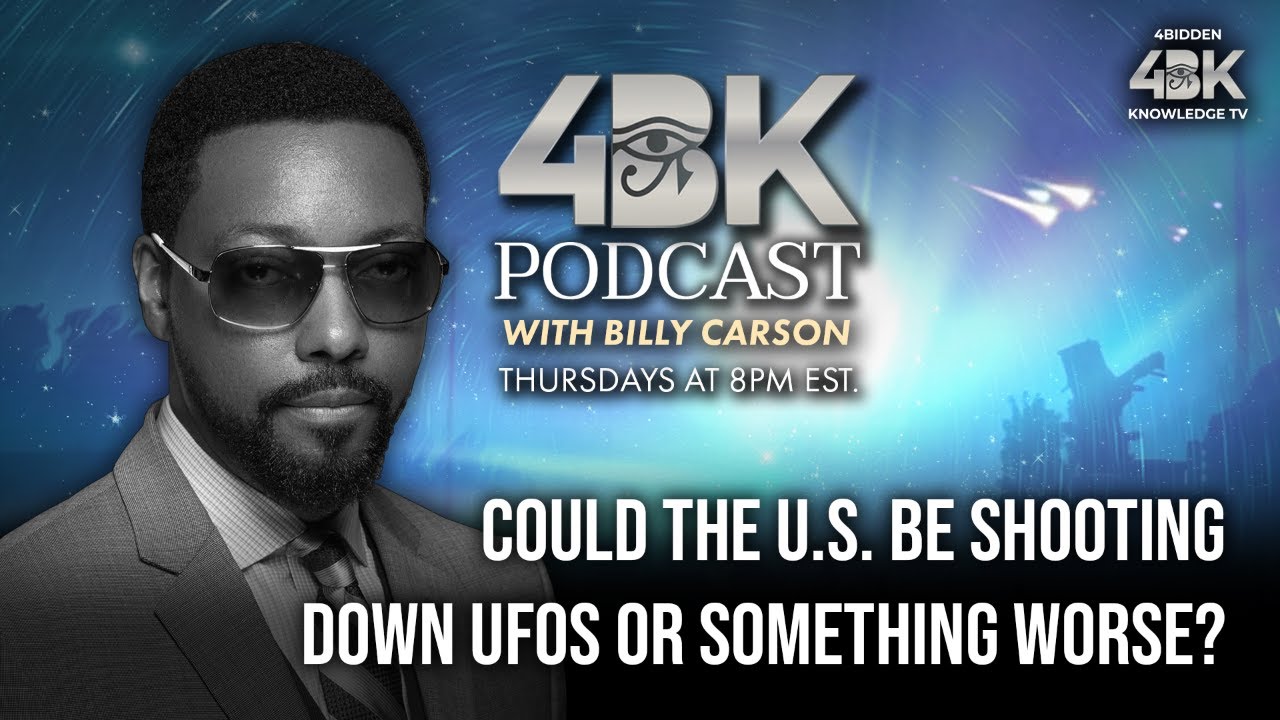
Billy Carson has not made a Rendlesham-specific video, so his reading comes from his wider position on military UFO testimony. In the companion piece on UAPs vs UFOs and the Disclosure Project testimony, he argues that UFO should mean what witnesses have described for generations: physical craft not built by humans. The newer term UAP, in his view, lumps those craft together with balloons, drones and classified aircraft, and the words officials use shape what gets investigated.
Carson gives real weight to military witnesses. Applied to Rendlesham, that approach treats Halt's memo and tape, and the accounts of trained security personnel, as credible testimony about genuine non-human craft rather than a misread lighthouse. The sceptical explanation remains the mainstream view. The same tension runs through Roswell in July 1947 and the UAP hearings from 2017 to 2026.
Watch, read and go deeper
For the military side of the UFO story, Richard Dolan's UFO Chronicles on 4BK TV covers reported missile shutdowns, the UFO dogfight over Iran and whistleblower accounts of early crashes. The Phoenix Lights explainer is a useful comparison, another case where lights seen by many drew competing explanations. Billy's framework is set out in the UAP-vs-UFO piece linked above, and the Anunnaki topic hub gathers his work on ancient contact. In Suffolk, the Forestry Commission's Rendlesham UFO Trail, opened in 2005, ends at a sculpture installed in 2014 and modelled on sketches of the reported craft.
Frequently asked questions
Why is Rendlesham called Britain's Roswell?
Rendlesham is called Britain's Roswell because it is the most famous UFO case in the United Kingdom and, like Roswell, involves military witnesses, alleged physical evidence and claims of a cover-up. No debris was ever recovered at Rendlesham.
When did the Rendlesham Forest incident happen?
The main events took place in the early hours of 26 and 28 December 1980. Halt's memo of 13 January 1981 gives the dates as 27 and 29 December, a one-day error researchers have noted. The story became public in October 1983.
Was the Rendlesham Forest incident ever explained?
There is no official explanation, because the Ministry of Defence judged it of no defence significance. The most widely accepted sceptical explanation combines a fireball, the Orford Ness lighthouse, bright stars such as Sirius and rabbit diggings mistaken for landing marks. Several witnesses, including Halt, reject it.
Can you visit the Rendlesham Forest landing site?
Yes. Rendlesham Forest is open to the public, and the Forestry Commission created a UFO Trail there in 2005 leading to the area linked with the sightings. A sculpture based on witness sketches was added at the end of the trail in 2014.
What was the Rendlesham binary code?
The binary code is a set of ones and zeros Jim Penniston says he wrote in his notebook the day after the encounter, having received it telepathically. He first made the claim publicly around December 2010. Sceptics note it emerged three decades later and that Burroughs said Penniston was not keeping a notebook during the encounter.
Sources and further reading
- Lt Col Charles I. Halt, memorandum "Unexplained Lights", 13 January 1981, MoD file DEFE 24/152, The National Archives, Kew.
- Ian Ridpath, Rendlesham Forest UFO case files, including his transcript of the Halt tape.
- David Clarke, The UFO Files: The Inside Story of Real-Life Sightings (The National Archives, 2009).
- Nick Pope, John Burroughs and Jim Penniston, Encounter in Rendlesham Forest (Thomas Dunne Books, 2014).
- Brenda Butler, Jenny Randles and Dot Street, Sky Crash: A Cosmic Conspiracy (1984).
- Larry Warren and Peter Robbins, Left at East Gate (1997).
- James McGaha and Joe Nickell, "The Rendlesham UFO Incident: A Study in Folly", Skeptical Inquirer 38, no. 5 (2014).
- Brian Dunning, "The Rendlesham Forest UFO", Skeptoid episode 135 (6 January 2009).