There’s something haunting about listening… and hearing nothing.
For years, the distant exoplanet K2-18b has sat in the spotlight of cosmic curiosity—a potential “water world” orbiting within its star’s habitable zone, about 124 light-years away. A place where, in theory, life could exist.
But recently, scientists turned their instruments toward it with one simple question:
Is anyone there?
The answer, for now, is silence.
→ What Makes K2-18b So Special? 4
K2-18b isn’t just another distant rock floating in space. It stands out for a few key reasons:
→ Located in the habitable zone It orbits a red dwarf star at just the right distance where liquid water could exist.
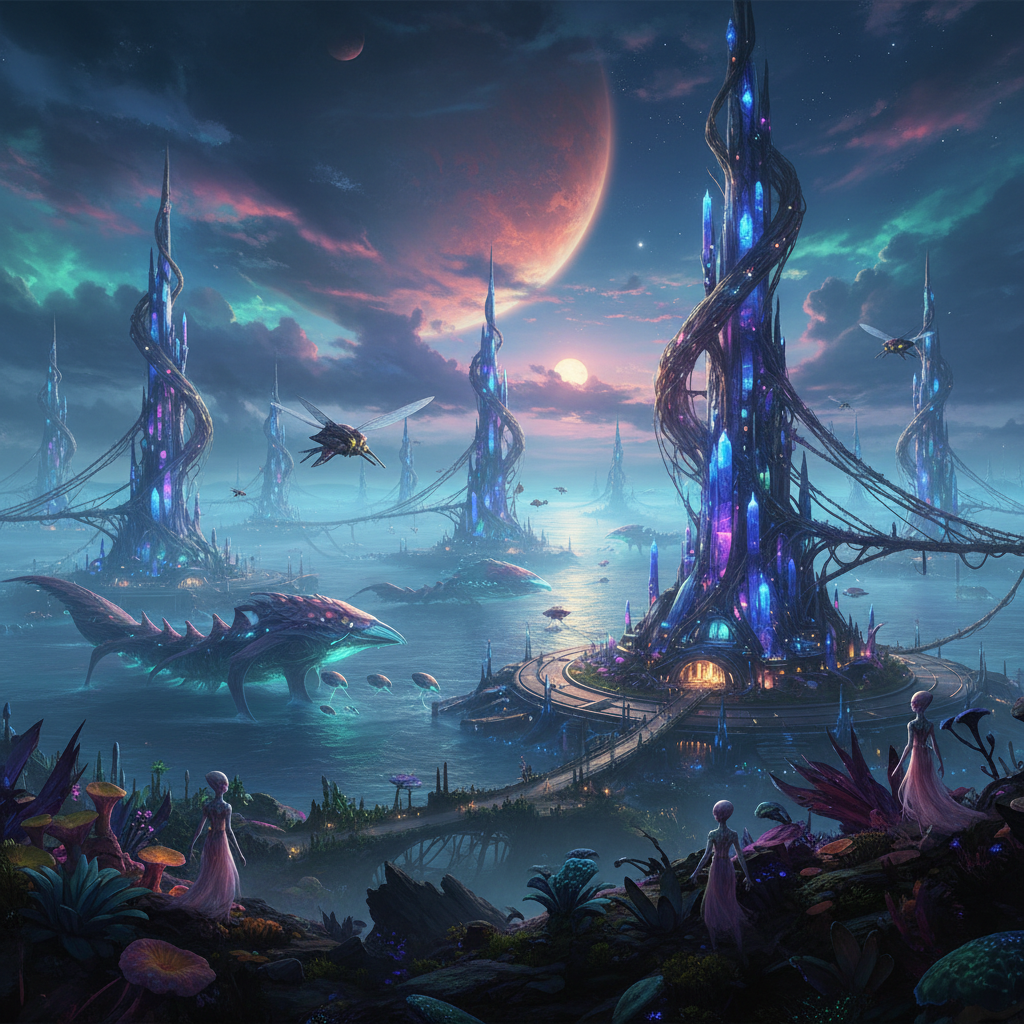
→ Possible “Hycean” world According to researchers like Nikku Madhusudhan from the University of Cambridge, K2-18b may be a Hycean planet—a hydrogen-rich world with vast global oceans beneath its atmosphere.
→ Chemical hints of life-friendly conditions Observations using the James Webb Space Telescope detected molecules like methane and carbon dioxide—ingredients often associated with biological processes.
→ Potential biosignature intrigue There have even been tentative discussions about dimethyl sulfide (DMS), a compound on Earth largely produced by marine life.
In short: if there were a shortlist of places to find alien life, K2-18b would be near the top.
→ The Big Question: Where Are the Signals?
Scientists recently used powerful radio telescopes to scan K2-18b for technosignatures—signals that might indicate intelligent life.
These include:
→ Artificial radio transmissions → Narrowband signals (unlike natural cosmic noise) → Repeating patterns that suggest intentional communication
Despite careful observation…
→ No signals were detected
Not even a whisper.
→ Why This Matters (Even If It’s “Nothing”)
It’s tempting to see this as disappointing—but in science, nothing is still something.
According to Jill Tarter, a pioneer in the search for extraterrestrial intelligence:
“Absence of evidence is not evidence of absence.”
Here’s what this “silence” actually tells us:
→ No detectable advanced civilizations (at least broadcasting our way) If intelligent life exists there, it may not use radio waves—or may not be transmitting at all.
→ Our search methods have limits We are still early in our ability to detect faint, distant signals across interstellar space.
→ Life ≠ technology Even if K2-18b hosts life, it could be microbial, ocean-based, or fundamentally different from anything that builds radios.
→ The Reality Check: We Might Be Listening Wrong 4
The search for alien intelligence often assumes something very human:
→ That other civilizations use radio waves → That they transmit signals continuously → That they even want to be found
But as Frank Drake, creator of the famous Drake Equation, suggested:
The universe may be full of life—but separated by vast distances, time gaps, or incompatible technologies.
In other words…
→ We might be tuning into the wrong channel → Or listening at the wrong time → Or asking the wrong question entirely
→ What Happens Next?
The story of K2-18b is far from over.
→ More detailed atmospheric studies are planned using next-generation telescopes → Scientists will continue searching for biosignatures, not just technosignatures → Future missions may refine our understanding of Hycean worlds
And perhaps most importantly:
→ We are learning how to ask better questions about life beyond Earth
→ Final Thought
K2-18b didn’t answer us.
But maybe that’s the point.
The universe doesn’t rush to reveal itself. It unfolds slowly, quietly—like a locked door that only opens when you’ve learned how to knock.
Right now, we’re still learning the rhythm.
And somewhere, 124 light-years away, an ocean world drifts in silence… not empty—just not speaking our language yet.