Remote viewing is the practice of attempting to describe a distant or hidden target, such as a place, an object or an event, by mental means alone, under a protocol in which the viewer is given no ordinary information about what the target is. The term was coined by the artist Ingo Swann during experiments at Stanford Research Institute in the early 1970s, and the method was studied and used by a series of US government programmes, best known by their final name, Stargate, until the work was closed in 1995.
Few claims about the mind come with a paper trail like this one. More than two decades of government funding, laboratory statistics argued over in peer-reviewed psychology journals, and a formal evaluation commissioned by the CIA make remote viewing the best-documented test case for a large question: can consciousness gather information beyond the ordinary senses? It pays to know both what the record shows and exactly where it stops.
What remote viewing is
Remote viewing is a structured exercise, not a free-form psychic reading: the defining feature is the protocol. Someone other than the viewer selects a target and seals it away. The viewer is given only an arbitrary reference, often a string of numbers, and records whatever impressions come: shapes, textures, colours, temperatures, sounds, a rough sketch. Only after the session is finished does the viewer see the target.
In laboratory versions, the transcript is then handed to a judge who does not know the answer and who must pick the real target out of a set that includes several decoys. If the viewer's descriptions match the real target more often than chance would predict across many trials, the experimenters count that as a hit rate above chance. That design separated remote viewing from looser claims of clairvoyance, and let critics test it on the same terms.
Where it started: SRI, Swann, Targ and Puthoff
Remote viewing research began in 1972 at Stanford Research Institute (later SRI International) in Menlo Park, California, under two laser physicists, Harold Puthoff and Russell Targ. Their first key participant was Ingo Swann, a New York artist who gave the practice its name. Another early subject, Pat Price, produced sessions that became among the most discussed in the programme's history.
The signature early design was the outbound experiment. One member of the team drove to a location chosen at random from a pool of sites, while the viewer, sitting in a shielded room at the lab, tried to describe where that person was. Targ and Puthoff reported strong results, and a paper by them appeared in Nature in 1974, accompanied by an editorial in which the journal set out its reservations.
The work drew criticism early. The psychologists David Marks and Richard Kammann argued in Nature in 1978 that the SRI transcripts contained incidental cues, such as references to earlier sessions, that could help a judge place each transcript in the correct order without any psychic input at all.
The government years: from Gondola Wish to Stargate
From 1972 to 1995 the US government funded and ran remote-viewing work under a series of code names: Gondola Wish, Grill Flame, Center Lane, Sun Streak and, finally, Stargate. The CIA provided the early research funding at SRI; the operational side later ran through the Army and then the Defense Intelligence Agency, with a small unit of viewers based at Fort Meade, Maryland.
The best known of those viewers is Joseph McMoneagle, an Army intelligence soldier recruited in the late 1970s and designated Remote Viewer 001. Other unit members, including Lyn Buchanan, Paul H. Smith and Ed Dames, would later become the main public teachers of the method. Alongside the operational unit, laboratory research continued at SRI and afterwards at Science Applications International Corporation (SAIC) under the physicist Edwin May.
The programme was closed and made public in 1995. In 2017 the CIA put its declassified Stargate material, roughly 90,000 pages, online in its electronic reading room, so much of this history can now be checked against the original documents.
What the 1995 CIA evaluation found
In 1995 the CIA commissioned the American Institutes for Research (AIR) to evaluate the programme, and its verdict was that remote viewing had not produced intelligence of operational value. AIR brought in two reviewers with opposing starting points to assess the laboratory evidence: Jessica Utts, a statistician at the University of California, Davis, and Ray Hyman, a psychologist at the University of Oregon and a long-standing critic of parapsychology.
Utts concluded that the laboratory studies showed a statistically significant effect that could not be explained away by the flaws she examined, and she argued that the case for psychic functioning was strong enough to warrant acceptance. Hyman agreed that the results were not easily dismissed but concluded that they did not establish psi: the effects had not been independently replicated by other laboratories under tight conditions, and there was no positive theory of what was supposedly happening, only an unexplained departure from chance.
Where the two agreed mattered most for the government. On the practical question, the evaluation found that the viewers' output had never been reliable or specific enough to act on as intelligence. The programme was closed.
What the wider science says
The honest summary of the scientific record is this: some laboratory studies report small effects above chance, there is no accepted mechanism to explain them, and there is no demonstrated, reliable operational use.
The Ganzfeld experiments are the closest laboratory cousin. In these, a receiver in mild sensory isolation tries to describe an image or clip that a sender elsewhere is viewing. Daryl Bem and Charles Honorton published a meta-analysis in Psychological Bulletin in 1994 arguing for a replicable effect. Julie Milton and Richard Wiseman answered in the same journal in 1999 with a meta-analysis of newer studies that found no significant overall effect. Lance Storm, Patrizio Tressoldi and Lorenzo Di Risio then published a further meta-analysis in Psychological Bulletin in 2010 reporting a positive result, and the back-and-forth has continued since.
In 2011 Bem published Feeling the Future, a set of nine experiments claiming evidence of precognition, in the Journal of Personality and Social Psychology. Attempts to repeat the work, including one by Stuart Ritchie, Richard Wiseman and Christopher French, failed to reproduce the effect. The episode became a touchstone in psychology's replication crisis.
The most recent high-profile exchange came in American Psychologist. In 2018 Etzel Cardeña published a review arguing that the experimental evidence for parapsychological phenomena was comparable to that accepted in other areas of psychology. Rolf Reber and James Alcock replied in the same journal that the claims conflict with well-established physical principles and that, on that basis, the reported effects are far more likely to reflect methodological problems than a real phenomenon.
Skeptics point to familiar explanations for apparent hits: sensory leakage and cueing in protocols, the file-drawer problem where unsuccessful studies go unpublished, flexible scoring, and the natural human tendency to read a match into vague descriptions. Proponents answer that better-controlled studies addressed many of these issues; either way, the question has not been settled in favour of psi.
How remote viewing is practiced today
Today remote viewing is mostly taught as a structured training exercise, usually in a form derived from Coordinate Remote Viewing (CRV), the protocol Ingo Swann and Harold Puthoff developed in the 1980s. Former unit members such as Lyn Buchanan, Paul H. Smith and Ed Dames went on to teach versions of it publicly, and each school has its own refinements.
In general terms, a CRV-style session follows a sequence of stages:
- Target reference. The viewer receives only a set of numbers standing in for the target, sometimes called coordinates, chosen by someone else.
- Ideogram. The viewer makes a quick, reflexive mark on paper in response to the reference, then describes the feel of that mark, for example whether it suggests something natural or manufactured, solid or fluid.
- Sensory impressions. The viewer lists raw perceptions such as textures, colours, temperatures, sounds and smells, deliberately avoiding naming what the target is.
- Sketching. Impressions of shape, scale and layout are drawn rather than described.
- Handling guesses. When the mind jumps to a named conclusion, such as a bridge or a church, the viewer writes it down separately and sets it aside. CRV calls this analytical overlay, and treats it as the main source of error.
- Feedback. Only after the session is closed does the viewer see the target and compare it with what was recorded.
Practitioners who take the discipline seriously keep the conditions honest: a target chosen blind by another person, impressions written down before any feedback, every session kept rather than only the good ones, and results scored the same way each time. Run like that, the exercise is a way of studying one's own perception, whatever one concludes about the larger claim. It is not a skill that comes with guaranteed outcomes, and anyone presenting it that way is overselling it.
Billy Carson's reading
Billy Carson treats remote viewing as a trainable skill and teaches it directly, through a 4BK TV workshop series and an Academy course, described in [the remote viewing workshop taught by Billy Carson](/remote-viewing-workshop-taught-by-billy-carson).
Carson frames remote viewing as accessing information within a holographic reality. In that view, information about a distant target is not locked away at its location, so a trained mind can in principle reach it without travelling there. That framing draws on the physics idea explored in [is the universe a hologram](/is-the-universe-a-hologram-holographic-principle-explained), although the holographic principle in physics is a proposal about how information is encoded in spacetime and does not itself say anything about perception. Readers following this thread will find related ideas about a universal store of knowledge in [the Akashic records explained](/the-akashic-records-explained-origins-what-people-claim-and-how-to-think-about-them), and about inner vision in [how to open your third eye](/how-to-open-your-third-eye-pineal-gland-meditation).
This is Carson's interpretation, not a finding of the Stargate programme or of the laboratory literature, and it is best read alongside the evidence set out above. What it shares with the government-era protocol is an emphasis on structure, practice and feedback.
Watch, read and go deeper
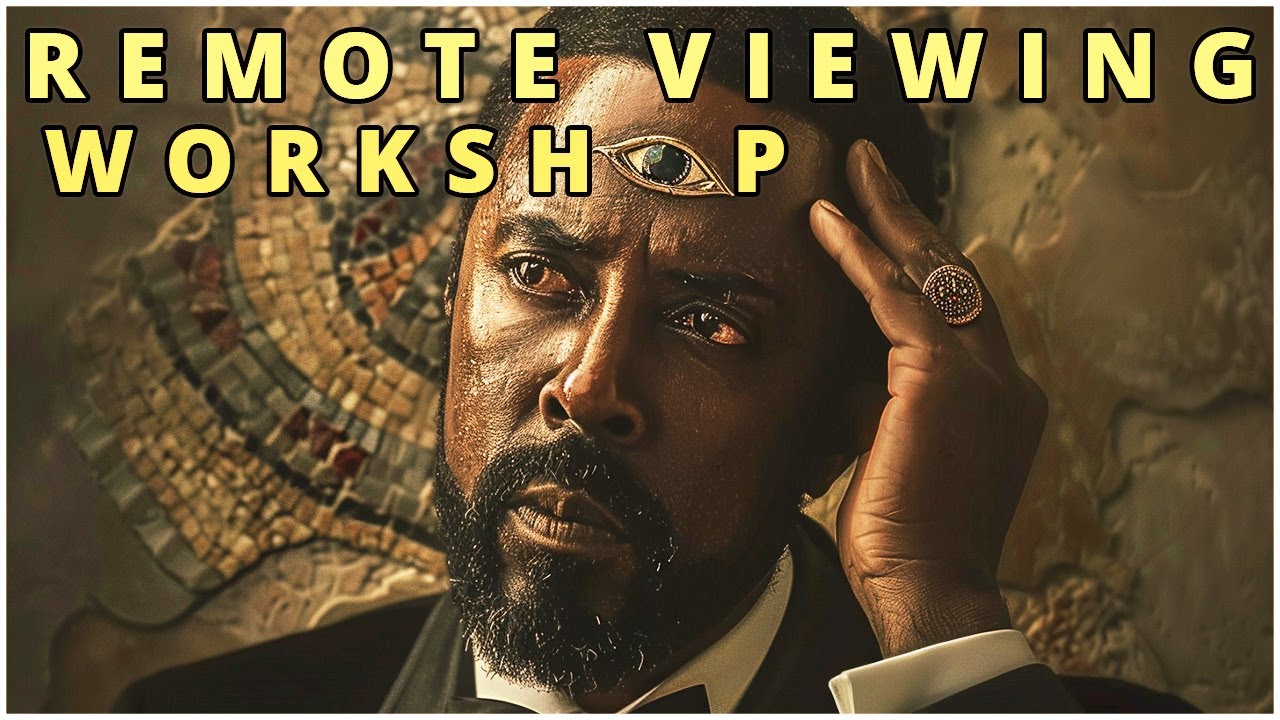
The full [Remote Viewing Workshop](/watch/remote-viewing-workshop) on 4BK TV presents Carson's approach to the practice. For a conversational overview, the podcast episode Remote Viewing Explained: How Your Mind Accesses Hidden Information covers the subject in conversation. Structured training is available through the 4biddenknowledge Academy. For related subjects, from meditation to theories of mind, start at the [consciousness topic hub](/topics/consciousness).
Frequently asked questions
Is remote viewing scientifically proven?
No. Some laboratory studies report small effects above chance, and a minority of researchers, such as the statistician Jessica Utts, argue those effects are real. Most scientists do not accept that psi has been established, because results have not replicated reliably across independent laboratories and there is no accepted mechanism. The 1995 CIA evaluation also found no reliable operational use.
Did the US government really use remote viewers?
Yes. From 1972 to 1995 the US government funded research and ran an operational unit under names including Gondola Wish, Grill Flame, Center Lane, Sun Streak and Stargate. The unit was based at Fort Meade, Maryland, and the programme was declassified in 1995. The CIA placed roughly 90,000 pages of related documents online in 2017.
Why was the Stargate programme shut down?
The programme was closed in 1995 after an evaluation by the American Institutes for Research for the CIA. The evaluators disagreed about whether the laboratory results showed a genuine effect, but the evaluation concluded that the viewers had not produced information reliable or specific enough to be used as intelligence.
What is Coordinate Remote Viewing?
Coordinate Remote Viewing (CRV) is a structured protocol developed by Ingo Swann and Harold Puthoff in the 1980s. The viewer is given only a numerical reference for a target and works through staged steps: an ideogram, sensory impressions, sketches, and separating out guesses, before receiving feedback. Former Stargate personnel including Lyn Buchanan, Paul H. Smith and Ed Dames later taught versions of it.
Who was Remote Viewer 001?
Remote Viewer 001 was the designation given to Joseph McMoneagle, an Army intelligence soldier recruited into the government programme in the late 1970s. He is the programme's best-known viewer.
Sources and further reading
- Russell Targ and Harold Puthoff, Mind-Reach: Scientists Look at Psychic Ability (1977).
- Michael Mumford, Andrew Rose and David Goslin, An Evaluation of Remote Viewing: Research and Applications, American Institutes for Research (1995).
- Jessica Utts, An Assessment of the Evidence for Psychic Functioning, and Ray Hyman, Evaluation of a Program on Anomalous Mental Phenomena, both written for the 1995 AIR evaluation.
- Daryl Bem and Charles Honorton, Does Psi Exist?, Psychological Bulletin (1994); Julie Milton and Richard Wiseman, Does Psi Exist? Lack of Replication of an Anomalous Process of Information Transfer, Psychological Bulletin (1999).
- Lance Storm, Patrizio Tressoldi and Lorenzo Di Risio, meta-analysis of free-response studies, Psychological Bulletin (2010).
- Etzel Cardeña, The Experimental Evidence for Parapsychological Phenomena: A Review, American Psychologist (2018), and the reply by Rolf Reber and James Alcock, Searching for the Impossible: Parapsychology's Elusive Quest, American Psychologist.
- Jim Schnabel, Remote Viewers: The Secret History of America's Psychic Spies (1997).
- Paul H. Smith, Reading the Enemy's Mind: Inside Star Gate, America's Psychic Espionage Program (2005).