 Travel with Billy Carson —
When most people think of Mercury, they imagine a scorched, lifeless world baking under the intense heat of the Sun. After all, Mercury is the closest planet to our star, with daytime temperatures soaring above 800°F (430°C).
That’s why one of the most surprising discoveries in planetary science was the confirmation that Mercury contains significant deposits of water ice hidden within permanently shadowed craters near its poles. Even more astonishing, new research suggests that much of that water may have arrived during a single catastrophic event that unfolded over just one Mercurian day.
Mercury's Ice Mystery
For decades, scientists struggled to explain how a planet so close to the Sun could hold onto water.
The answer lies at Mercury's poles.
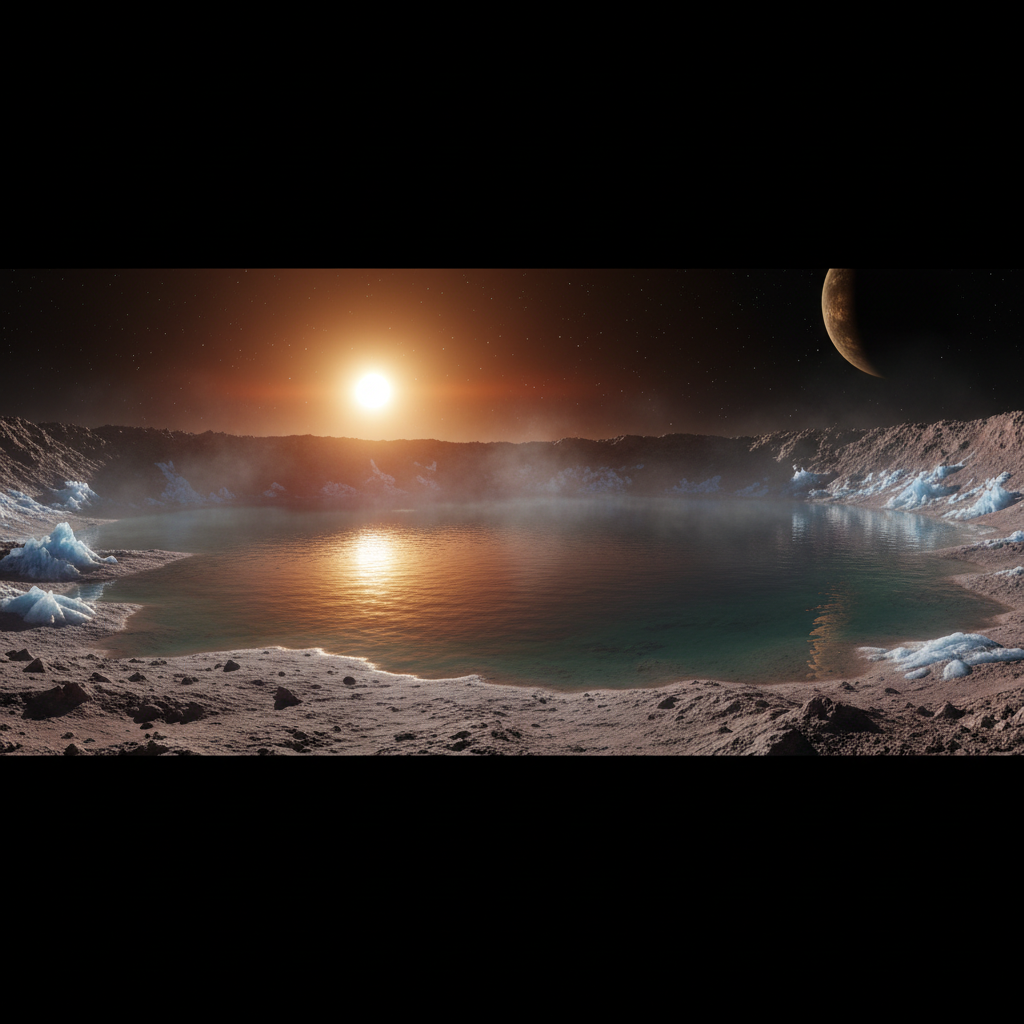
Because Mercury's axis is tilted by less than one degree, some deep polar craters never receive direct sunlight. These permanently shadowed regions remain extremely cold—cold enough to preserve water ice for billions of years. Observations from NASA's MESSENGER spacecraft confirmed the presence of water ice and organic-rich materials hidden inside these frozen craters.
Scientists have proposed several explanations for the ice:
→ Gradual delivery by micrometeorites
→ Impacts from comets over billions of years
→ Solar wind interactions with Mercury's surface
→ A single large water-rich asteroid or comet impact
A new study is now pointing strongly toward the final possibility.
One Impact That Changed Everything
Researchers led by planetary scientist Parvathy Prem used advanced computer simulations to investigate what would happen if a large water-rich asteroid or comet slammed into Mercury.
Their findings suggest that a massive impactor—possibly similar to the one that created Mercury's 97-kilometer-wide Hokusai Crater—could have delivered enormous amounts of water to the planet.
Here's how it may have happened:
→ A large asteroid or comet struck Mercury.
→ The collision instantly vaporized vast quantities of water.
→ A temporary atmosphere formed around the planet.
→ This atmosphere shielded water molecules from being destroyed by solar radiation.
→ Water migrated across the surface.
→ Significant amounts became trapped inside the permanently shadowed polar craters.
The entire process may have occurred within a single Mercurian day—the equivalent of about 176 Earth days.
Why Scientists Are Excited
According to the study, Mercury's ice deposits appear relatively pure and may have accumulated rapidly rather than slowly over billions of years.
This matters because it helps explain a long-standing puzzle.
Mercury has almost no atmosphere. Water molecules exposed to sunlight are quickly destroyed by intense ultraviolet radiation. Previous theories involving slow accumulation struggled to explain how enough water survived to create the large ice deposits observed today.
The new model shows that a temporary impact-generated atmosphere could have protected the water long enough for it to migrate into the polar cold traps.
As the researchers noted, this scenario allows water to be transported and preserved far more efficiently than scientists previously believed.
A Reminder That Space Is Full of Surprises
One of the most fascinating aspects of this discovery is how it challenges our assumptions.
We tend to think:
→ Hot planet = no water
→ Cold planet = water
But the universe rarely follows simple rules.
Mercury may be one of the harshest environments in the Solar System, yet hidden within its darkest craters are frozen reservoirs that have survived for potentially millions or even billions of years.
As astronomer and science communicator Carl Sagan famously observed:
"Somewhere, something incredible is waiting to be known."
Mercury's unexpected ice deposits are a perfect example of that philosophy. The closer scientists look, the more they discover that even the Solar System's smallest planet still has secrets to reveal.
What Comes Next?
Scientists are eagerly awaiting new observations from the joint European-Japanese mission BepiColombo, which is expected to provide unprecedented data about Mercury's surface, composition, and polar ice deposits. These observations could help confirm whether a single giant impact truly delivered Mercury's frozen water.
If the theory is correct, Mercury's water story may not be one of slow accumulation over eons, but rather the aftermath of one extraordinary day when a cosmic collision transformed the closest planet to the Sun.