By: April Carson
Through direct observation, a group of scientists from the University of Hawaii at Manoa (USA) announced the finding of a new super-Jupiter-type exoplanet candidate. The enormous planet is three to five times heavier than Jupiter, the solar system's largest planet. Its features do not seem to conform to current planet formation theories, according to astronomers.
A direct image of one of the youngest exoplanet candidates has been taken by scientists
The technique of direct observation of exoplanets is the most stunning among the techniques for studying them, but it has only recently become available. We didn't know about exoplanets for a long time, but this method demands the use of the most up-to-date telescopes and radiation detectors.
Targets
This technique is frequently used to investigate huge exoplanets in wide orbits around young stars, since they are still warm enough to be visible in the infrared region. Such examinations enable scientists to examine models of exoplanet formation, such as accretion on a solid core or splintering of a protoplanetary disk.
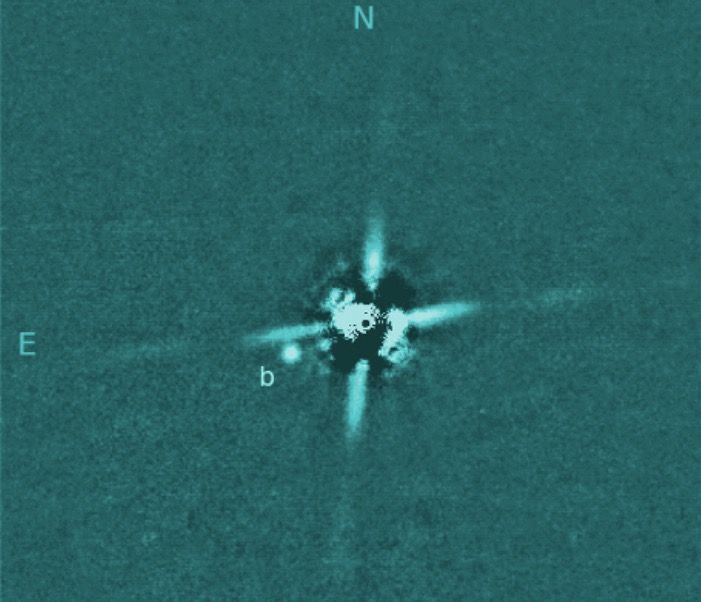
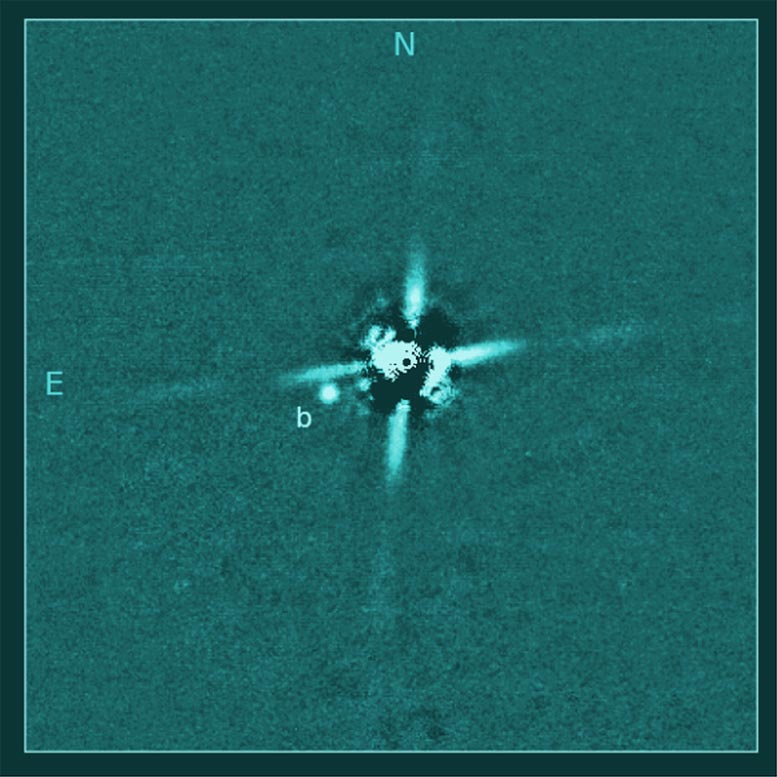
2M0437b is a exoplanet candidate
A team of astronomers from the University of Hawaii at Manoa, led by Eric Gaidos, discovered a young exoplanet candidate called 2M0437b using direct observations of the red dwarf 2MASS J04372171 + 2651014, which lies in the star-forming region of Taurus.
Age and Orbit
According to experts, 2M0437b formed two to five million years ago (when our planet is 4.5 billion years old). The planet's orbit is extremely elongated, and it is 100 times farther from its star than the Earth is from the Sun. Using adaptive optics, telescopes at the Keck Observatory and Subaru were used to measure the amount of light from a number of stars. The observations were conducted in the infrared spectrum with telescopes equipped with adaptive optics.
Characteristics
Comparison of the newly discovered body's brightness to existing models suggests a mass of 3-5 Jupiter masses, which is significantly lower than the deuterium burning limit, implying that it is not a brown dwarf but rather a young planet with characteristics similar to those of a super-Jupiter. Its real temperature is estimated at 1400-1500 degrees Celsius.
Importance
One of the youngest candidates for exoplanets, HD 2M0437b, was discovered directly. This is especially significant because scientists will now have access to it over time and learn more about how planets develop. It will join the long line of extrasolar planets that will be observed with the new James Webb Space Telescope, allowing scientists to obtain direct views of distant objects by eliminating previous problems.
The planet's formation model does not account for the accretion of disk material onto the core (due to the young system) or gravitational instability in the protoplanetary disk (due to the planet's enormous mass).
"The big surprise was that we could see this planet at all," said study author David Ehrenreich of the University of Geneva in Switzerland. "It's really close to its star and it's massive, more than five times the mass of Jupiter. It's a monster."
HD 2M0437b orbits very close to its host star, completing a full orbit in 1.5 days (a "year" on the planet is only 28 hours). Because of its proximity to its star and size, it was previously believed that the planet might have undergone atmospheric loss or developed into an un-breathable gas planet similar to Jupiter.
Join Psychic Cortney LIVE - Get Your Questions Answered LIVE

-------------------
LOOKING TO INVEST IN 4BIDDENKNOWLEDGE? CLICK HERE TO MAKE A CONTRIBUTION AND GET INVOLVED WITH 4BIDDENKNOWLEDGE TV AND BECOME PART OF THE MOVEMENT!
CLICK THE LINK TO INVEST
**
GET YOUR BOOK TODAY!

Related reading
- [The Black Knight Satellite explained](/black-knight-satellite-explained)
- [Who were the Anunnaki?](/who-were-the-anunnaki-sumerian-texts-vs-ancient-astronaut-theory)