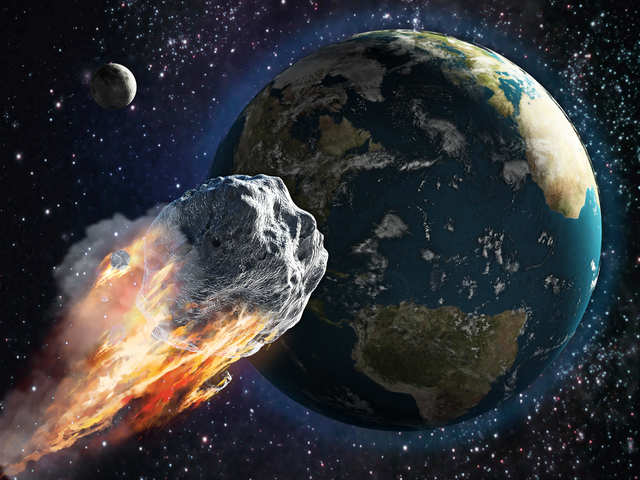
Did the Pentagon say an alien mothership is sitting in our solar system? In this live stream, Billy Carson traces the spring 2023 "alien mothership" headlines back to their source, an unreviewed draft paper co-written by Harvard astrophysicist Avi Loeb, and argues that the media turned a hypothetical into a headline. He then explains why he still takes large visiting craft seriously, working through the Reagan diaries, the Van Allen belts, the Kariong glyphs, the interstellar object 'Oumuamua and the Black Knight satellite.
The story had every ingredient of a viral UAP moment: a real paper, a real government official and a real question about objects from interstellar space. What changed between document and coverage was one word, "could". Carson's habit of reading the source first frames the session, and it is the best tool readers have for testing the claims that follow.
What the video covers
The draft paper behind the headlines (from about 6 min)
Carson puts the headline on screen, "Pentagon officials suggest alien mothership in our solar system could send mini probes to Earth". He says he does not jump on a story the day it breaks: "I want to get as close to the truth as possible." He looks up "draft" and "preliminary" on air to show that the source was an early version of a paper, not an announcement. "These are hypotheticals," he says.
The document was a March 2023 draft co-written by Avi Loeb and Sean Kirkpatrick, then director of the Pentagon's All-domain Anomaly Resolution Office (AARO); Carson names only Loeb. Among other things, it raised the possibility that an artificial interstellar parent craft passing close to the Sun could release small probes. Carson says he respects Loeb; his criticism is aimed at coverage that sold an unfinished draft as the start of disclosure.
The Reagan diary and hidden technology (from about 11 min)
To explain why he believes large craft exist, Carson points to former military witnesses associated with the Disclosure Project, one of whom, he says, described an object the size of two football fields. He then turns to the published Reagan diaries. In his telling, Reagan wrote that after meeting NASA scientists he learned the United States had a ship able to take 250 men and women into space, which Carson connects to a classified fleet he believes Reagan helped fund. He argues such technology is withheld from the public.
The diary entry itself is more modest. On June 11, 1985, Reagan described a lunch with space scientists and wrote that shuttle capacity was such that the US "could orbit 300 people". Most readers take that as a statement about the shuttle program, not evidence of a hidden ship. Carson adds an argument from space tourism (from about 18 min): if humans plan trips into space out of curiosity, far older civilizations would be visiting too.
The firmament and Tiamat (from about 19 min)
A viewer asks whether the firmament is real. Carson says it is, but "it's not a dome and it's not a barrier that we can't pass through". He reads it as the upper layers of the atmosphere and links the biblical "waters from the waters" to the Enuma Elish, the Babylonian creation epic. He reads Tiamat as a large planet, once fourth from the Sun, that broke apart, with Earth formed from a fragment and the debris becoming the asteroid belt. In his view, Genesis borrowed the framework and dropped the planetary story.
The Van Allen belts and escape velocity (from about 21 min)
Carson describes the Van Allen belts as charged particles from the Sun trapped by Earth's magnetic field. The concern, he says, was danger rather than impassability; a shielded capsule crossing quickly takes a limited dose, and trajectories used thinner regions. He adds that escaping Earth's gravity takes about 11.2 km per second, roughly 33 times the speed of sound. Staying in low orbit needs only about 7.8 km per second; escape speed matters for leaving Earth entirely.
The Kariong glyphs (from about 34 min)
Carson shows his own photographs from the Kariong (Gosford) glyphs in New South Wales, which he visited in early 2020. He describes one face of carvings he calls proto-Egyptian and another he calls Pleiadian, including a large shape with smaller craft coming out of it. He attributes the mothership reading to Aboriginal elders' oral history and ties it to the Loeb draft. He also recounts the story he says the hieroglyphs tell: two Egyptian brothers reach Australia, one dies of a snake bite and is mummified, and the survivor carries him home. Most archaeologists and Egyptologists treat the carvings as 20th-century work rather than ancient inscriptions.
'Oumuamua and Loeb's artificial-origin paper (from about 38 min)
'Oumuamua, the first known interstellar object, was discovered in 2017 by the Pan-STARRS telescope in Hawaii. "I don't believe that this is a comet or an asteroid," Carson says, citing its elongated shape, its path and how it crossed the inner solar system without striking anything. He reads from Loeb's paper "On the Possibility of an Artificial Origin for 'Oumuamua", which lists about half a dozen anomalies and argues that each natural explanation, from a porous dust cloud to a hydrogen or nitrogen iceberg, has quantitative shortcomings.
The paper compares 'Oumuamua to 2020 SO, a light object pushed by sunlight. Carson describes 2020 SO as a 1966 NASA solar-sail-style experiment driven by charged particles. That needs correcting: 2020 SO is a Centaur upper stage from the 1966 Surveyor 2 launch, pushed measurably by sunlight because it is hollow and light for its size. It carries no sail, and true solar sails ride the pressure of sunlight, not the solar wind.
Gravity assists and the data-probe idea (from about 50 min)
Carson explains the gravity assist, which uses a planet's gravity to change a spacecraft's speed and direction and save propellant. He traces it from the Soviet Luna 3, which photographed the Moon's far side in 1959, to Mariner 10 and the Voyager probes now in interstellar space. He shows NASA's Lucy mission swinging past Earth, then 'Oumuamua's arc around the Sun, and argues the object used the Sun to slingshot toward its next star. His hypothesis is that 'Oumuamua is a data probe, working or derelict, sent through star systems likely to harbor life and perhaps reporting home through quantum-entangled communication.
The Black Knight connection (from about 58 min)
Asked whether 'Oumuamua and the Black Knight satellite are related, Carson says they may be. He describes the Black Knight as an ancient probe in Earth orbit and lists the history covered in his documentary: signals attributed to Nikola Tesla, 1950s newspaper reports, a 1960 Time magazine mention, radio enthusiasts who decoded a signal as pointing to Epsilon Boötes, and a later declassified NSA document. Humanity keeps orbiters at Mars, he reasons, so others could keep one at Earth.
Key takeaways
- The "alien mothership" headlines came from an unreviewed draft by Avi Loeb and AARO's Sean Kirkpatrick that discussed a hypothetical, not a detection.
- The Reagan diary entry Carson cites speaks of shuttle capacity to "orbit 300 people", which most readers take as a statement about the shuttle program.
- Carson reads 'Oumuamua's shape and path as evidence of an engineered probe; that is his stated hypothesis, not scientific consensus.
- 2020 SO, Loeb's comparison object, is a 1966 Centaur rocket stage pushed by sunlight, not a solar sail.
Billy Carson's reading
Carson's position is that the universe is old enough, and full enough of possible civilizations, that visiting craft and probes should be expected. His strongest case is 'Oumuamua: an object that crossed the outer solar system, threaded the planets and swung around the Sun at a useful angle looks designed to him. He labels that conclusion plainly: "That's my personal opinion. That's not any scientific opinion."
He holds two ideas together: the headlines were overblown, and Loeb is probably right about 'Oumuamua. The case for and against is laid out in the 'Oumuamua explainer, and Carson's later commentary on a newer interstellar visitor is in 3I/ATLAS and Avi Loeb. The question underneath his argument, why clear evidence of other civilizations has not appeared, is the subject of the Fermi paradox and the Drake equation.
What mainstream scholarship says
Most astronomers treat 'Oumuamua as a natural object on a hyperbolic flyby: it fell in from interstellar space, rounded the Sun in September 2017 before it was spotted, and left. Its arc is what gravity does to any unbound object, not a gravity assist, since a flyby of the body at the center of the frame adds no net speed relative to it. The real puzzle is a small non-gravitational acceleration with no visible coma; natural models invoke outgassing of hidden ices, including hydrogen released from water ice in a 2023 Nature paper by Jennifer Bergner and Darryl Seligman. None is settled, so Loeb's artificial hypothesis remains in the literature as a minority view. Entanglement, physicists note, cannot carry messages faster than light.
Scholars read the Enuma Elish as a Babylonian creation myth honoring Marduk, with Tiamat as a primordial sea goddess; parallels with Genesis 1 are widely discussed, but the asteroid belt, a few percent of the Moon's mass in total, is not considered a destroyed planet. The Black Knight story is generally traced to early satellite tracks, radio echoes that writer Duncan Lunan interpreted as pointing to Epsilon Boötes and later abandoned, and a 1998 shuttle photograph NASA identifies as a lost thermal blanket. More context is in the Black Knight satellite explainer.
Watch, read and go deeper
Start with the 'Oumuamua explainer for the scientific debate, then the Black Knight satellite explainer for the history Carson sketches at the end of the stream. His reading of Tiamat is developed in the Enuma Elish and NASA, and related Sumerian and Babylonian topics are collected in the Anunnaki and Sumer hub. For a longer look at UFO history, Richard Dolan's UFO Chronicles is on 4BK TV.
Frequently asked questions
Did the Pentagon say there is an alien mothership in our solar system?
No. The headlines came from a March 2023 draft paper co-written by Avi Loeb and Sean Kirkpatrick, then head of the Pentagon's AARO office. It discussed, as one hypothesis, how an interstellar parent craft could in principle release small probes. It did not report detecting any such craft.
What is 'Oumuamua?
'Oumuamua is the first interstellar object observed passing through the solar system, discovered in October 2017 by the Pan-STARRS telescope in Hawaii. It appeared elongated or flattened and showed a small extra push away from the Sun. Most astronomers consider it natural, while Avi Loeb argues an artificial origin should be considered.
What is 2020 SO?
2020 SO is a spent Centaur upper rocket stage from NASA's 1966 Surveyor 2 launch that was briefly recaptured by Earth's gravity in 2020. Sunlight pushed it measurably, a sign of a hollow, lightweight object. Loeb uses it as a comparison for 'Oumuamua's motion; it was not a solar sail.
What is the Black Knight satellite?
The Black Knight satellite is a legend of an unidentified object in Earth orbit, often said to be thousands of years old. Skeptics trace it to misidentified satellites, misread radio echoes and a 1998 photo NASA identifies as a lost thermal blanket. Billy Carson explores the story in a documentary on 4BK TV.
Sources mentioned
Carson discusses Sean Kirkpatrick and Avi Loeb's 2023 draft "Physical Constraints on Unidentified Aerial Phenomena" (through its news coverage) and cites Loeb's paper "On the Possibility of an Artificial Origin for 'Oumuamua"; The Reagan Diaries, edited by Douglas Brinkley; the Enuma Elish and the Book of Genesis; Disclosure Project testimony; the Kariong glyphs and Aboriginal oral history; NASA's Lucy mission, Luna 3, Mariner 10 and Voyager; and his documentary Black Knight Satellite: Beyond the Signal. Standard references include the 'Oumuamua ISSI Team's 2019 Nature Astronomy review "The natural history of 'Oumuamua" and Bergner and Seligman's 2023 Nature paper.