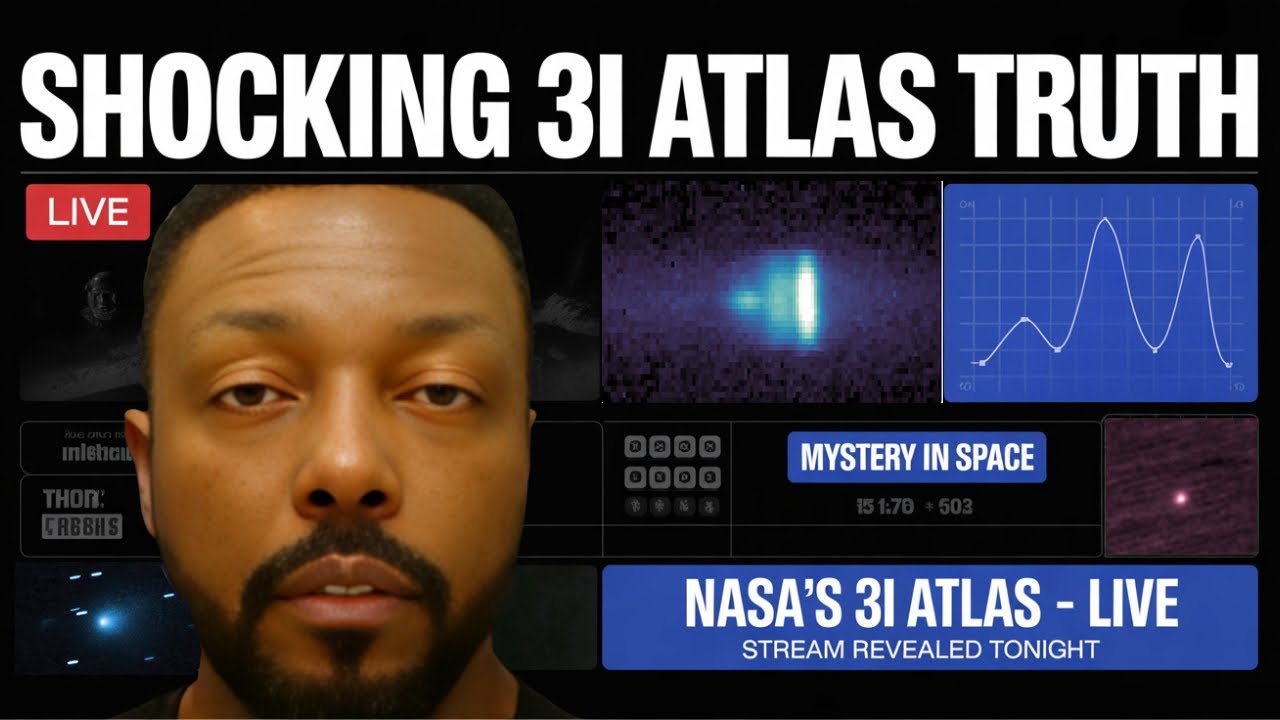
Terrence Howard's "new physics" is the claim that the universe contains no straight lines, that multiplication should be recursive so that one times one equals two, and that the "empty" space physics calls the vacuum is a dense aether made of what he calls wave conjugations. In this 4biddenknowledge Podcast Network live stream, Howard, his chief technology officer Chris Cely and Billy Carson argue that this geometry explains Saturn's polar storms, the origin of spin, gravity and even consciousness. Mainstream physics rejects the arithmetic and keeps its straight lines, but the two-hour conversation is the clearest statement yet of what Howard believes and why he thinks the academy will not engage with it.
The stream also wanders into politics and current events. This article covers only the physics, geometry and consciousness material, where Carson's own contribution sits, and sets each claim next to the position of working physicists.
Who is in the conversation?
The host opens with a 2019 clip of Howard announcing that he was leaving acting because he had "opened the flower of life properly." Seven years later he is on the 4biddenknowledge network with Cely, who runs the simulations and holds the patents with him, and Carson, a regular guest on the host's channel since the same year. Howard says his team had by then rebuilt Saturn in a simulator "without gravity, without dark matter, without dark energy," and that he expected the world to be relieved. "I overestimated the intelligence of mankind at that moment."
What does Howard mean by "there are no straight lines"?
Howard's starting point is that all energy is motion, all motion is waves, and all waves are curved, so the straight edges of the Platonic solids cannot exist in nature. He reads Newton against Newton: the first law has a body moving in a straight line unless acted on, but the third law says every action meets a reaction, reaction means resistance, and resistance bends the path. If there are no straight lines, there are no flat planes, no Platonic solids and no foundation under the theorems built on them. "All of their authority is a false authority."
Carson backs him with quantum language: if everything exists as waves of potential before an observer collapses it, then at the deepest level everything is curved, and the room next door exists "on curved space, an energetic field" until you walk in. Howard adds that straight lines have always stood for the masculine and curves for the feminine, and that the hostility he met was a reaction to bringing balance back.
The mainstream position is that a straight line is an idealization, not a physical object. Euclidean geometry is a model that works to extraordinary precision at human scales, and general relativity already describes space-time as curved, with free-falling bodies following geodesics. Newton's first law describes what happens in the absence of forces, which is why it does not contradict the third. The disagreement is not about whether curves exist but about whether they invalidate the mathematics engineers use to build bridges, chips and aircraft that work.
Why does Howard say one times one equals two?
For Howard, the equation 1 × 1 = 1 writes two actions on one side of the equals sign and a single result on the other, which he says abandons conservation of energy and action-reaction at the very first step. "An action times an action has a reaction." He offers a money illustration: a dollar times a dollar is one dollar, but ten dimes times ten dimes is a hundred dimes, so the answer depends on the unit, and he suggests banks already exploit that. Cely connects it to the square root of two and to pi, numbers whose decimals never resolve, which he reads as a "Pythagorean gap" that nature leaves open. Howard names that gap the "Howard comma," 109.47, the angle at which his lynchpin shapes refuse to close, and compares it to the pause between breaths.
Mathematicians answer that multiplication is a defined operation, and under the definitions every number system uses, one times one is one; changing the definition produces a different system, not a discovery about the old one. The dollar example is a units error: a dollar times a dollar is a square dollar, which is why physics tracks dimensions separately from magnitudes. 109.47 degrees is the tetrahedral angle, real and important in chemistry; the Pythagorean comma is a musical ratio of about 23.5 cents left over when twelve fifths are stacked against seven octaves. Howard's system borrows both names without doing the same work.
What did the Saturn simulation show?
Cely describes the model: 12 to 16 vortices pointed at a common center, no gravity term, and a field that "feeds back on itself." The result, he says, was a sphere with a hexagon at its north pole, matching Saturn's. The host reads out a report of a ten-sided wave found around the south pole, and Howard says that is what the geometry predicts, since order at one pole must be mirrored at the other. Carson scales a star tetrahedron, the Egyptian merkaba, inside the planet and says the vertices land where the storms are. Howard's larger lesson is that everything is formed by external pressure, so "even the smallest ant is necessary for there to be balance."
Saturn's hexagon has been known since Voyager imaged it in 1981, and it has been reproduced in laboratory tanks and shallow-water models as a standing wave produced by a fast jet stream shearing against slower air. A simulation that produces a polygon at a pole is in good company; the question physicists would ask is whether the same model also reproduces the planet's mass, orbit, moons and rings, all of which depend on gravity. Howard's team has not published that comparison.
What are the lynchpins and "tangential flight"?
The lynchpin is Howard's patented shape, a set of interlocking curved forms that he says can be mixed with all five Platonic pressure conditions while keeping a single symmetry. Cely says a simulation of lynchpin geometry produced jets from all six faces at once, which led them to build drones, and that four programmers using four codebases on the same geometry got the same odd flight behavior. They describe a paper in an SAE aerospace journal, a propulsion patent that they say shows more energy out than in, and applications from unloading cargo ships at sea to replacing fixed-wing aircraft. Howard says the team has solved all six remaining Millennium Prize problems.
The mainstream view is that an over-unity device, one that returns more energy than it consumes, has never passed an independent test, and that the Clay Mathematics Institute has not awarded a prize for the Navier–Stokes problem or any of the other five that remain open. A published aerodynamics paper and a flying drone are real achievements; neither requires the geometry to be doing what Howard says it does.
Is "empty space" actually aether?
Howard argues that Descartes and Newton removed the aether for reasons of church politics and that the Michelson–Morley experiment was an attempt to finish the job. Cely says permittivity and permeability, the constants that set how electric and magnetic fields move through the vacuum, are the aether's properties under another name. The 99 percent of the atom usually called empty is, for Howard, "super dense material" too fine to perceive. The host's reaction is the line of the night: if we are 99 percent aether, "we all should be studying aether."
The Michelson–Morley result of 1887 was null, and every repetition since has tightened it. Relativity replaced the aether with space-time, and quantum field theory then filled the vacuum with fields and fluctuations, which is why physicists say the vacuum is not empty without endorsing a classical aether. The dark-matter numbers Howard cites are roughly right, about 5 percent ordinary matter, 27 percent dark matter and 68 percent dark energy; the honest mainstream statement is that the last two name measured effects whose cause is unknown.
Is everything conscious?
This is Carson's section. He argues from the double-slit experiment that electrons "make a decision" to collapse from wave to particle when observed, so matter is aware of being watched. A microphone is a stack of atoms arranged by humans, but the atoms were made by source, so "we are a stack of atoms observing itself." He imagines children taught to respect their clothes, books and toys because everything is sacred. Howard agrees: the creator is immortal, so there is no death, only transition.
Physicists read the observer effect as interaction, not awareness: any measurement, including one made by an unconscious detector, disturbs a quantum system, and no experiment has shown that a conscious mind is required. The claim that matter has some form of experience is panpsychism, a serious position in philosophy of mind defended by writers such as Philip Goff, but it is a philosophical argument rather than an experimental result.
Are we living inside a black hole?
Cely says their mathematics "proves essentially that we're inside of a black hole," and Carson says mainstream science "just came out with this." The idea that our universe is the interior of a black hole in a parent universe was developed by Nikodem Poplawski in 2010 and revived in the press by a 2025 JWST study; it remains speculative and untested.
What does Carson want the viewer to take from it?
Carson's throughline is that good science tears down and rebuilds. He ties Howard's action-reaction logic to the Hermetic principle of cause and effect, Kemetic before it was Hermetic: a conscious thought multiplied by applied action always produces a result, never a return to the thought alone. Whether or not one accepts Howard's equations, that is the part of the conversation that connects to Carson's teaching on manifestation.
Watch, read, listen
- Watch the full stream:
- The 4biddenknowledge Podcast archive: https://4biddenknowledge.ai/Podcast
- Topic hub: Holographic Universe and Consciousness
- Related reading: Billy Carson and Robert Edward Grant on whether light travels, the flower of life explained, the merkaba and the star tetrahedron, holographic universe theory, Carson on simulation theory and fractal reality, can consciousness explain quantum mechanics?, are black holes an illusion of space-time? and Tesla's inventions and the 3-6-9 legend.
Frequently asked questions
Does Terrence Howard really claim that 1 × 1 = 2? Yes. His argument is that an action multiplied by an action must produce a reaction, so the product of two ones cannot be a single one without discarding conservation of energy. Mathematicians reply that multiplication is defined, and under that definition the product is one; a different rule defines a different system.
What is the "Howard comma"? Howard's name for 109.47 degrees, the gap angle in his lynchpin shapes. In chemistry that is the tetrahedral bond angle; the Pythagorean comma is a separate musical ratio.
Did Howard's team simulate Saturn's hexagon without gravity? Cely says a vortex-only model produced a sphere with a polar hexagon. Shallow-water and laboratory models driven by jet-stream shear reproduce it too, and those still rely on gravity for the planet itself.
Is the aether coming back? Not in the classical sense. Michelson–Morley found no medium at rest, but quantum field theory treats the vacuum as full of fields, which is why physicists say space is not empty without endorsing Howard's aether.
Sources mentioned
- Terrence Howard, 2019 interview on leaving acting (clip played by the host)
- Howard and Cely's lynchpin patents, propulsion patent and SAE aerospace journal paper, as described in the stream
- NASA Hubble report on a ten-sided wave at Saturn's south pole, read aloud by the host
- Albert Michelson and Edward Morley, aether-drift experiment (1887)
- Nikodem Poplawski, "Radial motion into an Einstein–Rosen bridge" (2010), on universes inside black holes
- Clay Mathematics Institute, Millennium Prize Problems
- The Kybalion and the Hermetic principle of cause and effect, as cited by Carson