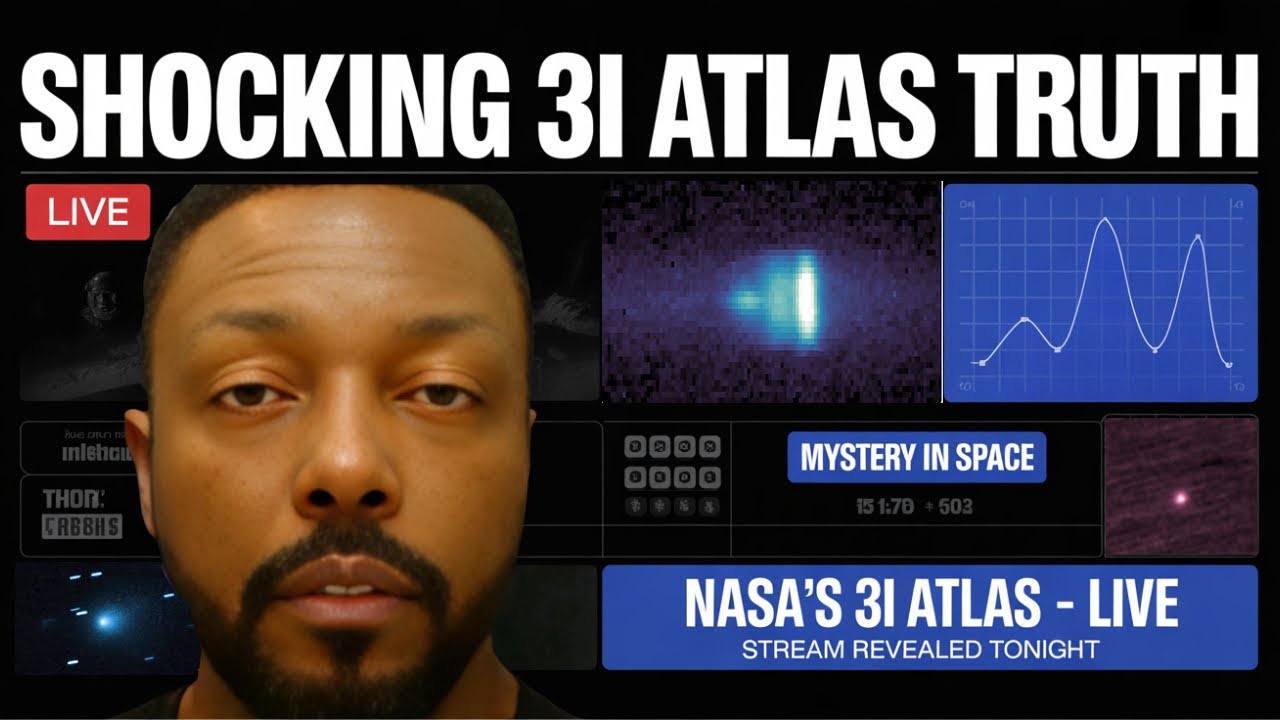
The 3I Atlas NASA briefing, held on November 19, 2025, was the agency's first full public account of comet 3I/ATLAS, the third interstellar object ever found, and its message was simple: the object is a natural comet from another star system. In this live stream Billy Carson re-broadcasts the briefing and then reacts, arguing that the images were poor, the presentation evasive, and that 3I/ATLAS is, in his personal opinion, an artificially created object.
Only three objects from outside the solar system have ever been confirmed passing through it, and each has set off a public debate about what they are. 'Oumuamua in 2017 drew the first serious alien-probe speculation from a working astronomer. 3I/ATLAS arrived just as a government shutdown silenced NASA, and the speculation that filled that silence frames both halves of this video: what the agency said once it could speak, and why Carson was not persuaded.
What the video covers
NASA opens by addressing the rumors (from about 1:45)
The briefing begins with NASA Associate Administrator Amit Kshatriya recapping the discovery: the NASA-funded ATLAS survey telescope in Chile reported the object to the Minor Planet Center on July 1, 2025. He then takes on the rumors directly. "This object is a comet," he says, adding that it looks and behaves like one and that it is only the third interstellar object humanity has found. He acknowledges the speculation that grew while NASA could not comment during the shutdown, and shows a HiRISE image from the Mars Reconnaissance Orbiter, taken October 2 from about 19 million miles, in which the comet's coma appears as a fuzzy white ball.
Nicki Fox on the fleet and the geometry (from about 4:50)
Nicki Fox, head of NASA science, explains why the observations were difficult. NASA's planetary defense office established early that 3I/ATLAS posed no danger to Earth. On October 30 it reached perihelion, its closest point to the Sun, just inside the orbit of Mars, while Earth sat on the far side of the Sun. That geometry made observing from Earth very hard, so NASA turned to its spacecraft.
Nearly 20 mission teams took part, some pushing instruments beyond their design limits. Fox lists the assets, among them Hubble, Webb, TESS, Swift, SPHEREx, the Perseverance rover, the Mars Reconnaissance Orbiter, MAVEN, Europa Clipper, Lucy, Psyche, Parker Solar Probe, PUNCH, STEREO and the joint ESA–NASA SOHO mission. She notes that all data go to a public archive and that the comet will pass the orbit of Jupiter in spring 2026.
Hubble, Webb and SPHEREx (from about 10:35)
NASA's astrophysics team then summarizes the early space-telescope work. Hubble observed the comet in July, when it was about 277 million miles from Earth, and saw a teardrop-shaped coma. Those data narrowed the nucleus to somewhere between roughly 1,400 feet and 3.5 miles across, showed it losing dust at a rate consistent with comets from our own solar system, and refined the orbit.
Webb and SPHEREx added infrared spectra, revealing a coma rich in carbon dioxide along with water ice. The ratio of carbon dioxide to water is higher than in typical solar system comets, and NASA offered natural explanations: carbon dioxide sublimates earlier, far from the Sun; the ices may have absorbed more radiation; or the comet formed where carbon dioxide ice was especially abundant. Swift observed the comet as well, and teams found pre-discovery images in TESS data from May.
The planetary and heliophysics images (from about 16:05)
NASA planetary scientist Tom Statler walks through the newer images, comparing the fleet to fans photographing a ball game from different seats. Psyche took four black-and-white images over eight hours on September 8 and 9 from about 33 million miles. Lucy, on September 16 and from about 240 million miles, captured both the coma and a tail pointing away from the Sun, a backlit view only possible from a spacecraft farther from the Sun than the comet.
When the comet passed within about 20 million miles of Mars in early October, MAVEN's ultraviolet spectrograph recorded hydrogen coming off the nucleus. SOHO picked it up on October 15 and 16 from about 222 million miles by stacking images of an object expected to be too faint to see.
NASA's closing caveat (from about 24:40)
Statler points viewers to the agency's 3I/ATLAS image page at go.nasa.gov/3I-atlas, notes that not all data have come down yet, and says the answers will come later, after calibration, analysis and peer-reviewed publication.
Carson's reaction (from about 25:40)
Carson seizes on that last point. In his view, taxpayers funded some of the most capable cameras ever built, yet the public got black-and-white smudges and spectra. He calls the presentation word salad, says NASA gives "never a straight answer", and argues that the shutdown explanation does not hold up, since Harvard astrophysicist Avi Loeb and other astronomers around the world had been demanding the data for weeks. He contrasts the images with Hubble's deep views of distant galaxies and asks why the same telescope could not produce a sharp picture of an object he describes as roughly the size of Manhattan.
His position: artificial, with a caveat (from about 29:20)
Carson then states his view plainly: he personally believes 3I/ATLAS is "an artificially created object". His biggest red flag is that, as he describes it, the object has changed its speed and trajectory several times and is now speeding up as it moves away from the Sun with non-gravitational acceleration, which to him means it is "intelligently controlled". He calls this an opinion drawn from his own research, says people who disagree are not his enemies, and tells viewers "you're free to think of it as just a rock in space with ice coming off of it."
The CME and the third-eye wordplay (from about 31:50)
Near the end, Carson says that when 3I/ATLAS went around the back side of the Sun, a large coronal mass ejection followed, and he announces plans for a podcast with an astrophysicist to examine it. He closes with wordplay, calling the object the third-eye Atlas and pointing to Atlas, the Titan of Greek myth popularly pictured carrying the world on his shoulders, as a hint that the name may carry a different message than the one intended.
Key takeaways
- NASA's position at the November 19, 2025 briefing was unambiguous: 3I/ATLAS is a natural comet and only the third interstellar object ever detected.
- Perihelion on October 30, 2025 came just inside Mars's orbit with Earth on the far side of the Sun, which is why Mars orbiters and deep-space probes produced the key autumn images.
- The coma is rich in carbon dioxide relative to water, which NASA says has several natural explanations.
- Carson found the imagery poor and the presentation evasive, and he argued the shutdown did not explain the delay in releasing data.
- His personal view is that 3I/ATLAS is artificial, based mainly on reported changes in speed and trajectory and on non-gravitational acceleration, and he explicitly allows that others may disagree.
Billy Carson's reading
Carson's reading rests on two things: behavior and trust. On behavior, he treats non-gravitational acceleration as the signature that separates a controlled craft from a passive rock, the same anomaly that made 'Oumuamua famous in 2017. Our explainer on the first interstellar object and the alien probe debate covers how that argument developed.
On trust, his frustration is with institutions. He reads the delayed data, the low-resolution images and the promise that answers will come later as a pattern of managed disclosure, one he sees repeated across decades of official handling of unexplained aerial and space phenomena. His interest in what a non-human intelligence might send through the solar system also connects to questions he has explored for years in ancient astronaut theory: whether humanity has been visited, and whether institutions would admit it. Throughout, Carson presents his conclusion as an opinion rather than a finding and leaves viewers to weigh the evidence.
What mainstream scholarship says
Astronomers overwhelmingly agree with NASA that 3I/ATLAS is a comet. Non-gravitational acceleration is routinely measured in ordinary comets: as ices sublimate near the Sun, escaping gas acts like a set of small thrusters and nudges the orbit. 'Oumuamua was puzzling because it showed this effect without a visible coma; 3I/ATLAS has an obvious coma and tail, so outgassing is the straightforward explanation. Changes in speed are expected too: any object falling toward the Sun speeds up on the way in and slows on the way out.
On image quality, the limit is physics rather than secrecy. A nucleus at most a few miles wide, seen from hundreds of millions of miles away, spans an angle many times smaller than the finest detail Hubble can resolve, and it is wrapped in a bright coma. Deep-field galaxies look detailed because they are enormous. Avi Loeb, the most prominent scientist to raise the artificial possibility, frames it as a hypothesis worth testing with data rather than a conclusion, and his view remains a minority one. Coronal mass ejections are frequent, especially in the active years around solar maximum, and no known mechanism would let a small comet trigger one; any link between the two is Carson's claim, not an established connection.
Watch, read and go deeper
For how earlier visitors set the terms of this debate, read the puzzling behavior of interstellar visitors like 'Oumuamua. The trust question at the heart of Carson's reaction runs through the UAP hearings from 2017 to 2026. On 4BK TV, Richard Dolan's UFO Chronicles traces the history of official secrecy. For more of Carson's commentary on space, science and hidden history, see Best of Billy Carson. The audio of this stream is also available on the 4biddenknowledge Podcast.
Frequently asked questions
What is 3I/ATLAS?
3I/ATLAS is an interstellar comet discovered on July 1, 2025 by the NASA-funded ATLAS survey telescope in Chile. The 3I designation marks it as the third interstellar object confirmed in the solar system, after 'Oumuamua in 2017 and comet 2I/Borisov in 2019. Its unbound path shows it came from another star system.
What did NASA say at the 3I/ATLAS briefing?
At its November 19, 2025 briefing, NASA said 3I/ATLAS is a natural comet and poses no danger to Earth. Officials presented observations gathered by nearly 20 mission teams, from Hubble and Webb to Mars orbiters and SOHO. The data are publicly available.
Is 3I/ATLAS an alien spacecraft?
NASA and most astronomers say no: it has a coma and tail, and its non-gravitational acceleration is consistent with outgassing. Billy Carson holds the personal opinion that it is artificial, citing changes in its speed and trajectory, and Avi Loeb has argued the possibility deserves testing. No evidence presented to date establishes that the object is technological.
Where is 3I/ATLAS going?
After perihelion on October 30, 2025, just inside the orbit of Mars, 3I/ATLAS is heading back out of the solar system. NASA said it will pass the orbit of Jupiter in spring 2026; because its path is unbound, it will not return.
Sources mentioned
The video's primary source is NASA's 3I/ATLAS media briefing of November 19, 2025, with presentations by Amit Kshatriya, Nicki Fox, NASA's astrophysics team and Tom Statler. The observations discussed come from the ATLAS survey telescope and the Minor Planet Center, the Hubble Space Telescope, the James Webb Space Telescope, SPHEREx, Swift, TESS, Psyche, Lucy, MAVEN, the Mars Reconnaissance Orbiter's HiRISE camera, SOHO and Parker Solar Probe. Carson also cites Avi Loeb's calls for the data's release. For background, see Micheli and colleagues' 2018 Nature paper on non-gravitational acceleration in the trajectory of 'Oumuamua, the 'Oumuamua ISSI Team's 2019 review The Natural History of 'Oumuamua in Nature Astronomy, and Avi Loeb's 2021 book Extraterrestrial: The First Sign of Intelligent Life Beyond Earth.