By: April Carson
Jupiter’s moon Europa has long intrigued scientists with its potential to harbor life. With its icy crust and the tantalizing possibility of a vast subsurface ocean, Europa stands out as one of the most promising candidates in the search for extraterrestrial life within our solar system. A groundbreaking study published in 2024 sheds new light on this enigmatic world, offering exciting insights into its habitability.
The Enigmatic World of Europa
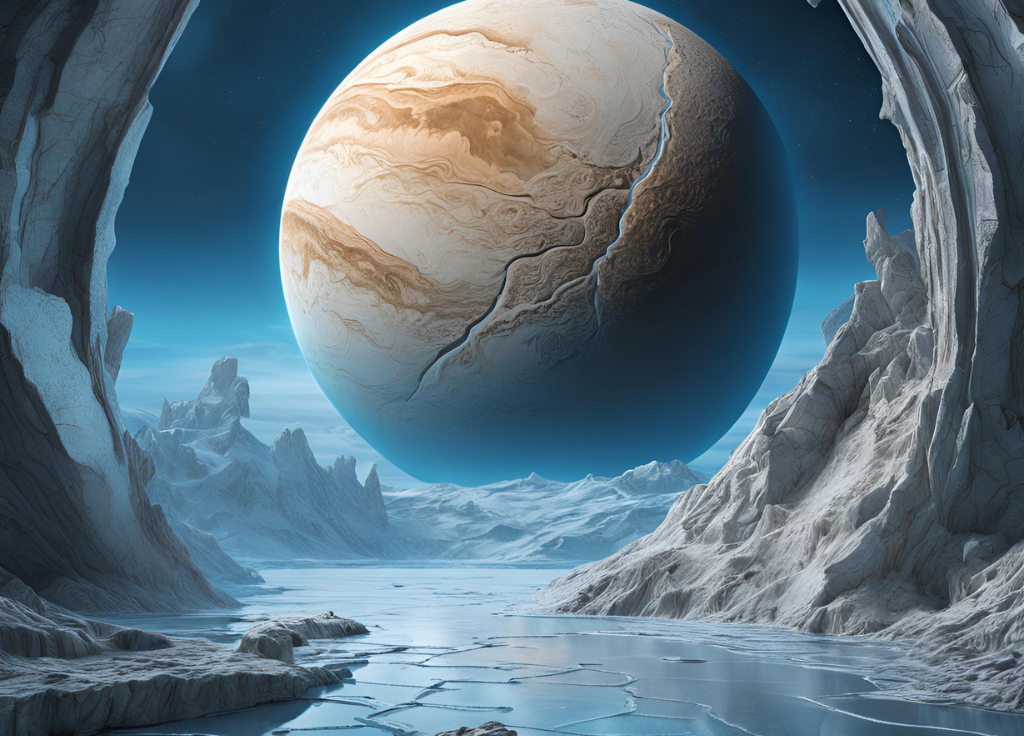
Europa, one of Jupiter’s four Galilean moons, is slightly smaller than Earth’s Moon. What makes it extraordinary is the thick shell of ice that encases its surface, beneath which lies a global ocean that may contain more water than all of Earth’s oceans combined. This environment—cold, dark, yet dynamic—is believed to be kept warm by tidal heating caused by gravitational interactions with Jupiter and its other moons.
Scientists have speculated that this subsurface ocean could contain the key ingredients for life: water, a stable energy source, and essential chemical compounds. The new study published in Nature Astronomy (2024) deepens our understanding of Europa’s ocean and its potential to support life.
Key Findings from the 2024 Study
The 2024 study utilized data from NASA’s Juno spacecraft and advanced computer modeling to uncover new details about Europa’s subsurface ocean. Here are the highlights:
- Dynamic Ocean Currents: The study reveals evidence of dynamic ocean currents beneath Europa’s icy crust, driven by variations in salinity and temperature. These currents could help circulate nutrients and energy, creating microenvironments that might support life.
- Surface-Ice Exchange: Observations suggest active exchange between the icy crust and the ocean below, potentially delivering surface chemicals like oxidants into the ocean, which could serve as an energy source for microbial life.
- Hydrothermal Activity: The modeling indicates that Europa’s rocky seafloor might experience hydrothermal activity, similar to Earth’s deep-sea hydrothermal vents. These environments on Earth are known to host diverse ecosystems, raising hopes for similar possibilities on Europa.
Challenges of Exploring Europa
Despite its promise, studying Europa is not without challenges. Its icy crust, estimated to be 10-30 kilometers thick, poses a significant barrier to directly accessing the subsurface ocean. Furthermore, the harsh radiation environment surrounding Jupiter adds another layer of difficulty for spacecraft operations.
NASA’s upcoming Europa Clipper mission, scheduled to launch in the 2020s, aims to overcome some of these challenges. Equipped with advanced instruments, the spacecraft will fly by Europa multiple times, mapping its surface and analyzing its ice composition, surface features, and potential water plumes.
Why Europa Matters in the Search for Life
Europa’s potential habitability challenges our understanding of life’s boundaries. If life exists beneath Europa’s ice, it would demonstrate that life can emerge and persist in environments vastly different from Earth. Such a discovery would revolutionize our understanding of biology and the prevalence of life in the universe.
Moreover, studying Europa can help us refine the techniques and technologies needed to explore other icy worlds, such as Saturn’s moon Enceladus, further broadening our horizons in astrobiology.
What Lies Ahead?
The Europa Clipper mission will undoubtedly provide invaluable data, but it is only the beginning. Future missions, including potential landers and ice-penetrating probes, could one day directly sample Europa’s ocean. International collaborations and technological advancements will play a critical role in turning these ambitious plans into reality.
References:
- Nature Astronomy, "Dynamic Ocean Currents on Europa," 2024.
- NASA’s Europa Clipper Mission Overview: https://www.nasa.gov/europa
- Schmidt, B. E., & Blankenship, D. D. (2024). "Surface-Ice Exchange and Habitability of Europa’s Ocean." Journal of Astrobiology.
- Chyba, C. F., & Phillips, C. B. (2024). "Energy Sources for Life on Icy Worlds," Annual Review of Planetary Science.
The Secret Society Dark Symbols Hidden in the OREO Cookie

Ready to elevate your consciousness and expand your mind?
If you're not already a member of the 4BK TV Channel, it's time to join the journey! Immerse yourself in a captivating collection of workshops by Billy Carson on 4bk.tv, covering everything from Remote Viewing and Ancient History to Anomaly Hunting. Don't miss out on the extraordinary – become a member now and unlock a world of limitless possibilities!"
Start your 3-day FREE trial now!